 Hacker Cinema
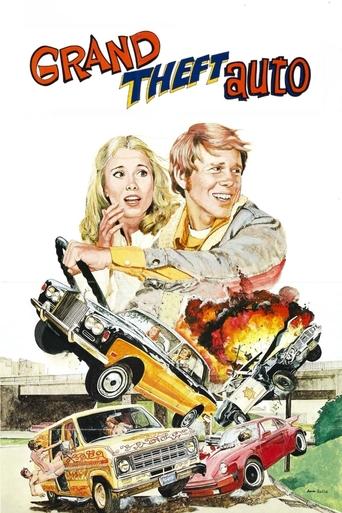
Grand Theft Auto
1977 · Film · 84 min
Directed by Ron Howard
A rich girl steals her dad's Rolls Royce and heads off to Las Vegas to get married. However, her angry parents, a jealous suitor, and a bunch of reward seekers are determined to stop her.
1 negative10 neutralfrom 11 commenters
Where to watch
No streaming data for this title.

11 comments on Hacker News
I don't really see myself as defending AI as much as arguing that people who don't recognize an entertainment product as an entertainment product have a problem if they think this is really categorically different than claiming that playing grand theft auto makes people into carjackers. (Or that movie studios should be on the hook for their kid watching R rated movies, or porn companies on the hook for their kid visiting a porn site unsupervised.)
I was putting a lot of thought into this just yesterday, talking with some friends about the "Thing: Japan" phenomenon
It's important to recognize that any discussion about Japanese media outside of Japan is more or less only receiving the media that Japan is exporting to the world. Yes there are exceptions to this, people going out of their way to fan sub shows and such, but for the majority of Western people who are experiencing Japanese media it is very mainstream popular stuff like Studio Ghibli films and the most popular anime
With that said, I think the approach Japan has towards making media is very different than Western studios, especially when it comes to depictions of real world Japan
American TV and writing is very cynical about America. Consider the common depictions of rural America in most American media (rednecks, racist, boring, dirty) to the common depictions of rural Japan in Japanese media (idyllic, colorful, spiritual, friendly)
Even compare how a fictional Japanese city is depicted in the Yakuza game series (where you play a criminal doing crimes) and how a fictional American city is depicted in the Grand Theft Auto series (where you play a criminal doing crimes)
I really think Japanese creators like Japan more than American creators like America, and it shows through their work by smoothing over a lot of the rough edges of Japanese society
Video is really a series of frames, the framerate for film/human can get away with 24 frames/second-- so maybe ~40ms/image for real-time at least?
What's cool about the era in which we live is if you look at high-performance graphics for games or simulations, for instance, it may in fact be faster to a the model to "enhance" a low-resolution frame rather than trying to render it fully on the machine.
ex. AMD's FSR vs NVIDIA DLSS
- AMD FSR (Fidelity FX Super Resolution): https://www.amd.com/en/technologies/fidelityfx-super-resolution
- NVIDIA DLSS (Deep Learning Super Sampling): jhttps://www.nvidia.com/en-us/geforce/technologies/dlss/
AMD's approach renders the game at a crummy, low-detail resolution then each frame uses "upscales"
Both FSR and DLSS aim to improve frames-per-second in games by rendering them below your monitor’s native resolution, then upscaling them to make up the difference in sharpness. Currently, FSR uses spatial upscaling, meaning it only applies its upscaling algorithm to one frame at a time. Temporal upscalers, like DLSS, can compare multiple frames at once, to reconstruct a more finely-detailed image that both more closely resembles native res and can better handle motion. DLSS specifically uses the machine learning capabilities of GeForce RTX graphics cards to process all that data in (more or less) real time.
Video is really a series of frames, the framerate for film/human could get away with 24 frames/second-- ~40ms/image for real-time.
What's cool about the era in which we live is if you look at high-performance graphics for games or simulations, it may in fact be faster to run the model on each frame to "enhance" a low-resolution frame rather than trying to render it fully on the machine.
ex. AMD's FSR vs NVIDIA DLSS
- AMD FSR (Fidelity FX Super Resolution): https://www.amd.com/en/technologies/fidelityfx-super-resolution
- NVIDIA DLSS (Deep Learning Super Sampling): https://www.nvidia.com/en-us/geforce/technologies/dlss/
AMD's approach renders the game at a crummy, low-detail resolution then use "spatial upscaling" to enhance the images one frame at a time.
NVIDIA DLSS uses "temporal upscaling" to pass over multiple frames and uses other capabilities exclusive to Nvidia's cards to stitch together the frames.
This is a different challenge than generating the content from scratch
I don't think this is possible in real-time yet, but someone put a filter trained on the German country side to produce photorealistic Grand Theft Auto driving gameplay:
https://www.youtube.com/watch?v=P1IcaBn3ej0
Notice the mountains in the background go from Southern California brown to lush green
https://www.rockpapershotgun.com/amd-fsr-20-is-a-more-demanding-higher-quality-upscaling-upgrade#:~:text=Currently%2C%20FSR%20uses%20spatial%20upscaling,and%20can%20better%20handle%20motion.
Just to be clear, the music in the video is not Philip Glass' Koyaanisqatsi at all. FWIW, Koyaanisqatsi was a 1982 film [1], effectively a 90 minute music video before videos were a thing.
The film has lots of unsavory city clips in contrast with nature clips [2] to make the point of Life Out of Balance, the subtitle of the film. The music and film clips are frequently used to illustrate decay. or the unhealthy nature of city life in general, most notably in a Grand Theft Auto commercial [3].
[1]. https://en.wikipedia.org/wiki/Koyaanisqatsi
[2]. https://www.youtube.com/watch?v=tDW-1JIa2gI
[3]. https://www.thefader.com/2007/03/30/video-grand-theft-philip-glass
"the failure of particular media verticals to monetize and adequately understand the landscape of the industry they operate in" doesn't apply as directly as the author would hope.
The failing "sell records at the record store" model is one thing, but the model for the rights to include music in television shows, movies, plays, video games and such is a different one.
If the maker of a game like Grand Theft Auto pays the rights holder to use music in a game then it is worth something to the game maker because it is exclusive -- and it wouldn't be if that exclusivity wasn't enforced.
It's not as if they are afraid people would watch your stream because they don't want to pay for a music streaming service or buy records.
The rules have always lagged practice in this area. The DVD release of 1980s TV show Knight Rider was hung up for years because of negotiations over the sound track, which was packed with contemporary music, some of which they got the rights for, some of which they replaced with covers, some of which got replaced completely. At the time nobody thought about the DVD rights.
>useless
Well, they are not exactly useless. Even discounting for educational games, pointless games like Borderlands / Grand Theft Auto have great value. That value lies in providing entertainment in an interactive way, something that was never possible for most of human existence.
There is something magical about highly interactive games, like say Far Cry. GTA, etc, where the player knows his game, while being the same product, is unique to him/her. Services like Twitch have created whole new ecosystems of micro-economies, where a section of population is replacing movies with watching others playing games. There is great fun in watching an expert gamer playing a game. Part of the experience is in unexpected humor through mistakes, wrong decisions, distractions, etc. Part of the experience is in knowing that none of it is scripted and everything is happening in real time.
As an evolution of the entertainment industry, it's not useless.
There are many negative aspects of gaming as well. If played in excess, at the cost of childhood related activities, like playing with friends outside, etc, it can be detrimental to social development.
But those sorts of problems are there in many areas of life. Anything done in excess is detrimental.
Nothing wrong with that. You might laugh at skeletons being where they choose to draw the line, but we have rules as well about what can happen in a video game. There are no kids in Grand Theft Auto for a reason.
Also, Blizzard only removed them from the game in china
What would be more disturbing is if they had to rewrite some orc-politics story so it wouldn't offend chinese sensibilities, and US consumers got the rewritten version as well.
The movie Red Dawn(2012) was a remake of a 1984 action film where a communist army invades the US. They updated the invader from the USSR to China, come to "repossess" the US after we defaulted on national debt. This offended the chinese, so the producers had to spend $1M editing every reference to china in the film and making it a North Korean invasion instead. This was the version US consumers were sold.
> a lot of books are tripe worse than TV shows and video games
I've never been a fan of this line of thinking. There are plenty of people who use critical thinking skills and participate in mentally stimulating activities throughout the day. When it's over, they just want to relax. So they watch shows like Family Guy, read basic action novels, or play Grand Theft Auto for an hour or two.
Why does everything have to be in pursuit of knowledge or something that contributes to a community?
You implied that cartoonish violence like Contra will have substantially negative psychological effects on children. I've never seen any support for that and my own experiences tell me the opposite. A quick google search shows evidence going both ways, so lacking time for an exhaustive analysis I'm sticking with my experiences.
Take my anecdotes with as big a grain of salt as you like, but analytically the benefits didn't outweigh the cons in my case. Not having access to the same video games, movies and entertainment as my peers greatly damaged my ability to form relationships at a young age. The only upside was perhaps a marginal increase in analytical thinking skills, which was easily offset by the anxiety/insecurities and resultant academic underperformance I had as a result of underdeveloped social skills. Your kids' mileage may vary.
Sure I grew up and that's all long in the past now, but that doesn't mean it was useful, justified, or harmless. When the fiancée and I decide to have kids, I intend to give them every opportunity I can within reason, that includes the resources for a vibrant social life if they want. Obviously I won't be buying them Grand Theft Auto at age 6, but Star Wars? Absolutely.
Agree with everything you're saying here. But the argument reminds me of a similar one, where the established industry leaders try and define what skills and processes go into cinema. Such as no sound vs sound, or film vs digital. The fact that it's story telling on a screen is what in my mind defines cinema.
There is cinematography in current virtual storytelling, such as firewatch, life is strange, and grand theft auto. While none of those are VR, they could be adopted to that medium as well. Cinematography is much more than camera angle, and lens choice, imo, especially in the digitally generated world. There are other techniques to lead the viewers attention, not so different than techniques used on a well made imax.
Also of interesting note, 360 moving image recording is not new, and has been around since the 1950s. https://en.m.wikipedia.org/wiki/Circle-Vision_360°
Its a conservative Supreme Court that had come down strongly in favor of free expression and religious freedom. E.g. Brown v. EMA, the video game free speech case. Different sides of the same coin.
What is insane to me are people who agree with Brown but disagree with Citizens United. A political movie isn't free speech, but Grand Theft Auto is?!