 Hacker Cinema
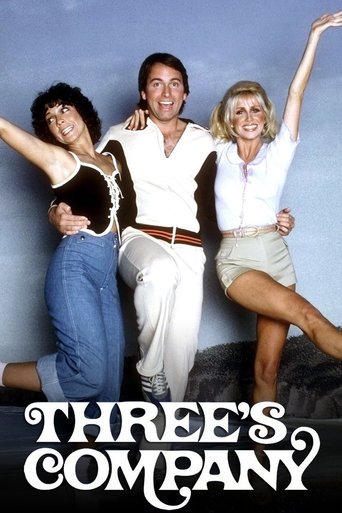
Three's Company
1977 · TV series · 25 min episodes · 8 seasons
Created by Johnnie Mortimer, Brian Cooke
When two single girls, Janet and Chrissy, need a roommate to share their Santa Monica apartment, they decide to offer a room to Jack, a man they find passed out in the bathtub after the going-away party for their last roommate. However, hijinks ensure when Jack must pretend to be gay in order to throw off the scent of the trio's conservative landlady.
2 positive5 negative1 mixed5 neutralfrom 13 commenters
Where to watch
No streaming data for this title.



13 comments on Hacker News
That was a great episode of Three's Company!
It is crazy to think about, I agree. Additionally, before 200 years ago, nobody even owned anything written, except for a tiny amount of people. We spent the vast majority of our existence knowing nothing, at least how we think of knowledge now. But we still had these awesome brains - instead we had it filled with local knowledge - people, places, and things from the environment we lived in, which was pretty small. Can you imagine the detail we understood back then? And yet nobody knew the answers to what we consider important these days. It's really mind warping to contemplate this.
Even now compared to 30 years ago or so is weird. Prior to the internet, largely speaking if your immediate group didn't know the answer to something, you just largely didn't know it ... ever. I mean you could find out if you really wanted to, probably. But there were things we just didn't have the answer to.
"Remember that episode of Three's Company that had that one guy in it? What was his name?"
Guess what - we never found out that answer! The lyric of that song? Never found out before the Internet. Even today I still find myself remembering things I wanted to know growing up but the knowledge was inaccessible back then, but now I can find out in seconds.
Such a weird time we live in if you think about it. We have this weird mono culture, in a way, but within that mono culture we're getting all these tiny nano-cultures embedded in it. My son (13) loves some of the most obscure things and is able to find people also excited about it (Not just SCP, but SCP maps and mods done in Garry's Mod, for instance - there's like 100 people in the world that like that combination).
Now I'm just rambling, but yes, the vast majority of our existence we were isolated (globally speaking) and ignorant in profound ways. And now we are just the opposite.
Seinfeld, NewsRadio, and Frasier
I'm not familiar with NewsRadio, but both Seinfeld and Frasier are simply named after the main character. This inherently gives the show some latitude.
But, say, Three's Company was based on the premise that this guy was pretending to be gay in order to justify living with two women because they all were pretty poor and he couldn't find another place. That's pretty constraining as to what you can do with the plot line.
It means that any episode that was at the beginning holding out hope that one of the characters would suddenly start making more money and be able to afford to move or something was an episode where the viewer could confidently predict that this would fall through because if it didn't you no longer had a show with the premise that some guy needs to pretend he's gay in order to have an affordable housing situation where he lives platonically with two women.
What's funny there is the tension of, no, they aren't having a threesome. No, he's not sleeping with either of the women. No, he's not really gay, but most people would never believe he's honest to god just living with two women to split the rent if he weren't pretending to be gay.
It's funny because it casts some light on a lot of serious social issues in a way that's socially acceptable to poke fun at, but it's extremely contrived and you can't otherwise try to address those kinds of topics. They are too hot button.
So you can't do it humorously without an extremely contrived situation and you can't do it in earnest without it being terrible drama.
Humor is one of the ways society processes hot button topics and works through them without it turning into terrible real life conflict.
Think of it as translation. Should you read Dante in his original medieval Italian or in a modern English translation? Yes. But if you want to understand and make strong arguments about Dante, you'll probably have to dig out the Italian.
Or, alternatively, back in the day there were these shows called "situation comedies" or sitcoms. One of them was "Three's Company." Many of the stories of the episodes of Three's Company were taken more or less directly from Shakespeare's comedies. Is it elitism to suggest that seeing a production of Shakespeare's plays is a better way of connecting with what he was trying to say than watching a '70s sitcom?
Seconded.
To me physical comedy is about physicality: the body, its gestures and movements.
Can it involve pain or the possibility of death? Sure, but that's not essential.
I was always a fan of John Ritter in Three's Company. He'd flail about in every episode, almost falling or tripping or just making crazy expressions with his face.
Yea, I don't think the average show from the 70's was good.
Though, if your going to compare the average show, then the competition is more like 'Pawn Stars', 'My Teen is Pregnant', 'Tiny House Hunters', etc. Or you could compare similar longer running shows like Three's company (8 seasons) vs. Two and a Half Men (12 seasons).
So, my guess is a random episode of 'Sonny and Cher Comedy Hour' was probably better than a random episode of a random cable TV show. Though, it's also very dated at this point. It's also likely worse than say the best south park episode or whatever show you actually like.
Anyway, I am not saying the 70's wins hands down, hell I was not even alive then. But, I do think people are confusing shows about things they like with actual quality. I might like 'How It's Made' but it's not exactly deep.
Hmmm...
When I pull up a random television network schedule from the 1970s -- let's pull up 1976-1977. (https://en.wikipedia.org/wiki/1976%E2%80%9377_United_States_network_television_schedule) I see some shows generally recognized as quality television.
And, er, some television that isn't. No surprise.
At least, I certainly don't think the variety shows count as "great" by most people's scope, of which 1970s television had a lot of. At least, I'm not aware of modern demand for the Tony and Dawn Rainbow Hour, Donny & Marie, the Shields and Yarnell show, or the Sonny and Cher Comedy Hour. Maybe I'm wrong.
In the scripted department, there's several single-season or less programs. I presume weren't that great. Shows like Holmes and Yo-Yo, Nashville 99, Quinn Martin's Tales of the Unexpected, and Gemini Man, were they that great? (A "TV movie" -- Riding With Death -- from the last one was used as fodder for MST3K. So, probably not.)
The one thing I think is notable in older TV listings is just how strongly several formats dominate. Namely, in addition to the variety shows, sitcoms and crime / medical dramas seem to dominate. (If you are looking for fantasy / horror / sci-fi, to give a few other genre examples, your pickings are slim.)
"Good" is by nature subjective. But one thing I can say is that none of these genres are typically noted for multilayered messaging. To give two examples from the sitcom side, here are two 1976 shows that are generally reviewed as "good": "Three's Company" and "Good Times". One is basically a farce often criticized as "jiggle television". One basically became a platform for the wacky antics of JJ. Not sure I'd describe either of these shows as very "deep". :)
Today, in the era of DVRs and on-demand streaming, I do think it's easier for writers to "risk" multi-episode plotlines.
This reminds me of my childhood church, in the late 70's & early 80's. The pastor was absolutely obsessed with Three's Company. Felt like not only was it the worst show on television, but that it was a harbinger of the end times. That women in short shorts in a comedy of manners was going to destroy America as we know it. Mom at first forbade it in our home, and then she caught an episode by accident. Turned out to be one of her favorite shows and a regular in our house.
I'd like to see a followup article on how the meat of different sitcoms is presented. For example, I remember figuring out the formula for Three's Company, where in almost every episode the "muddle" mostly involves a misunderstanding between characters, or where the audience has information that one or more of the characters doesn't have. Whereas other sitcoms have information that is kept from the audience until the end, which builds a different kind of suspense (in the first case, you are wondering when and how a character is going to "get it", and in the second case you are waiting for the characters to reveal final information to you).
This post illustrates the folly of valuing form over function. Certainly we should strive to write code that is readable and robust. However, it's important to remember that before all else the code should actually work.
The example used as a demonstration is a bit like an episode of Three's Company. The premise revolves around a simple misunderstanding, and it's a bit hard to believe that the misunderstanding went on for so long. The original code is a prime candidate for documentation, and there were even unit tests. If you accept the misunderstanding at face value though, the lesson works well enough.
No, most of 'these stories' have been about the minutiae associated with Snowden's asylum requests. Reading one of these stories or the associated discussion is like watching an old episode of Three's Company - the details might be slightly different from episode to episode, but you already know the general plot. These stories take the place of articles that are more interesting, degrading the site as a whole, and do absolutely nothing to help any sort of political cause - in fact, because most of the stories are so content-free, they probably cause people to skip over the rarer more-meaningful ones. It's all really rather tiresome.
I thought the section on TV shows was nonsense as well. He cherry picked a few examples that fit his model.
Off the top of my head some modern comedies that don't fit are Modern Family, Parks and Recreation, and Desperate Housewives.
There were plenty of classic shows set in the city as well. Mary Tyler Moore, The Jeffersons, The Bob Newhart Show, Three's Company, Taxi, Welcome Back Kotter.
> The company says that if the episode had been broadcast in 2008, and not rebroadcast repeatedly it would not have sued.
FYI Tesla, TV has these things called reruns, they've been around forever. Reruns of Three's Company has outlasted John Ritter (sadly).
Honestly, if this idiocy is an example of the collective intelligence of Tesla's management, then that comment alone will make me not buy anything Tesla. At least every other American car manufacturer doesn't bitch and moan at a comparably great review from Clarkson (it's an electric vehicle, it's a miracle he even did a segment on it. He rags on diesel even when it's comparable to a gas, and he was actually enthused about the roadster). Honestly, it just shows me that North America will never make another great car, because North America can't get intelligent car manufacturers.