 Hacker Cinema
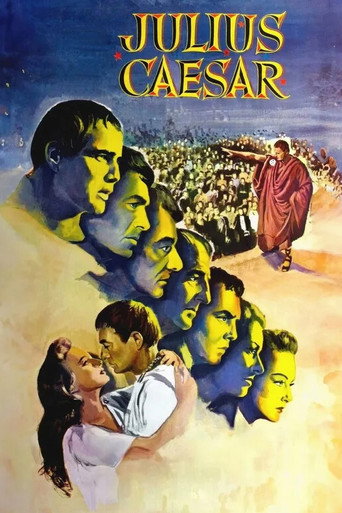
Julius Caesar
1953 · Film · 121 min
Directed by Joseph L. Mankiewicz
The growing ambition of Julius Caesar is a source of major concern to his close friend Brutus. Cassius persuades him to participate in his plot to assassinate Caesar but both have sorely underestimated Mark Antony.
1 positive3 neutralfrom 4 commenters
Where to watch
No streaming data for this title.


4 comments on Hacker News
And that film is an adaptation of the play by Shakespeare: https://en.wikipedia.org/wiki/Julius_Caesar_(play)?wprov=sfti1
Both Julius Caesar and Star Wars Episodes I, II, and III use the historical/fictional setting of the fall of the Roman/Galactic Republic to talk tell a deeper story than what first appears. The fact that Lucas intended the movies to be an allegory for the fall of the Roman Republic is well known and even cited on the trilogy's Wikipedia page.
In the original post I replied to, you said:
>From [Shakespeare] you learn more about our current society and humanity in general, including today's crazy disfuntion, the mis/disinformation and people's responses, than from all the quantitative research combined; art is a mirror that looks into ourselves. And as objects of another human being's creation, they are incredibly inspirational and beautiful. I'm wiser and have grown since a week ago. Would I turn to Shakespeare and get so much from the plays without studying literature in college? I doubt it, though that's just me.
The plot of the prequels revolves around Palpatine's manipulations to destroy democracy and gain absolute control over the Republic. He does so by manipulating people like the CIS/Trade Federation with misinformation and promising to take care of their legitimate grievances. He gets them to start a war, which is legitimized through a complex legal system but immoral and unjust in reality. He then uses this war to justify the creation of an army loyal to him, which he later uses to seize power. It doesn't take a genius to realize how lessons learned from the movies could be applied to real life, in the same manner that you described Shakespeare's plays doing for you. Shakespeare doesn't talk about misinformation or modern society's disfunction directly, you inferred that, and there is nothing stopping someone from drawing similar life lessons from more modern material. It's the entire concept of allegories/fables which are thousands of years old!
I noticed that you didn't make a single argument about why Shakespeare is above being pop culture; you only asserted that it is somehow better. Since future humanities students won't have grown up viewing Star Wars as plebian content, it is possible that they will worship Star Wars the same way present day ones worship Shakespeare, Dickens, and many other historical writers who wrote for primarily to entertain. Your casual dismissal of the prequels while implying that you like the original trilogy also doesn't bode well for your argument that university education in the humanities is useful for being able to analyze and draw conclusions from literature, since the prequels have a much more complex plot and fleshed out world than the originals do. The movies have just as deep of a story as any Shakespeare play and one can draw any of the conclusions you mentioned from them, and in fact many do even without having the "proper" education. There are no analysis skills that one gains from a university humanities education, which is also likely why you didn't list any of the "tools" the "giants" have created.
A humanities education is definitely not necessary, and possibly even determinantal, to address the "critical issues in the world and life, the ones beyond quantitative understanding, which is most of them", and to think otherwise is to think that being a member of an expensive book club makes you qualified to rule the world.
Here is one:
The scene between (actors) Jack Nicholson and Tom Cruise in which Tom tells Jack "I'm not your son, and you're under arrest, you $#%#%@^!" is a good one. I forget the name of the film though.
Another one is the scene in the movie Julius Caesar (maybe based on some classical novel about him, possibly by Shakespeare?), which occurs just before his death. Powerful performances by both the actor playing Caesar and other Roman officials of the time.
What is fundamentally flawed with the state of journalism is not what Mike Daisey does. He's an actor who created a one man show.
What is flawed is that journalists continue to mistake his one man show for investigative reporting.
The journalistic failings fall on journalists. Ira Glass from the transcript of the original This American Life piece:
When I saw Mike Daisey perform this story on stage, when I left the theater I had a lot of questions. I mean, he's not a reporter, and I wondered, did he get it right?
http://www.thisamericanlife.org/radio-archives/episode/454/transcript
Rob Schmitz should be able to distinguish between a news report and entertainment. He should be able to provide context for the large themes in Daisey's performance given that they largely coincide with his own journalistic reports for Marketplace. He could have done actual journalism, instead he conflated theater with journalism and then revealed it as theater while pretending to conduct journalism.
http://www.marketplace.org/topics/business/apple-economy/apple-admits-child-labor-growing-problem-its-china-factories
http://www.marketplace.org/topics/tech/apple-economy/china-concerns-grow-over-environmental-costs-apple-products
Rob Schmitz's investigation is the journalistic equivalent to revealing that Julius Caesar could not have said:
Forget not, in your speed, Antonius, To touch Calpurnia; for our elders say, The barren, touched in this holy chase, Shake off their sterile curse.
Because he did not speak Elizabethan English.