 Hacker Cinema
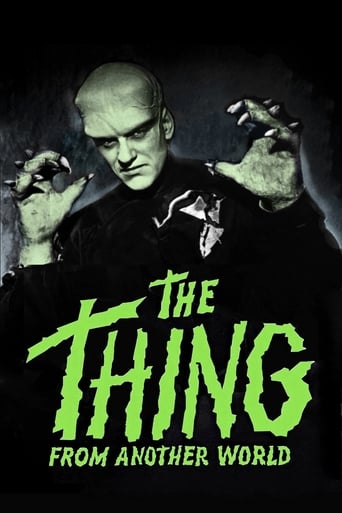
The Thing from Another World
1951 · Film · 87 min
Directed by Christian Nyby
Scientists and US Air Force officials fend off a blood-thirsty alien organism while investigating at a remote arctic outpost.
1 positive1 mixed3 neutralfrom 5 commenters
Where to watch
No streaming data for this title.




6 comments on Hacker News
>The Thing (the one you know of—though the other had a longer title anyway) was a remake.
I think it's more accurate to say they're both based off the same 1938 novella: "Who Goes There?" by John W. Campbell. The 1951 movie "The Thing from Another World" is a very loose adaptation because it omits the most important plot point of the shapeshifting alien imitating people. The 1982 movie "The Thing" is a closer adaptation that includes it. This makes it a much better movie even if you ignore the improved special effects, because the drama of the characters not knowing who's really the Thing is a big part of the appeal.
1938 -- Who Goes There? is a science fiction novella by John W. Campbell Jr. In the story, scientists discover 20 Million year old space craft in Antarctica. They accidentally thaw the alien pilot who can kill and take on the personality of its victims. People are dying; no one trusts anyone, etc.
1951 -- The Thing From Another World, directed by Christian Nyby, is a sci-fi film in which scientists go to North Pole to investigate a UFO, find crashed craft and frozen alien. They take alien back to base and unintentionally let it thaw. (see above)
1982 -- The Thing a film directed by John Carpenter. Same basic story as above (but as in the original, the plot takes place in Antartica).
2011 -- The Thing a film directed by Matthijs van Heijningen Jr. Same basic story again, but it is the prequel to the 1982 version.
Growing up in the 50s, I loved the 1951 movie The Thing. I learned from it to beware of what you find frozen in the ice! Seriously, viruses that we haven’t evolved to fight off can be very dangerous.
IMHO, a lot of what is in the OP is correct, but I conclude that a more nuanced view is important.
Yes, I have long wanted, and still want, to know what is important, both to me personally and more generally, about what is going on in the world so still make efforts to be so "informed". Then, over time, I went through much of the negative views about news in the OP: (1) One summer while in college, I was with my parents in DC and read The Washington Post, a lot of it, everyday and at the end of the summer concluded that I'd learned next to nothing and 99 44/100% had just wasted time. (2) Later, one day I counted and found that, in trying to be informed, I was getting 22 print periodicals, concluded that even the 22 were not telling me much of value, and cut way back. (3) I happened to notice in an Andy Hardy movie from the 1930s that then, too, apparently the movie makers believed that their audience would accept that the news was junk information. (4) I have left over from the past three quite good TV sets and with my phone and Internet service have some TV service for no extra charge. Still, I have no TV set connected to a cable or any other source and haven't watched TV in years with one exception: I tried to watch the first Republican debate on TV; mostly that was a flop. I watched the debate later on the Internet and got and read a transcript -- much better.
For the mainstream media, say AP, Reuters, NYT, WaPo, Boston Globe, LAT, ABC, CBS, CNN, Fox, MSNBC, NBC, Slate, Salon, Huffpo, Business Insider, and more, I have a triage:
(i) I am willing to glance at the headlines if only to see what nonsense the MSM is pushing onto the public now. And if there really is a big story, say, a nuke exploded somewhere, then I will want to know and likely that will be in the headlines. Also I get some lessons by example in, say, PR nonsense from some experts in getting attention from even usually next to nothing in meaningful content! Like in the remark about writing news stories of the reporter in the original version of the movie The Thing, if the real story is not good, then he "will make it good". So, the news distorting the truth is an old story. I also learn about "the common man in the street" -- from the fact that millions of people watch that stuff -- maybe the most important thing can learn from watching the news is about people from the fact that each day hundreds of millions of people pay attention to that stuff!
(ii) Any article written by a reporter or news organization, e.g., AP, I nearly always refuse to take seriously or even read at all anymore. From my huge sample of such articles I did read in the past, I assume that such an article fails even common high school term paper writing standards for meaningful, trustworthy content and that it is likely some or all of uninformed, misinformed, biased, and deliberately distorted, fabricated, or lying. I say that such articles are (borrowing from the Bogart movie The Maltese Falcon), with bitter contempt, by newsies and nearly always refuse to read them or, if read them for some special reason, flatly refuse to take the content at face value.
(iii) I am eager to pay attention to news stories on topics I'm interested in and signed by people with high credibility. Mostly for such an article, I keep a copy on my computer with a reference to the source and with an abstract and an entry in an index.
I believe that staying "informed" is important: E.g., here in the US we just had an election for POTUS. IMHO, the two main candidates were very different and promised significantly different, better/worse, results for the US and even my own life.
So, first, I tried to say informed and, to some extent, more superficial than I would like, did. And by watching the campaigns, the candidates, and the reactions of the newsies and citizens, I did get some education in such things -- I got some more insight into people, personalities, politics, e.g., stuff I didn't learn much about studying mathematics!
And, second, I got involved by practicing my writing and posting on-line -- so, I tried to do better as a US citizen.
So, sure, now I get essentially all my news from the Internet. One important approach is to use HN as a filter to find more important content.
Here at HN, often there are references to articles at the NYT. Unless such articles appear to be signed by people with credibility and independent of the NYT, I flatly, automatically refuse to read them. I have, maybe with one exception a decade, zip, zilch, and zero respect for anything the NYT thinks or believes.
The Internet permits a news organization, maybe just some one person, to reach nearly everyone who might be interested in content from that person. From that fact, I am guessing that the Internet -- that does permit deeper presentations of information -- is the key to an irresistible, radical transformation of public understanding and effectiveness in the US democracy.
So, net, with some nuance, I disagree with some of the OP and conclude that the news and staying informed, are important.
The X-Files movie was probably referencing "The Thing From Another World[0]," a 1951 movie based on the novella "Who Goes There?[1]" by John W. Campbell, which was remade[2] by John Carpenter in 1982.
[0]https://en.wikipedia.org/wiki/The_Thing_from_Another_World
[1]http://nzr.mvnu.edu/faculty/trearick/english/rearick/readings/manuscri/Who%20Goes%20There/Who%20Goes%20There%20Index.htm
[2]https://en.wikipedia.org/wiki/The_Thing_%281982_film%29
For the manic guy, sorry 'bout him. My experience with people who are driven, determined, and brilliant but also unstable psychologically is that the instability is a serious flaw, gives instances of irrationality, and, net, can, from some of the instances, be fatal to whatever effort is being attempted and sometimes also to the person making the attempt.
I don't believe that the article is much about manic entrepreneurs and had another take: The article was from an NYT newsie trying to write something shocking to grab people by the gut to get eyeballs for ad revenue. So, the article is NOT about communicating realistic information about manic entrepreneurs but JUST about getting eyeballs for ads. Or, as in the 1951 movie The Thing from Another World where the newsie character Ned 'Scotty' Scott said about writing a news story: "If it's not good, I'll MAKE it good".
To get some entrepreneurship credibility to help in his eyeball grabbing effort, the NYT newsie went to
Mr. Paul Maeder
General Partner
Highland Capital Partners
There Maeder played along: Maeder seems to have wanted to have his name in the paper to help him get deal flow. And in particular he wanted to suggest that he was open to funding even "crazy" efforts. So, Maeder gave the statement:
“You need to suspend disbelief to start a company, because so many people will tell you that what you’re doing can’t be done, and if it could be done, someone would have done it already,” says Paul Maeder, a general partner at Highland Capital. “There are six billion human beings on this planet, we’ve been around for hundreds of thousands of years, we’re a couple hundred years into the industrial revolution — and nobody has done what you want to do? It’s kind of crazy.”
I flatly do NOT take this statement at face value at all. Instead, the statement is (1) to give the NYT newsie a grabber "crazy" (to go along with the manic part of the article) and (2) again, to suggest to entrepreneurs that all of entrepreneurship is "crazy" and, thus, he, Maeder, is willing to fund even "crazy" ideas from "crazy" people.
On "crazy" ideas:
“There are six billion human beings on this planet, we’ve been around for hundreds of thousands of years, we’re a couple hundred years into the industrial revolution — and nobody has done what you want to do? It’s kind of crazy.”
This statement is DUMB: Maeder is in effect claiming that no one can do original research and discover results that are, and clearly seen to be, new, correct, and powerful for real, practical problems. Nonsense -- totally misinformed and/or uninformed, just plain wrong, dangerous, brain-dead, head in the sand, disconnected NONSENSE. The NSF, NIH, and DoD provide contradictions by the hundreds each year and have for decades.
Any entrepreneur who understands how to find new, correct, powerful, valuable ideas at anywhere near the level of the work of the NSF, NIH, or DoD will have to conclude that Maeder will regard the work as just "crazy" and stay away from Maeder.
Next, anyone familiar with venture capital and the plans approved by the limited partners will know that nearly all venture partners, and likely also Maeder, make Series A venture funding decisions heavily on objectively observable numerical measures of traction and also on the founders and their track records and personalities where being "crazy" is NOT an advantage. That an idea is "crazy" does NOT improve the chances of funding; that there is good traction may permit ignoring that an idea is "crazy". That is, good traction, a "crazy" idea, and a manic founder are not nearly as good as just good traction.
More generally, part of the venture capital sales technique to attract deal flow is to toss out lots of vague cliches about the purpose and criteria of the venture firm. Instead, the purpose is to make money for the limiteds within the 10 year or so life of the fund, and the criteria are nearly all just traction and/or earnings, rapidly growing. There is little role for "crazy".
NYT newsies are at it again, as the NYT finances spiral down from the long river of various kinds of their brain-dead nonsense.