 Hacker Cinema
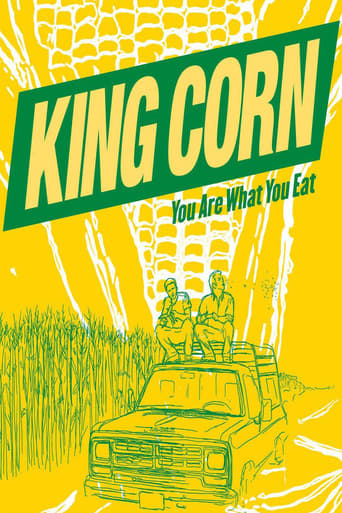
King Corn
2007 · Film · documentary · 88 min
Directed by Aaron Woolf
King Corn is a fun and crusading journey into the digestive tract of our fast food nation where one ultra-industrial, pesticide-laden, heavily-subsidized commodity dominates the food pyramid from top to bottom – corn. Fueled by curiosity and a dash of naiveté, two college buddies return to their ancestral home of Greene, Iowa to figure out how a modest kernel conquered America. With the help of some real farmers, oodles of fertilizer and government aide, and some genetically modified seeds, the friends manage to grow one acre of corn. Along the way, they unlock the hilarious absurdities and scary but hidden truths about America’s modern food system in this engrossing and eye-opening documentary.
13 positivefrom 13 commenters
Where to watch
No streaming data for this title.
Videos commenters linked
From YouTube links in the comments below. Most are clips and trailers; “Full” means the uploader says so.




15 comments on Hacker News
See also: King Corn [0] - in which two random guys try to grow an acre of corn and learn about industrialized agriculture in the proces.
[0] https://www.imdb.com/title/tt1112115/
Watch the documentary King Corn. Corn is in everything. They have lobbied it to be in our food, animal food, packaging, ethanol gas, batteries, plastics, crayons, whiskey, glue, and cough drops, hygiene products, matchsticks, and many medications and vitamins.
From a big picture, socio-economic point of view, yes, the ruling class (Fortune 500 CEOs and elected officials they donate to and lobby) are essentially forcing the poor, the unaware, the average Joe to eat a diet full of high-fructose corn syrup and other carbohydrates, which happens to be produced by giant agricultural companies.
Corn is a subsidized crop by the US Department of Agriculture—we pay farmers to grow it. See the documentary "King Corn" about two guys who didn't know the first thing about growing corn but still made a profit on 1 acre of corn [1].
It's often said your zip code is a huge indicator of many demographic stats and what food you have access to is one of them.
I've lived in food deserts and I can tell you getting healthy food can be quite an arduous task, especially if you rely on public transportation.
Recent data shows that 80%(!) of black women in the United States are obese [2].
This isn't an organic phenomenon; this level of obesity is the result of a system—some intentional and some not—at work.
[1]: https://www.kingcorn.net
[2]: https://minorityhealth.hhs.gov/omh/browse.aspx?lvl=4&lvlid=25
There is a documentary called king corn which basically showed that all profit in the corn industry is basically from subsidies. Without the subsidy, corn is not profitable to grow in the United States. Also the bigger beneficiaries are actually larger AG companies that benefit from being able to buy artificially low value corn to make their products. In essence, the corn subsidy is a welfare program not for the "family owned farm" it is for large corporate food processors like coca-cola, pepsi, cargil etc.
Disagree. Govt subsidies cause prices to sink so low that it costs more to grow than to sell.
It’s an old one, but King Corn is still one of my favourite Farm/food documentary. I recommend it highly.
I am flatly skeptical that changes of that scale can be designed at all. We in the US enjoy many institutions which took decades to mature to any use. It takes dedicated bureaucrats decades to fine tune such things. And most simply don't make it.
Example: there was much meddling in the 1930s with farm production. It took until the 1970s before the modern version of farm subsidy latched in - call it 4 decades. ( See the film "King Corn" for an excellent treatise)
I've just never been able to use Maslow to make predictions. It just doesn't explain things like poets at all. People who "move up the Maslow hierarchy" often become duller and duller - all the weight of maintaining that drags em down. I've known too many people who didn't know where their next meal was coming from, and for some of them, that was a sort of freedom.
I think the magic of the Founders was all the shuffling off to The Colonies of all the malcontents and radicals, in a time when that produced favorable results. You'd get more current theory at Harvard than at King's College.
It all seems rather unlikely. There are all sorts of shocks, all the time in agricultural production but we have a hybrid system composed of subsidies ( that cause pretty significant overproduction ) and derivatives that lay off price risk. SFAIK, these are now deeply entangled.
It hardly perfect, but it's been polished and debugged over decades. The film "King Corn" does a good job of a layman's exposition of at least the subsidy system.
In the documentary King Corn [1] they suggest that HFCS is ubiquitous because of the government subsidies for growing corn. The surplus of corn was so large, they started looking for creative ways to use it all up. HFCS was one of those, as-is feeding it to livestock (which traditionally don't eat corn).
The subsidies are such that a cattle farmer can actually make a profit buy growing corn, selling it (with subsidies), then buying corn back to feed their own livestock.
[1] http://www.imdb.com/title/tt1112115/
You would probably like King Corn http://www.imdb.com/title/tt1112115/
King Corn [PBS documentary] http://www.pbs.org/independentlens/kingcorn/
Extended clip Youtube: http://www.youtube.com/watch?v=jDurZc5Yr6c
You might be interested in the documentary, King Corn, http://www.pbs.org/independentlens/kingcorn/
The US Government subsidizes corn production to the tune of like $22 an acre or something like that so corn based products are artificially cheap.
Some Good documentary films about food...
http://www.hulu.com/watch/67878/the-future-of-food
http://www.foodincmovie.com/
http://en.wikipedia.org/wiki/King_Corn_%28film%29
(You can rent the last two on iTunes)
A few details are a little off, but mostly correct. Excess consumption of carbohydrates does not cause a sympathetic stress response. Cortisol (the primary adrenal stess hormone) is actually stimulated by hypo-glycemia.
The carbs do account for metabolic syndrome (a somewhat out-of-fashion term for the prelude to type 2 diabetes mellitus). The carbs do account for excess body fat. There are a lot of causes of fatty liver. Fructose is a particular problem because it bypasses the pancreas's natural insulin response, which collaborates with grehlin and other hormones to induce satiety. Better to simply say fructose, more than other carbs, contributes to the obesity problem.
As for the addiction issue . . . there's some evidence that carbs actually lower serum dopamine concentration, though regional concentrations in the brain may vary differently, and are likely more important. Dopamine usually spikes after satisfying and addictive urge. So addiction is probably not the right analogy.
I alluded to what I believe is a better model in the first paragraph: fructose eludes the satiety response. So you become hungry at the sight of food (the cephalic phase of gustation), and even though you eventually become satieted, the calories derived from fructose didn't contribute to the natural negative feedback relationship.
Here's a somewhat simplified feedback diagram I made on the issue, which reflects the review and feedback of Dr Todd Berstain at University of Iowa http://nielsolson.us/Haversian/2006/12/nutritional_model.html
The movie King Corn does a good job of explaining the economics (http://www.kingcorn.net/), and it just so happens that the corn breeds we have lead to a lot of fructose.
If you plot obesity rate over time from 1900 to now, I think you'll see a significant change in the US obesity curve around the time Earl Butz, Nixon's Secretary of Agriculture, changed the focus of farm policy toward corporate monoculture.
If you are interested in this you might check out King Corn. It is a documentary about two guys who grow 1 acre of corn to see how it is done and where it goes. They also get into the fact that Americans are mostly made of corn because of the incentives to grow it.
movie recommendation (and accidental pun on parent poster): King Corn (http://www.imdb.com/title/tt1112115). Enlightening.