 Hacker Cinema
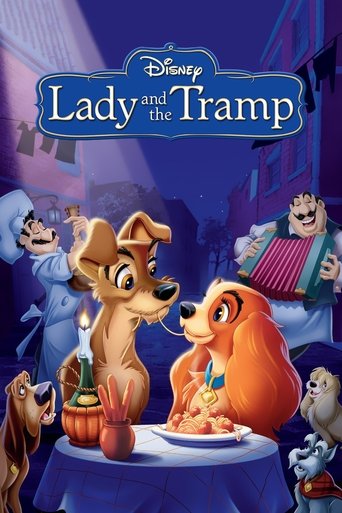
Lady and the Tramp
1955 · Film · 76 min
Directed by Hamilton Luske, Wilfred Jackson, Clyde Geronimi
AnimationFamilyRomanceAdventureComedy
Lady, a golden cocker spaniel, meets up with a mongrel dog who calls himself the Tramp. He is obviously from the wrong side of town, but happenings at Lady's home make her decide to travel with him for a while.
5 neutralfrom 5 commenters
Where to watch
No streaming data for this title.




5 comments on Hacker News
Disney is only slightly better about nuking old “offensive” content than other providers. Many times they just gave an unskippable “this is culturally offensive to some” text and call it good. For example the old lady and the tramp has that “we are Siamese” song, which I guess is offensive… at least they still let you watch it.
Hulu on the other hand just pulls shit. For example they pulled my favorite it’s always sunny episode where they do that diehard movie. I guess the fact they do black face makes it racist (which they call out as such in the show itself!) and since we are all apparently too stupid to think for ourselves about the content we watch they better block it. After all they know better than me about what is offensive.
… shit like that… that is what is gonna lead me back to piracy.
arent Friends and The Office some of the most streamed shows?
I have to think Disneys back catalog of shows and movies will be a bigger draw short term than their new content. Are people buying it to watch The Mandalorian and the new Lady and the Tramp, or are they buying it so their kids can watch every disney movie ever made? Dont get me wrong, having a bunch of Marvel mini-series as their launch content is a brilliant move to make it not "just the old stuff."
> I don't know what you think a Disney story is, but all of Disney's major works are based on existing folk stories and other works already in the public domain.
False. Here's some of their animated features based on copyrighted works (as best as I can tell):
Dumbo
Bambi
Peter Pan
Lady and the Tramp
One Hundred and One Dalmatians
The Sword in the Stone
The Many Adventures of Winnie the Pooh
The Rescuers
The Fox and the Hound
The Black Cauldron
The Great Mouse Detective
Treasure Planet (partially based on the 1987 TV miniseries Treasure Island in Outer Space)
Meet the Robinsons
The Princess and the Frog
Big Hero 6
(I'm using the list in https://en.wikipedia.org/wiki/List_of_Walt_Disney_Animation_Studios_films, and picking out the “based on” or ”inspired by” credits that look recent enough.)
I'm a bit obsessive about researching things I buy, so the idea of just picking something seems like a relief. Then again, having had gadgets with one flaw that annoyed the crap out of me, I'm driven back to research. (For example, a DVD player that suddenly decided that 1) a parental controls limit had been set and needed a password to override (0000 worked fine), and 2) EVERY movie was above that limit, including Lady and the Tramp, which is a children's movie from the 50s for goodness' sake.)
>I know that Disney stops people from taking Walt's original concepts. But is that a bad thing? What concepts did Disney steal? None: he made his own. Other people can do that too.
This is completely wrong. Nearly every famous early work of Disney's was "stolen" from others. Among the more famous are Snow White (1937), Fantasia (1940), Pinocchio (1940), Dumbo (1941), Bambi (1942), /Song of the South (1946), Cinderella (1950), Alice in Wonderland (1951), /Robin Hood (1952), Peter Pan (1953), Lady and the Tramp (1955), Mulan (1998), Sleeping Beauty (1959), 101 Dalmatians (1961), The Sword in the Stone (1963), and The Jungle Book (1967).
The first iteration of Mickey Mouse, called "Steamboat Willie", was copied directly from Buster Keaton's "Steamboat Bill."
This is an excerpt from one of Lawrence Lessig's speeches about the topic: "It was a parody, a take-off; it was built upon Steamboat Bill. Steamboat Bill was produced in 1928, no [waiting] 14 years--just take it, rip, mix, and burn, as he did [laughter] to produce the Disney empire. This was his character. Walt always parroted feature-length mainstream films to produce the Disney empire, and we see the product of this. This is the Disney Corporation: taking works in the public domain, and not even in the public domain, and turning them into vastly greater, new creativity. They took the works of this guy, these guys, the Brothers Grimm, who you think are probably great authors on their own. They produce these horrible stories, these fairy tales, which anybody should keep their children far from because they're utterly bloody and moralistic stories, and are not the sort of thing that children should see, but they were retold for us by the Disney Corporation. Now the Disney Corporation could do this because that culture lived in a commons, an intellectual commons, a cultural commons, where people could freely take and build. It was a lawyer-free zone."
To address your second point, "the idea of capitalism" does not necessarily require giving anyone permanent, state-enforced monopolies of anything, no matter how well written it is. Any justification for copyright has to stem from a benefit to society. Strong arguments can be made for giving creators temporary monopolies of a limited scope, but permanent monopolies are bad for both innovation and the public.