 Hacker Cinema
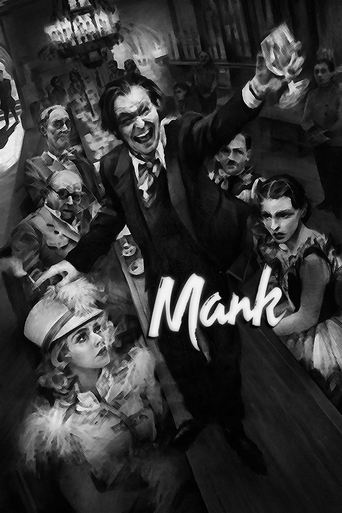
Mank
2020 · Film · 132 min
Directed by David Fincher
1930s Hollywood is reevaluated through the eyes of scathing social critic and alcoholic screenwriter Herman J. Mankiewicz as he races to finish the screenplay of Citizen Kane.
5 positive3 negative1 mixed6 neutralfrom 15 commenters
Where to watch
No streaming data for this title.
16 comments on Hacker News
'Movies' at Blockbuster level pivoted to ersatz carnival rides post-'Pirates of the Caribbean', focusing on safe IPs and simple plots designed to aid comprehension of the major story beats in the SEA markets without the need to resort to subtitles or dubbing.
'True' Cinema has been going from strength to strength the last decade, with even Netflix putting out Fincher spectacles like 'Mank' on streaming, and A24 bringing introducing a new audience to phenomenal Korean Cinema like 'Parasite' and 'Minari'.
Even in the traditional studio system we have been spoilt in recent years by a succession of Palm D'Or and Oscar winners like Anatomy of a Fall, Triangle of Sadness, Zone of Interest, The Brutalist, Oppenheimer and Killers of the Flower Moon.
I said YouTube isn't a net negative. Even then you have to think globally, what about children who grew up consuming AI generated abomination animations made with 0 oversight of even its greedy creators?
Netflix was the cause for current slate of tax writeoff cancellations (no Netflix no overinvestment by Warner etc and no clumsy Zaslav cleanup), terrible shows being greenlit, homogeneity of camerawork, casting, identity-politics pandering that nobody asked for, oversaturation of the market with streaming services that is almost as bad as cable etc. It's basically a cancer overgrowth, good short-term and terrible long-term. Binge-tv model is also not a good thing, in terms of how much time it takes up, how little it brings in terms of pleasure and validates our growing impatience. I could go on and on. Does anyone even remember Mank or The Killer? Imagine Poor Things being Netflix-only release. Nobody would even say a single peep about it outside of niche film twitter accounts.
Generally speaking, if you've read "Seeing Like a State", then you can apply the same logic to companies and the entire industries, or really any aspirations of "man". We crave control and fear uncertainty, so we make environments far more deterministic, which brings more short-term profit but ruins the environment (be it nature or film itself). Look at Disney, Iger created the superhero movie boom (by making it super deterministic and boring: every movie is part of a giant puzzle so that each piece brings money) but in the process killed Star vehicles, killed experimentation (by directors, actors), and now Scorsese and Coppola need to throw around their weight to reverse the course. Sure, A24 exists, but before this all movies were A24 movies essentially. Now a major star being in a horror movie is an "Event". (Who is even a star anymore? DiCaprio, Cruise? These people were around since 80s. You think Chris Evans will have the same longevity?) Yeah, there were similar periods of dominance (80s action movies) but they weren't so precisely fine-tuned and featured greater directorial freedom and less emphasis on being non-offensive.
I guarantee you none of you will quote Avengers (Ultron onwards) in next 20 years. People still quote Terminator 2 or Predator or Lethal Weapon, despite them also being brainless flicks (some not so brainless actually). Look at Dr Strange 2, they forced Raimi to stop being Raimi basically (the first movie has some good moments), and made him fall in line with the "agenda", because the plan™ is too important to compromise on. In reality the plan™ is the money perputuum mobile lol. Sure, these people were always greedy, but stochasticity of the system allowed for good stuff to pass through their Eyes of Sauron lmao.
Tbh I don't even know why I'm responding a "throwaway" account.
I have great nostalgia for physical media beyond the current reemergence of vinyl records. Compact cassette, minidisc, CD, reel to reel, and digital audio tape are in my hifi system.
I also love blu-ray and DVD. I just bought “Mank” on Blu-ray despite being easily seen on Netflix.
Obviously I’m an outlier. Yet my 26 year-old daughter has become enamored with cassette tapes and CD’s when the used car she bought had a head unit capable of playing both.
So it’s not just me being old and nostalgic. Beyond the familiar arguments about the art and extras that come with physical media - I do have a problem paying monthly for access to music or movies. Or having digital purchases disappear when formats become obsolete. I still pay for these services, but I like the idea that I can stop paying and I lose nothing I love.
I’ll probably buy a copy of Wes Anderson’s Netflix short “The Wonderful Story of Henry Sugar”. It’s utterly delightful and will look spectacular on my 12 foot projection screen - much better than the Netflix compression allows.
I’m familiar with all the streaming and digital purchase arguments. But I’m curious if my daughter and her friends are a precursor to a fatigue with the ephemeral nature of digital purchases.
2022 - Kimi, After Yang, Crimes of the Future, White Noise, Official Competition, Everything Everywhere All At Once, Tar, Mona Lisa and the Blood Moon
2021 - Nightmare Alley, The Card Counter, Zola, The French Dispatch, Come True, Don't Look Up, I Care A Lot,
2020 - I'm Thinking of Ending Things, Mank, The Sound of Metal, Possessor, His House
2019 - Climax, Uncut Gems, Parasite, Vivarium, First Cow
2018 - The Clovehitch Killer, Prospect, Mute, Anon, Mandy, The House That Jack Built, Cam, Sorry to Bother You
2018 had a glut of Netflix sci-fi B-movies that I think are very solidly good if not so great. I think they're underrated so I included them. I might have also messed up on the years.
These are all films I've seen. There are many others that I suspect are even better that I haven't seen.
Roma? The Irishman? The Two Popes? Marriage Story? Mank? Beasts of No Nation? Power of the Dog? Tick Tick Boom?
Can't really take a comment seriously that puts Apple's film output over this. Besides Coda has Apple produced or even just distributed anything of comparable quality?
Nowadays you have: superhero movies, sequels, remakes, empowerment of certain groups that aren't me, movies with a political message, or some sad dour art house movie that makes you walk out feeling bummed out about life.
Compare 1994 or 1999 movie releases to 2021.
Fight club, the matrix, forrest gump, Magnolia, office space, sixth sense, american beauty, clerks, etc.
Nowadays: the father?, Mank?, black messiah, , chicago 7?
It's not about creating magical new worlds with thought provoking ideas anymore.
Maybe I'm explaining it poorly but film seems to have gone the way of the music industry.
Commodified instead of inspired.
I LOVE going to the movies.
I just wish there was something I wanted to see.
Sorry I was unclear. There is a strict standardized format for scripts, for typography and layout, and certain words and character names are always capitalized. E.g. every scene starts with a capitalized header like:
INT. TYRELL CORPORATION INTERROGATION ROOM - DUSK
or
EXT. OVERHEAD VIEW CITY - NIGHT
The header indicate (1) interior or exterior (2) setting (3) time of day. (The movie Mank actually display these headers on the screen to introduce the flashback scenes. It is an inside joke since it is a movie about a screenwriter.)
Dialogue lines are always indented, and with the character name in capitals:
Leon's upper lip is quivering.
LEON Whatya mean, I'm not helping?
HOLDEN I mean you're not helping! Why is that, Leon?
Now in addition to such capitalization rules, the author can capitalize words the reader should pay special attention to, typically visual or sound cues.
A blimp is drifting silently over the city reflect- ed in an eyeball while we hear the SOUNDS OF THE STREET.
But there are no hard and fast rules about which words to capitalize here. The scriptwriter in the article do seem to like to emphasize many words.
> I suppose I could be reluctantly convinced to part with $5 or $10 for the latest predictable comic book CGI-fest.
You'd probably never get that chance if prices floated; those films go out to a market that bases their social life on consuming genre fiction and for whom seeing them is not optional. Prices would shoot up to $40 a ticket, and marketing would just be laser-targeted towards that audience, who would pay like putting money into the collection tray at church. Kickstarter has proved that 5-10% of that audience would be willing to pay multiples of that (2x to probably 50x) extra without anything in return but exclusive tokens that are evidence that they paid.
IMO, mostly middle-of-the-road, highly-competent directors like Fincher would be in trouble in that world, since they are both going for a general audience and relying on a general media narrative of genius and award potential to market their films. Genre movies withdrawing from general reviewers and general marketing (like awards shows) reduces the impact of those awards, and leaves them as a de facto genre themselves - like mainstream literary fiction. Maybe able to crank out one or two films that crack the top 10 every year and barely self-supporting on average; highly dependent on government and institutional support.
Talent graduates from mainstream non-genre awards-show films to comic book films, not vice-versa, which is why awards shows are desperately trying to get those films into every category, as a means to market those traditional blockbusters to genre fans.
> mass-market lowest-common-denominator marvel or transformers nonsense
So, tl;dr, IMO Fincher is the mass-market lowest-common-denominator choice, and bombastic genre trash targets a small inelastic market that would still be sustainable at a far higher price point. The number who would pay a premium for Fincher wouldn't be enough to support his budgets and marketing. Mainstream Fincher films would only survive given away for a token (or in order to market something else.) 20M people would pay $60 for The Avengers 8, but 400M might be willing to pay $3 for Mank or watch it for free if you put it on all of some brand's devices as a promotion (like a U2 album, or Netflix.)
Of course Fincher would be (and probably is) highly desired in genre films, so in that world he'd probably be charging $100 per to 40M fans for The Incredulous Spider-Man: Sapphire Empire's Revenge Chapter II or The New Fast More Furious 19.
If you are a fan of Citizen Kane and the whole mythos around this movie, you might enjoy Mank. If not, you will probably find it quite boring and pointless.
Fincher is certainly no art house director. He makes big-budget movies with stars like Brad Pitt or Ben Affleck. He is kind of like Steven Spielberg - a director so talented in the craft he elevates rater middlebrow material to be uniquely enjoyable. Fincher just gets a bit more respect because he is "dark". But dark does not mean deep. For example Seven is really quite silly and contrived, but his excellence at directing makes us forget that.
This is an interesting but problematic idea.
Firstly, I'm not certain of how the economics would play out: the "marvel or transformers nonsense" (and boy is it nonsense) tends to cost a lot of money to make, because they feature famous actors and they're end-to-end expensive CGI; arthouse films tend to be a lot cheaper because they feature less CGI, and sometimes the actors involved will work for less money because the films are more "worthy", or they like the director. More people watch the superhero drivel than the arthouse films, for sure, so perhaps it would all balance out, but it's unclear.
Secondly, while I broadly love Terrence Malick, if I'd paid £20 for "Knight of Cups" (which was dire), I would have to think very, very hard about parting with another £20 for his next film unless the notices were very good. I think you'd end up with a minuscule audience if you started marking up arthouse films in this way.
Unrelatedly, I have to admit that "Mank" sounds really boring and I'm not eager to watch it, even though I have a Netflix subscription and I've enjoyed many of Fincher's previous films (hell, I even liked "Alien 3").
Me neither. Coming up with a film like Mank in 2020 is nothing short of miraculous. (Yes, it's a film, it's not a documentary, it can tweak facts if it needs to).
While I was watching it in awe, gleeful at the I don't have the time nor I will spoonfeed here, if viewers don't know the references nor what we're talking about, that's their problem attitude, I couldn't help wondering what fraction of potential audiences today could possibly get it.
Just the sequence where Oldman and Seyfried as confidants, roam utterly extravagant San Simeon/Xanadu's gardens in an ethereal evening after this politics/business/class faux pas of the Brooklyn mistress... That's the old magic of the moving pictures, people. This one tells you why Citizen Kane happened (that's spelled out in that sequence BTW). It doesn't have to be accurate, only tell you the story, and this it does beautifully.
Yea idk what he’s talking about. I thought Mank was incredible. The costume and set designs were great. Gary Oldman, like usual, gave an Oscar worthy performance. Amanda Seyfrieds portrayal of Marion Davies will probably get overlooked but I think it was one of her best performances. Great film, especially if you’ve seen Kane recently. Definitely recommended
> The recently released Mank is … a disaster of a film, probably Fincher’s worst
Could you elaborate on this? The general critical reception of Mank seems positive.
There is no “inevitable fall” of Citizen Kane, neither in the article itself nor in film theory circles. The closest the article gets is this, which is not exactly convincing:
But one thing seems sure. The idea of a consensus pick, and for that matter the need for any kind of consensus, is a thing of the past. Citizen Kane, the ultimate canon title, has itself become proof that canons are there to be exploded.
The recently released Mank is the reason for a renewed interest in Kane, and in an ironic twist of fate, it’s a disaster of a film, probably Fincher’s worst, and it makes Welles’ cutting hand and firm direction seem like the actual genius behind the picture.
In any case, if you ever have a few free hours, I recommend listening to some interviews with Welles. He had to be one of the most entertaining and erudite conversationalists we’ve ever had. With all the names and situations referenced in his (probably embellished) stories, it’s like listening to a recording from a lost world.
https://youtu.be/oQYazeJA-Oo
https://youtu.be/1LnuQZ6VD_Y
A horrible movie. The end of the golden era. The best era ever. Mank, David Fincher's new movie about that dispute will open on Dec 4. Mankiewicz was the original writer of Citizen Kane, about one if the most important fascists if those times, until Orson Wells butchered it.
The famous Kael piece about Mank is mandatory reading for every film lover.
It’s okay. Fincher cancelled it to do a movie with Netflix that looks great. Netflix wasn’t going to get Mindhunter continued successfully without Fincher’s interest.
https://en.m.wikipedia.org/wiki/Mank