 Hacker Cinema
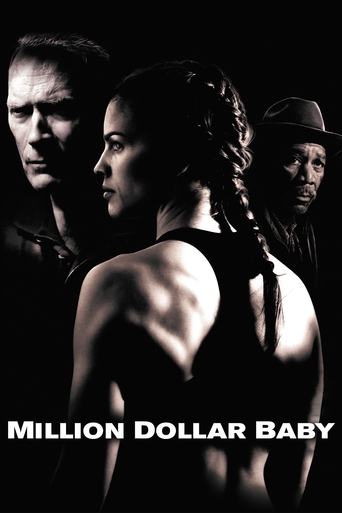
Million Dollar Baby
2004 · Film · 132 min
Directed by Clint Eastwood
Despondent over a painful estrangement from his daughter, trainer Frankie Dunn isn't prepared for boxer Maggie Fitzgerald to enter his life. But Maggie's determined to go pro and to convince Dunn and his cohort to help her.
4 positive9 neutralfrom 13 commenters
Where to watch
No streaming data for this title.


13 comments on Hacker News
I'd actually put one in for Clint Eastwood.
Although most popular knowledge about him revolves around his earlier acting career (Westerns, Dirty Harry), you'll notice a distinct change in many of his films once he started directing.
* Play Misty for Me
* Breezy
* Unforgiven
* A Perfect World
* The Bridges of Madison County
* Midnight in the Garden of Good and Evil
* Mystic River
* Million Dollar Baby
* Changeling
* Gran Torino
* American Sniper
* Sully
* The Mule
Agree 100%.
I watched Million Dollar Baby for the first time a year or two ago. I thought it was just a boxing movie, something like rocky or something.
I don't think reading the synopsis would have affected me like that movie did. I thought about it for days afterwards.
Kubrick’s results were all over the map. He made maybe three great films:
Dr. Strangelove
Full Metal Jacket
A Clockwork Orange
A bunch of not bad films:
2001
Lolita
Barry Lyndon
The Shining
Spartacus
One real turd of a film:
Eyes Wide Shut
And a bunch of forgettable filler:
All the other films he made.
Compare this to the Anti-Kubrick, Clint Eastwood, who made:
Unforgiven
Mystic River
Million Dollar Baby
Letters From Iwo Jima
Gran Torino
And a bunch of okay films:
Pretty much everything else
And it’s pretty obvious that you don’t need to be an abusive taskmaster like Kubrick to make great art.
I was gonna watch that tonight. Thx a bunch. Have you seen Million Dollar Baby? Let me tell you a little something about that movie. She dies.
This can be done in a natural way though. Take the movie Million Dollar Baby. The movie portrays a woman with strong physical characteristics but does so within the context of a good story that tackles a complex social issue. At no point in the movie does the main character’s physical abilities seem un-natural or forced. There are many other examples where socially desirable characteristics are portrayed by minority groups within the context of a good story without being forced or out of place.
Oh I'm not scottish ... always thought gaelic languages were native to the islands but not recognised. Glad to see thats not the case. There are not many cultural references to it ... I came across it from the movie - Million Dollar Baby.
> It's not that simple.
The combination of money and family never make things simple. Not sure if you watch the movie "Million dollar baby", the back story of the inheritance/power of attorney in this movie really make me sad for our human race and our behavior.
Someone pulls the plug in the movie Million DOllar Baby.
I was just thinking that they recently got some good content added.
These were all added this month: Batman Begins, Clerks, Gran Torino, Million Dollar Baby, No Reservations, Stripes, The Aviator, and The Fellowship of the Ring. The entire Comedians in Cars series is a lot of fun. Heat, The Godfather, Gangs of New York, Casino, and Seven.
Maybe you're bored of all that, but it's not like the films on Netflix are universally terrible.
I have been thinking about this problem for quite a while now. I will in this comment describe the beginnings of a formal system of encoding the equations that underpin one aspect of emotions. It's incorrect, and incomplete, so forgive me.
1. Everyone have a different skill levels for each of unlimited variety of tasks, for example, in cooking, cycling, running, eating quickly, enjoying food, planning vacations, etc. Everyone also have a different perception of their own skill level on each of those tasks. Some people view their own skill level at a particular task as better than it really is, some underestimate themselves and view their own skill level as worse than it really is, and some have a realistic perceptions. The disparity between reality and their self-perception is called ego. For some people, the disparity between perception and reality is so wide, and self-awareness in all aspects of life so low, we either call them narcissists, or co-dependents, depending on which direction the disparity goes. Let's denote a person's ego at a particular skill level as +EGO<cycling>, meaning the person overestimates their cycling ability or -EGO<cooking>, meaning the person underestimates their cooking ability.
2. In a society, people interact with each other socially. Of the wide range of human interactions, two important ones are approval, and disapproval of another person's skill level at a particular task. These two messages, from the sender's point of view, can be deserved (a compliment / a criticism), or undeserved (flattery, insult). Over-simplifying a bit, a deserved compliment simply means the person is sending the compliment views the receiver as competent as a particular task, whereas an undeserved compliment means the person is sending the approval or disapproval, knows it has no bearing on reality, and is only doing the sending to achieve some motive, such as manipulating the social hierarchy, or to balance the disequilibrium that is occurring in their own selves, for example, insecurity. I've described deserved & unreservedness as discrete, though it is continuous. E.g. A person (prison guard in an nazi-like atmosphere?) complimenting Usain Bolt "You're not bad at running, I'll let you run around the camp." intending it as an insult, is a positive appraisal, but is underserved, because to the sender's knowledge, Usain Bolt is better than "not bad". There's also a case, where, for example, Usain Bolt's best friend who is bad at running saying "The store's almost closed, you go buy it. You're the one good at running." as a humorous understatement. I think that should still be classified undeserved compliment. The purpose of understating the compliment would be to maintain one's social standing in Bolt's eyes.
We can denote such a message as ++APPRAISAL<cycling>. The first sign "+" indicates it is a positive appraisal, the second sign "+" indicates in which direction it deviates from reality. If it contains only one sign, "-APPRAISAL<cycling>", then it will mean it is a realistic appraisal, as far as the sender is concerned.
3. People are different. It means they deal with their own and others' emotions differently. People change. Each time they deal with a scenario, they change a little more. Now that we have some notations defined from above, let's describe a scenario, where a narcissistic mother, Earline, gives an negative, undeserved appraisal to her daughter, Maggie, who participates in a boxing competition[1]. The daughter had just bought her mother a house. As a narcissist, the mother is concerned with her image, and she thinks her daughter should also be concerned with the same thing. The mother is criticising her daughter's ability to generate a positive image, i.e., status, in society.
EARLINE: Find a man, Marry him. Live proper. People hear 'bout what you're doing and they laugh. Hurts me to tell you, but they laugh at you.
It's undeserved, because the only people who laugh are Earline's friends. Do Maggie's fans laugh? No. Does her mentor laugh? No. As a codependent who is -EGO<X> where X is not boxing, she takes it to heart, for now. Earline has been raising Maggie this way since forever, it will explain why in the movie the narrator tells the audience Maggie "knows she is trash". This continues until the final moments in the movie, when Maggie figured out her mother wouldn't praise her even when she was nearly the world champion at something.
Sending an appraisal message will alter the person's ego in some way. Sending a false appraisal message will also alter the person's ego in someway, but, like borrowing debt, while depositing cash in assets, creating a corresponding liability at the same time, the false appraisal message, when found out as false, will discredit the sender, diminishing the feelings the receiver have for the sender towards the negative direction.
We'll make an "equation" to describe the effect of an appraisal message to a person's psyche. As people are constantly changing, as they have experiences, we'll use => to separate the left side and the right side.
{0}{1}APPRAISAL<X>(sender, receiver) => {0}EGO<X>(receiver) + {1}RELATIONSHIP(receiver, sender)
{0}, {1}, are either positive or negative signs.
The notation as it is, isn't sufficient to describe the fact the negative effect on the relationship between the receiver and the sender is delayed until receiver realises the appraisal is fake, retroactively. It is important to note, as the receiver realises the appraisal is fake, the receiver's ego heals, so in fact, my equation isn't even correct, because over time, it doesn't balance.
Anyway, it's my first stab at it and I think it needs a lot of improvement. Thanks for writing this Ask HN to give me opportunity to try hashing some things that's been on my mind for a while. I've worked out relationships and the emotions that occur between narcissists and codependents, and the initial courting process between a male and a female, have some structure as to how people fall in love with each other, whether a couple will be stable, looking at the disparity between their attractiveness, and what kind of interactions that might occur if the disparity is too big. I have some idea of what happens when two strangers meet, and how they become friends. I think I know enough to eventually encode all of these, but there are more social interactions than between narcissists and codependents, and between husband's and wive's and their mistresses, and between strangers becoming friends. I thought about implementing a set of notations as programming code eventually, but I can't think of a use for it besides building more realistic diplomacy in strategy games...:) And it's going to be a lot of effort I don't know if I can even make some sort of significant headway.
[1] Scenario taken from "Million dollar baby". See script. http://screenplayexplorer.com/wp-content/scripts/Million-Dollar-Baby.pdf
--------------------------------------------------------------
Given that type theory is a system for describing mathematics, and given that "Math can be applied everywhere", why is it that type theory can't seem to be applied to personality type theory? I've been thinking about this since about I started studying type theory. I'm thinking that one abstraction will be: a jolly man can act as a catalyst on a social environment and then cause the environment to be jolly as well. But I'm thinking as well about the case when a man "wearing a hat" can act as a catalyst on a social environment and then cause the environment to be "wearing a hat" as well. An environment "wearing a hat" doesn't sound good, does it? Well, my main question has a tendency to be flawed, but I would really like to have sincere answers. It would really help if the answers would focus on type theory.
With the jolly man, through empathy, others feel the same joy, and through peer pressure, some others will feel forced to show joy. On one hand it will temporarily raise the mood of the social environment, on the other, in some individuals the forced joy will even enhance their negative feelings and resentment, causing jealousy. These negative emotions leak out eventually, to return the environment to equilibrium (contentment, like a rock, like a tree, like a baby drinking breast milk, like a sheep chewing on grass, like a man or woman asleep). Of course in cycles, it usually overshoots to the other end of the equilibrium, so you have that bouncing back and forth waves of joy and discontent.
With the "wearing a hat", I grew a beard once, and within months half the people in my company had a beard. So it can be said "the social environment became more amenable to hat wearing", so what you're saying works on some level. Of course eventually more people had a beard than didn't, and people who wanted to show their individuality showed it by cutting their beard off first, and then everyone followed through, and now I'm back to the only one with a beard.
--------------------------------------------------------------
I suspect there's no type system to describe all these is because no one who knows enough about social interactions is interested and has the ability to define it through a type system has started doing this yet. Can you think of a way to denote all these specific aspects of persons and interactions in symbols, and devise a way to show the deltas of these symbols, and describe the changes the reverberate through the environment?
Isn't this basically the plot of Million Dollar Baby or Maximus's first fights in Gladiator? The fighter in both movies wins all their fights very quickly. The difference is that in Gladiator, he is told to slow down and give the crowd a spectacle. In Million Dollar Baby, nobody wants to fight her without extra participation money.
I wonder what kind of pressure is being applied to Rousey by her manager, agent and fight organizers?
> You wouldn't catch many 20 and 30 years old dead in something like Comic-Con 30 years ago.
BayCon has been around for 30 years. Before that, the niche interests just change -- my dad and his friends have been dressing up in 20s garb and driving 20s cars to period events since the 60s. There are Civil War re-enactments and sex clubs and costume parties and all sorts of things.
And anyway, making those things into an indictment of society at large is silly, especially when there are so many trivially easy indictments of society (like the way everyone always thinks this generation is worse than the ones before it).
> Something like "The Searchers" is an order of magnitude more poignant and challenging than Iron Man or Avengers.
Are you being disingenuous, or did you not realize you're cherry-picking here? Spaghetti Westerns and shoot-em-ups and grindhouse films and silent comedies have all occupied a place as entertainment alongside more serious films, and "serious" films, if that's what you're into, are still alive and well.
Try comparing Laurel and Hardy's "A Perfect Day" to The Avengers while comparing The Searchers to, I dunno, Gran Torino or Million Dollar Baby or Interstellar or whatever your poison.
> Just that those kind of movies (and even more naive "action" movies) are prevalent today with the 20-40 demographic, something which wasn't the case in decades past.
And my point is that he's wrong, and history proves it.
This is just a classic rose-colored glasses problem, that's all. People are imagining history as they prefer to imagine it, not as it was.
This page has a picture of the nonexistent 20-40 year olds turning out to see Stan Laurel in 1947: http://www.nwemail.co.uk/memories/stan-at-queen-s-first-royal-variety-show-1.1015949
"When one goes, as I did recently, to a city like Chicago and finds on the South Side, a district equivalent to New York’s Harlem, a two-million-dollar building of a magnificence housing nothing but photoplays, and sees over four thousand people packed in, watching and listening and obviously amused and thrilled, he asks what all this means, and admits, unless he is a Dumbkopf, the coming in of a new order. Particularly is he amazed and bewildered when, in the same city, he witnesses a brilliant spoken farce-comedy, deftly played by distinguished actors, given before half-empty benches – yet in the very heart of the town. What is one to say in the light of such over-whelming evidence? Simply that something has entered the world, suddenly, which grips the people, appeals to them, rivets their attention, and drives them out of the old established theatres."
That was written in 1921.
Context at https://nenaghsilentfilmfestival.wordpress.com/category/friday-facts/
The thing is, if you're not doing some sort of incredibly bloated production, you don't need 10,000 people to make a movie. Most movies are NOT Lord of the Rings.
For instance, one of the best critically received movies of the last decade was probably No Country For Old Men. Budget? $25 million. Made back well over triple that at the US box office alone.
The King's Speech? $15 million, made over $135 million
Argo? $44 million, and that had lots of expensive location shoots in the middle east
The Hurt Locker? $15 million
Slumdog Millionaire? $15 million
Crash? $6.5 million
Million Dollar Baby? $30 million
All movies that did very well at the box office, and were made for $25 million or less (with one exception). They also all won the Best Picture oscar. So there is PLENTY of evidence that you can make a great movie without getting anywhere near a 9-figure price tag.
Of course, for "indie" films, you can go well under that. "Clerks" cost about as much a new car. The original Texas Chainsaw Massacre was barely over $100k....the first Saw movie was made for just over $1m and grossed 100 times that.