 Hacker Cinema
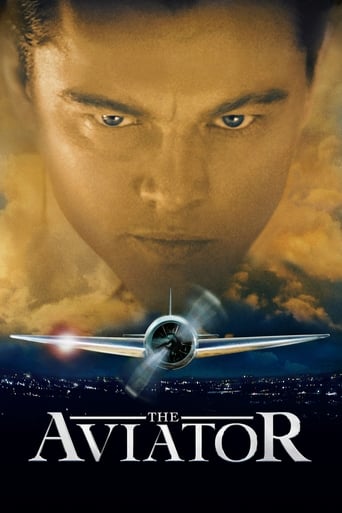
The Aviator
2004 · Film · 170 min
Directed by Martin Scorsese
A biopic depicting the life of filmmaker and aviation pioneer Howard Hughes from 1927 to 1947, during which time he became a successful film producer and an aviation magnate, while simultaneously growing more unstable due to severe obsessive-compulsive disorder.
9 positive2 negative1 mixed10 neutralfrom 22 commenters
Where to watch
No streaming data for this title.
Videos commenters linked
From YouTube links in the comments below. Most are clips and trailers; “Full” means the uploader says so.




26 comments on Hacker News
I finally got around to watching that a year or two ago. That scene is among several that are just remarkable bits of work, but somehow the whole film itself felt like a slog.
I feel like that's the problem generally with late career Scorsese. The last of his films that felt consistently interesting and free of flab was, to me, Casino, though he got close for me with The Aviator and The Departed.
I hate editing mistakes more. The Aviator has quite a few of these where for example in cut A two characters talk by walking side by side, in cut B they stop and turn towards each other (still talking), and in cut C they continue the talking but you can see cut A and C are the continuation of each other and cut B was inserted in the middle https://files.catbox.moe/dljiiw.mp4
And that's just one example that film is full of those. Here is another jarring one https://files.catbox.moe/9m3gjq.mp4
Despite that it won the Academy Award for Best Editing...
Yeah those are fun too eg. Wolf of Wallstreet, Big Short
But I was more looking at the tech ones eg. hardware/software I know HFT, I don't mean that
I'd throw The Aviator in there but again not tech, but that idea swimming in money, possibility, changing the future. One day a movie about EM ha.
Anyway I wish I had my thing I was chasing/something novel. Maybe one day.
"The Aviator" [1] about Howard Hughes? Love to also talk about real startups movies without failure as a main theme. For example, "The Social Network" (includes Winklevoss and Eduardo Saverin "failures"). We have other non-fictional ones such as "The Founder" [2] about McDonalds. Classic: "Pirates of Silicon Valley". Ford v Ferrari (amazing if you have not seen it) [3].
[1] https://www.imdb.com/title/tt0338751/
[2] https://en.wikipedia.org/wiki/The_Founder
[3] https://es.wikipedia.org/wiki/Ford_v_Ferrari
Hated it. I was apparently not alone; it did poorly at the box office. I'm also generally not a fan of religious films.
Also hated (and could not finish) the utterly turgid THE IRISHMAN. WOLF OF WALL STREET had its moments, but I'm honestly not sure why the film existed -- I mean, it's the same sort of story as GOODFELLAS.
SHUTTER ISLAND was crap. THE DEPARTED was maybe ok. The last one I loved was THE AVIATOR.
Given how awful THE IRISHMAN was, and the trendline I see with his work, I have no plans to see the adaptation of KILLERS OF THE FLOWER MOON.
Harry potter movie changed directors a few times right?
Amazon is getting a 160mil tax credit in NZ.
Regarding the team: "The team who will be creating the “LOTR” TV series includes: executive producers Lindsey Weber (“10 Cloverfield Lane”), Bruce Richmond (“Game of Thrones”), Gene Kelly (“Boardwalk Empire”) and Sharon Tal Yguado; writer/executive producer Gennifer Hutchison (“Breaking Bad”); writer/executive producer Jason Cahill (“The Sopranos”) writer/executive producer Justin Doble (“Stranger Things”); consulting producers Bryan Cogman (“Game of Thrones”) and Stephany Folsom (“Toy Story 4”); producer Ron Ames (“The Aviator”); writer/co-producer Helen Shang (“Hannibal”) and writing consultant Glenise Mullins."
So they have established people in the background and a well known franchise. As for not involving Peter Jackson maybe they just wanted to start fresh, no idea but George Lucas isn't involved of the Mandalorian
I do not follow Naomi Wu but one of the funniest moments in the movie "The aviator" is the scene in which Hughes (di Caprio) tries to convince the censoring bureau (whatever its name is) that showing part of (I forget the actress) a female breast is NOT pornography.
That sequence has stayed with me for the clear depiction of prudishness and stupidity to which people can reach when censoring something.
Not as crazy as reading his biography as I did with HH. But I was amazed with the whole Zip2/Paypal thing like "that's the goal/plan"(make a lot of dineros). The space venture is great I'm glad he's one of the few people (with noticeable impact) that has a future-looking mind unlike the "why spend money on space" thing. I mean PayPal personally affected me, I was using it in stores when I was really poor selling my stuff/getting paid through PayPal and using my phone number by keypad to buy nuts/iced tea at home depot. Just surreal/weird.
But yeah I only really became aware of him because people kept comparing Tony Stark with Elon Musk haha... but at least Elon's stuff works... HH stuff worked too but seemed to be "impractical" or a one-off eg. the giant 88rpm helicopter.
Anyway, I watched the movie The Aviator over and over when I was younger, mostly the intro/mood. The color thing I think was well done indicating time... "Where are my god damn clouds!" haha. I was also super into aviation(models and trying to get into aero industry) until I ended up going to software instead.
The Aviator - I don't know why I was so obsessed with this guy eg. Howard Hughes his tragic/surreal life having so much money and descent into madness. The passage of time makes me sad as well, you see the peak/height of the day...
The Master - this is emotional the churning water scenes in particular with the music great sound track
Her - mostly I enjoy the intro, I don't know maybe it's a part of being alone a lot up to where he meets the OS for the first time, something like this is interesting
Lost in Translation - somehow I found this movie and the social aspect is nice
Iron Man movies - for motivation
Blade Runner - I was obsessed with this movie in high school 10 years ago quoting it ha "I've seen things..."
2001 Space Odyssey - probably my most favorite humbling scene the bone becoming a space craft [1] it's just so emotional "exiting the system". It felt freeing briefly to think you can leave everything that exists and go to nothing, it was an idea of escape for me at the time. It makes me want to strive for that, but it's not a 1-man job and it takes a while eg. probably not in our life time... the whole 4 years to nearest star at light speed thing. And what is there anyway.
Jobs - probably get hate for this but there was something profound the idea of the chips becoming state/data on a screen.
Social Network - sorry to be basic but I used to watch that to get pumped trying to come up with something big(lol). It's funny when I first watched that movie I was not into software/web dev and later on I understood more and more of the basic stuff he was doing to make the girl comparison app and also mentioning Apache to host the initial The Facebook like "Ooh I know what that is".
[1] https://www.youtube.com/watch?v=0ZoSYsNADtY
Worth watching the scenes from The Aviator: https://www.youtube.com/watch?v=KMYSaImuIgo
The real hearing of Mr. Hughes: https://www.youtube.com/watch?v=GDkTkpoyfL0
I'd be very surprised if Tim Cook lied in his testimony. Politicians seem to have a major problem with big tech,. They just don't understand any of this and hopefully they don't make the same mistakes they made with Bell, that basically fragmented the OS stack and caused more problems than it solved.
Well you point is correct then, because he definitely doesn't have anything that would be considered "event movies" (which I assume by this you mean tent pole movies like what Marvel does, or other summer blockbusters).
With that said, my counter point was mainly to point out that you boxing in Scorsese as the "mob" guy is really bizarre. He has plenty of other kind's of movies, some of which you might find uplifting. The Aviator, Silence, or Hugo might fall into the uplifting category, but I feel a lot of his work (and the work of good artists) ends up being more nuanced to the point where associating one emotion to it is kind of diminishing the work.
superhero movies are generally liked by capitalist types as it tick boxes the right things. good wins over bad, you work hard you succeed, and when you succeed you get all the good things. + very poor treatment of death, failure and loss. revelation and surprise are indeed missing. there are many movies that i cherish for just one scene eg., the survival scene in dersu uzala, senate hearing scene in scorsese's aviator when hughes says 'thats what i do'. these moments make me pause the movie and contemplate and play it back again etc which is easier to do on the smaller screen at home though ;)
i disagree that all movies are for the big screen. star wars yes, a jane austen drama? come on. superhero movies work well on the big screen or as he puts it audio-visual entertainment especially without audience interaction. a game would work on super small screens but not a movie. although people are putting up with anything on long commutes.
This brings to mind an excerpt from the movie 'The Aviator (2004)':
Senator: "Mr. Mayer works for you, does he not?"
Mr. Hughes: "He does."
Senator: "And what is his official title?"
Mr. Hughes: "Well I don't exactly know, Senator. A lot of people work for me."
Senator: "Explain why your press agent would pay out $170,000 to representatives of the United States Air Force."
Mr. Hughes: "Well I don't know, I suppose you'd have to ask him, Senator."
Senator: "Well would you produce him?"
Mr. Hughes: "Produce him?"
Senator: "Will you cause him to appear?"
Mr. Hughes: "Senator, you had John Mayer on the stand for three days last week."
Senator: "Well be that as it may, we would like him to reappear. Would you ask him to return?"
Mr. Hughes: (long pause) "No, I don't think I will."
Senator: "Will you try to have him appear?"
Mr. Hughes: "No, I don't think I'll try."
Senator: "You don't think you'll try..."
Mr. Hughes: "No... I don't think so."
In other words, go fork yourself, Senator.
Talking is maybe more of an issue, but taking a phone call in the middle of a movie doesn't work around me. It has only happened once, near the emotional peak of The Aviator in 2004. The theater wasn't that crowded, and after just a few seconds I yelled "Take it outside, buddy!" across twenty seats. He took it outside. I was ready to stand up and yell again, and walk over to him and yell again, if necessary. If he's ruining the movie for me, I'm sure as hell going to ruin his phone call. But that was the only time it has ever happened to me, and I see a medium number of movies. I saw an unusual 14 movies in my three month MoviePass membership before I canceled, with zero phone calls or talkers.
I was just thinking that they recently got some good content added.
These were all added this month: Batman Begins, Clerks, Gran Torino, Million Dollar Baby, No Reservations, Stripes, The Aviator, and The Fellowship of the Ring. The entire Comedians in Cars series is a lot of fun. Heat, The Godfather, Gangs of New York, Casino, and Seven.
Maybe you're bored of all that, but it's not like the films on Netflix are universally terrible.
Ha also by Howard Hughes... ah I was obsessed with this guy for a while... I realize it's a movie but The Aviator is a favorite... Katherine Hepburn/Howard Golf scene haha
edit: CIA and kursk submarine, was it the kursk doesn't sound like the right time
edit: nope Kursk is 141, K-129 is the one they wanted (Glomar Explorer)
I like the jet-rotor tip helicopter too
edit: haha yeah beast (photo of the helicopter with massive rotors spinning I think at 88rpms)
https://s-media-cache-ak0.pinimg.com/736x/04/f9/9b/04f99b793b69e6bdae94bb5db7931be3.jpg
I'm not going to discuss TV movies.
But let's look at the other ones, shall we:
2004's Kinsey. Kinsey's a hero to the social justice movement, also: https://en.wikipedia.org/wiki/Alfred_Kinsey#Personal_habits
2009's Creation. Opened on 7 screens in the US. Hardly a cultural phenomenon.
2004's Aviator. Close, big surprise Hollywood chooses to mythologize a legendary director's early life.
Tim's Vermeer. "Inventor Tim Jenison seeks to understand the painting techniques used by Dutch Master Johannes Vermeer." Are you intentionally wasting my time?
2011's A Dangerous Method. Look who got first billing and is on the center of the cover. http://www.imdb.com/title/tt1571222/?ref_=fn_al_tt_1
2015's Experimenter. Do you not know who Milgram is? From the IMDB page the focus of the movie is his inhumane experiments. Whose case does "look at the horrible things this white guy did to people" help more?
1999's Insider. It's a stretch because it's a movie about a whistleblower who happens to be a scientist, but at least it was a big film with real actors.
2008's The Strangest Dream. A Canadian documentary that nobody's ever heard of. Doesn't even have a cover picture on IMDB or even one vote on Rotten Tomatoes. It's about the one guy who left the Manhattan Project. What are the odds that this is a vehicle to pass judgement on all the other guys who didn't leave the Manhattan Project?
> You for some reason switched to fictional scientists with Gravity (2013) and Interstellar (2014). Why is that? For that matter, you restricted me to scientists and mathematicians, while the protagonists of Gravity are engineers and astronauts - it's poor form to change your metric part-way through.
I hoped you would connect the dots that I was talking about large-scale, big-budget movies.
> If I expand the list to include engineers, astronauts, and similar occupations, then "Captain Phillips" (2013) concerns the captain of the MV Maersk Alabama, which was hijacked by pirates, "The Wind Rises" (2013) about Jiro Horikoshi, the man who designed Japanese fighter planes during World War II ... oops ! Sory, not a white man, though he would have been an "honorary white" in apartheid South Africa, " Zvorykin-Muromets" (2010) about the Russian inventor of television, "Flash of Genius" (2008) about the Robert Kearns and his invention of the intermittent windshield wiper,
At this point it appears you're intentionally wasting my time for effect, like maybe you're hoping somebody who glances over your post will assume it's well-researched and well-thought.
Naoki Mori? I was hoping you would notice from context I was referencing male scientists who were publicly disgraced as people, not as fraudulent scientists.
I'm sure you'll understand that I don't have enough time to fact-check your ridiculous list of movies and sift through all of your loaded questions, so I've left them unanswered.
> How do you define 'mythologizing' in such a way that it's at least roughly repeatable?....If you can't do that, then you don't really have a good metric.
http://www.merriam-webster.com/dictionary/mythologize
At least you closed with Deep Web which might be an actual counterpoint.
That list was incomplete. I added a recent Indian film about Ramanujan and a Soviet film about Sofia Kovalevskaya from the 1980s. FWIW, there's also an upcoming film "Dau" (in post-production) about the Russian mathematical physicist Lev Landau.
One difficulty is that the Wikipedia list does not include made for TV movies and documentaries, like 'Dangerous Knowledge' (2007) on Georg Cantor, Ludwig Boltzmann, Kurt Gödel and Alan Turing, or the BBC documentary 'Isaac Newton: The Last Magician' (2013), or the PBS documentary 'Newton's Dark Secrets' (2005), or "Breaking the Code" (1996), another biography of Turing, or "Freedom Man" (1989) about the black American mathematician Benjamin Banneker, or the 1973 Italian TV movie "Non ho tempo" about Galois, or Simon Singh's 1996 documentary "Fermat's Last Theorem", focusing on Andrew Wiles but including other mathematicians.
Or the BBC documentary "The Birth Of Calculus" (1986) on Leibniz, the four-part BBC series "The Story of Maths" (2008), the 2008 "Julia Robinson and Hilbert's Tenth Problem", or ... I think you get the picture that there are many TV movies about mathematicians, and most of them are white males. BTW, none of them are "average".
When "Moneyball" was turned into a movie, people asked how a book that dealt with statistics could be turned into a movie, since statistics alone isn't that interesting. What big screen movie is there to make out of Dirichlet's life? Of Riemann's? Of Wiles'?
So, of "regular white guy scientists or mathematicians we've mythologized in the past 20 years", where I'll define "mythologized" to mean "made a movie about them", and I'll limit it to feature length films based on lives of actual scientists:
"Kinsey" (2004) on Kinsey, "Copenhagen" (2002, TV) on a meeting between Bohr and Heisenberg, "Creation" (2009) on Darwin, "Something the Lord Made" (2004) about heart surgeons (one of which was a white male), "Tim's Vermeer" (2013) though that's more an amateur scientist, "The Aviator" (2004) about Howard Hughes (aerospace engineer and inventor), "A Dangerous Method" (2011) concerning Jung, Freud, and Sabina Spielrein (the first two being white males), this fall the film "Experimenter" about Stanley Milgram will be released, "The Insider" (1999) is a drama based on the research scientist Jeffrey Wigand, and "The Strangest Dream" (2008) about the physicist Joseph Rotblat.
Those are movies about 10+ real scientists, all male, straight, and not disabled, plus a couple of others. (There were a few movies with other than white, male, straight characters, but certainly not this many.)
You for some reason switched to fictional scientists with Gravity (2013) and Interstellar (2014). Why is that? For that matter, you restricted me to scientists and mathematicians, while the protagonists of Gravity are engineers and astronauts - it's poor form to change your metric part-way through.
If I expand the list to include engineers, astronauts, and similar occupations, then "Captain Phillips" (2013) concerns the captain of the MV Maersk Alabama, which was hijacked by pirates, "The Wind Rises" (2013) about Jiro Horikoshi, the man who designed Japanese fighter planes during World War II ... oops ! Sory, not a white man, though he would have been an "honorary white" in apartheid South Africa, " Zvorykin-Muromets" (2010) about the Russian inventor of television, "Flash of Genius" (2008) about the Robert Kearns and his invention of the intermittent windshield wiper,
A problem with your list is it's easily interpreted as cherry picking. Jodie Foster was the protagonist of "Contact" (1997), a big budget sci-fi film. How does your choice now of "Gravity" indicate a changed pattern from nearly 20 years ago?
Another problem is that you haven't established what the baseline should be. Given the 12.2% of the US population is "Non-Hispanic Black or African American", what percentage of films with 'hero scientists' should have a "Non-Hispanic Black or African American" in that role? Given that 51% of the adult population in the US are women, how many hero scientist movies should have a women in that role? Perhaps it's more that these roles were previously underrepresented?
Is the pattern you see simply explained by the secular trend that people other than straight white males are becoming more frequent in science?
You ended by picking two items from a different context - postings to HN in the last month and 'male scientists who have been publicly disgraced in the past year', I think to establish a pattern. But you again lack the evidence needed to tell if your observations are really a pattern instead of cherry picking. What is the expected baseline?
If the ratio of men to women in science is 4:1, then we would expect a female scientist to be publicly disgraced with about the same ratio. (It's hard to give a good ratio since I think it's more likely that a senior researcher will be found out and reported in the international news. I believe there are more males in higher level positions than females. Also, "Japanese women account for only 10% of the researchers in Japan" and "only 12 percent of the science and engineering workforce in India was female in 2010", so the international ratio is probably more like 8:1.
Checking now, I searched "Retraction Watch" for all people described by the writers as being "disgraced". The complete list of male scientists in the last few years are: Naoki Mori, James H. Hunton, Dipak Das, Don Poldermans, Yoshitaka Fujii, Joachim Boldt, Diederik Stapel, and Woo-Suk Hwang.
The only disgraced female scientist mentioned is Bengu Sezen.
This 8:1 ratio is about what I expect from the percentage of women doing science in the world stage, and within the error bars for something with so few numbers.
What method did you use to count disgraced male and female scientists? I see you missed Haruko Obokata as another disgraced female scientist, so it doesn't seem like you've done a systematic search.
(A double-check search against sciencemag.org finds Jens Förster and Marc Hauser as additional 'disgraced' male researchers and no additional female researchers. Note that Science does not use the term 'disgraced' in articles about Haruko Obokata.)
Also, what do you use as the ratio for males in science vs. females in science? If it's 4:1 or higher then with 3 male disgraces you would expect less than a 50% chance of hearing about a female in the same situation, no?
Otherwise, if you're just making connections based on the latest hot gossip, then you'll be suffering from some serious bias error. You're not going to hear about Naoki Mori on HN.
Regarding postings to HN, what is your criteria? For example, "Alain Badiou Is Making a Movie About Plato with Brad Pitt and Sean Connery" from 7 days ago is a movie about a guy. Is it mythologizing a male? What about "Deep Web (2015 Documentary) – The Story of the Silk Road" from a month ago - does it mythologize Ross William Ulbricht? How do you define 'mythologizing' in such a way that it's at least roughly repeatable?
If you can't do that, then you don't really have a good metric.
It's very easy to see patterns which aren't present. We as humans are quite good at doing this. How might I confirm that this pattern is present?
To start, let's look at movies that deal with "Scientists, Engineers, Doctors, Researchers, Inventors, Explorers and People who do Amazing Things", from http://www.imdb.com/list/ls050940841/ . These include Apollo 13, Fat Man and Little Boy, Einstein and Eddington, Shackleton, Creation, Captain Cook: Obsession and Discovery, Gorillas in the Mist, Temple Grandin, Jobs, and Reach for the Sky.
Of the 31 films (though two are not biographies or based on real-life), 2 are about women (Gorillas in the Mist, Temple Grandin), and the rest are about men. Einstein is certainly high on the list of mythologized people, so mythologization is not limited to women. (Feynman would be another. Infinity (1996) is a biopic about Feynman, but it's not on the list.)
Women appears underrepresented in that list compared to their modern presence in STEM fields. To be fair, the movies include Pasteur from the 1800s, and Harrison from the 1700s. Women were often strongly restricted from doing research in STEM fields during that time.
I saw one non-white person on that list, Vivien Thomas, from the 2004 film "Something the Lord Made".
"Reach for the Sky" from 1956 is "The true story of airman Douglas Bader who overcame the loss of both legs in a 1931 flying accident", and Temple Grandin is autistic. However, since 1956 is rather a long time ago, it does point out the need for a baseline - if the percentage of movies about disabled people has been stable, then it's not a growing pattern. As another example of someone who 'received the mythology treatment', consider "Helen Keller in Her Story" from 1954.
(Howard Hughes, in 'The Aviator' (2004), may also fall into the mentally challenged category, due to his obsessive-compulsive disorder which was present already by the 1930s. I haven't seen the film to see if it touches on his mental illness.)
Films about gay people would have been restricted under the Motion Picture Production Code, so not really seen in films from the 1930s to 1968. That would make it hard to establish a long term pattern. Still, as about 2% of the US adult population (1.2 to 5.6 according to https://en.wikipedia.org/wiki/LGBT_demographics_of_the_United_States ) identifies as LGBT, then about 2% of the films about famous people in STEM should concern someone LGBT.
It should not be hard to come up with an evaluation technique, like "all biopics about people in STEM done as movies/made-for-TV movies in the US from 1970 to the present", and redo this same evaluation to see if there is a pattern.
The tricky part is to normalize it. If 2% of the population is homosexual, then what percentage should we expect to see portrayed as they are in movies? If 51% of the US population are women, and 27.9 percent of the PhDs in the physical sciences are women, what patterns should we expect to see in films?
Otherwise you might just be seeing the secular trend that more women are getting involved in STEM, that policies like the ADA make it easier for people with disabilities to get advanced educations, etc.
How have you done the analysis to determine if the patterns you see are due to the expected shift in population distribution of people in STEM, vs. any special sort of mythologization?
This catch-22 applies across the government-aerospace interface surface.
I used to intern for a company trying to break into aerospace software---not hardware, just tracking and modeling. At the time, they faced a nearly-vertical climb into the market to get around the big names in aerospace; they couldn't sell to them directly (the people involved in the purchasing decisions were the people who would be getting downsized if the software proved to be as good as advertised) and they couldn't sell to the Air Force (it's basically nearly impossible to get into an AF contract cycle if you haven't been in an AF contract cycle).
Their break-in point was the US Army; at the time, the Army had a relatively small air asset capability (relative to the other branches), but a sudden need to know what was up with the GPS constellation AT ALL TIMES relative to their land and air deployments. The company was able to get face-time with the Army reps because the regular aerospace names wanted to sell them software that came at a price-point that usually bundled a shiny new fighter jet or stealth asset with it, and they weren't willing to drop their prices because they didn't want their regular Air Force customers asking "Why is the Army getting this software for a tenth of the up-charge you quoted us when we closed this whole contract last year?"
Sadly, that was years ago and I have no idea of the shape of the market now. My only other data point is the portrayal of the aerospace industry in the movie _The Aviator_ and the observation that it hadn't changed much between then and the early-21st century. ;)
in the movie "Aviator" there is a scene where PanAm almost successfully gets monopoly on international flights. Watching it i could feel only "WTF?". The same way we'd be feeling couple decades later about monopolies that weak [in particular to the influence of industry] governments at all levels have been granting to telcos.
> I suspect the way it works is that the legislators tell their staffs what they want the bills to do
Many bills today (perhaps most) are not written by legislators and their staff, but rather by lobbyists. That might have been the case since forever (if the movie "The Aviator" is not too dramatized, this has been true in the 1930's as well)
Cheaper By the Dozen http://www.imdb.com/title/tt0042327/, The Aviator http://www.imdb.com/title/tt0338751/
I was watching 'The Aviator' just the other day and I realized that at some point someone will make a movie called 'the Astronaut' or something like it about Elon Musk.
If SpaceX goes public I'll buy stock. To me it will mean investing in humanity and in our collective future.
Assuming SOPA, et al, are defeated, there is some real news here:
1. The government(S) have decided that anonymity on the internet, is not a god given right.
2. There is a battle going on. Defeating SOPA at best will produce a delay. The language will appear again in other legislation or will change to be less obvious or will pass without anyone realizing it.
3. The intentions of the government are clear. They believe they have the right to regulate the internet, at a fundamental level. This is bad news, because if they are able to do so, we risk the internet becoming like airlines were back in the Pan Am era. (If you haven't seen it The Aviator, by Martin Scorsese is a great movie.)
4. Even if there is no legislation passed, the government is currently (illegally, as far as I can tell) censoring the internet by shunting dot coms and dotnets to a DHS website via Verisign rolling over to their demands (the torrent site attacks of last year.)
5. There is no method that we can use to fight this. Nobody even is trying to fight the PATRIOT ACT, or NDAA, etc. Once passed, they are carved in stone, and even if they aren't passed, what can we do?
It's time to try and find a way to route around censorship, and let my grandma still be able to find what she's looking for without knowing what DNS is.
It's a good story. From a naive distance (the only perspective I have to offer), coal mining is equal parts romantic and disgusting. We can worry all we want about sitting at a desk all day long, but our life expectancy has to be considerably better than a coal miners.
I do wonder if such stories become less likely (more difficult) over time. Ever watch the movie The Aviator? Average movie, but what struck me in that movie was that you had someone who knew nothing/little about planes, learn to fly, build planes and build an empire on them. Try to do that today. The cost of entry, the licensing, the vastness of knowledge..forget about it. You could probably spend your entire life learning about a single little widget.
Software is crossing that same chasm. Simple "i could have done that" ideas aren't as frequent as they used to be (although mobile computing has rejuvenated this many times over). Building software is becoming increasingly complicated. You can't beat facebook without being better than facebook, you can't build source hosting without beating github. You can't build a mobile phone without copy and paste (well...at least, you can't really sell one...).