 Hacker Cinema
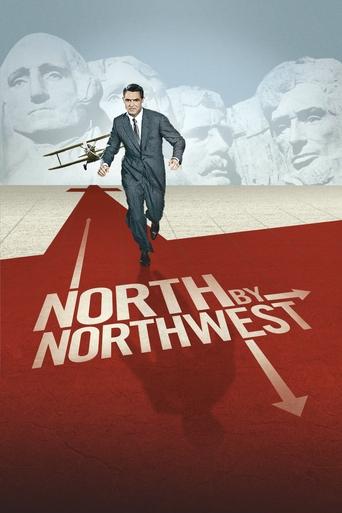
North by Northwest
1959 · Film · 137 min
Directed by Alfred Hitchcock
Advertising man Roger Thornhill is mistaken for a spy, triggering a deadly cross-country chase.
7 positive8 neutralfrom 15 commenters
Where to watch
No streaming data for this title.
Videos commenters linked
From YouTube links in the comments below. Most are clips and trailers; “Full” means the uploader says so.





15 comments on Hacker News
Well adding to the above list of what could be considered stand out movies, these below are some I really enjoyed / admired -- in no particular order.
Dark City
Ice Planet (2001)
The Green Mile
Mortadelo & Filemon: The Big Adventure
Flodder 3
Gettin' Square
Midnight Run
The Accountant
Slipstream (2005)
To Kill a Mockingbird
North by Northwest
In the Heat of the Night
What the Deaf Man Heard
The Simple Life of Noah Dearborn
Short film - Forklift Driver Klaus – The First Day on the Job
Also immortalized in the Hitchcock classic movie "North by Northwest".
Visual style of old James Bond movies was heavily influenced by Hitchcock's movies, specifically by North by Northwest
Will there be an Emacsmerse compatibility mode? ;)
But more seriously (but still on the spirit of Emacs), how will your 3D video player be scriptable and extensible at runtime?
I have some positive experience with extensible 3D panoramic stereo videos players, which I'd love to share with you:
I developed a system for JauntVR that enables cross-platform scripting of Unity3D applications in JavaScript, for Jaunt's 3D panoramic video player. It also greatly eases and accelerates development and debugging, which is otherwise extremely slow and tedious with Unity.
Unfortunately JauntVR ran out of money for that project and pivoted to other stuff before publishing it, but Arthur van Hoff generously let me open source the general purpose Unity/JavaScript scripting system I'd developed for it, which I call "UnityJS".
It's useful for all kinds of other things beyond scripting 3D videos, and it works quite nicely not just on mobile devices but also with WebGL, but scripting interactive 3D video was the problem I originally created it to solve.
I've used for several applications and integrated it with several libraries, including financial data visualization on WebGL, TextMeshPro in Unity, ARCore on Android, and ARKit on iOS.
UnityJS also makes developing and debugging scriptable Unity apps much easier and quicker (by orders of magnitude) because you can use the standard JavaScript debuggers (even on mobile devices) and just restart the app to reload new code in seconds, instead of waiting the 10-60 minutes it takes to totally rebuild the app in Unity.
By using the same standard built-in JavaScript engine of the web browser on each platform, you can implement cross-platform interfaces in JavaScript instead of re-tooling the interface for each platform in different languages, and incorporate standard up-to-date off-the-shelf JavaScript libraries.
I believe the 3D video player should be much more like an extensible scriptable browser (and like Emacs and NeWS!), instead of just a dumb fixed-function play/pause/rewind/fast-forward video player (like piping a text file through "more" on a VT100).
So you can download dynamic content and scripts that implement custom interfaces for 3D videos, like interactive titles and credits, custom menus, theater lobbies, even networked multi player environments for watching 3D videos together.
It's great fun to overlay live 3D graphics, text, physics simulation, interactive kinetic typography, particle systems, etc, into 3D videos.
It's extremely useful for selecting and navigating content, displaying interactive titles and credits, or anything else you might imagine, like games and applications embedded in and orchestrating 3D video.
And of course you can publish new content, hot updates, and extend the experience by downloading new code and data over the internet, instead of pushing out a new version of the app through the app store every time you want to improve the experience or publish a new video or series.
Some obvious and useful application for 3D videos is designing compelling opening and closing credits, captions, subtitles, pop-up notifications, pie menus, player controls, navigation, bookmarking, tagging, and any other kinds of user interfaces, that can adapt to the content and environment in whatever direction you're currently looking, so you don't miss them and they're not unusable, just because you were looking in the wrong direction at the wrong time.
3D videos suffer practically and creatively from hard-coded static title sequences and credits, because you might not be looking in the right direction at the right time to see them. It's like pointing a movie camera at a stage to film a play, instead of inventing a whole new expressive cinematic language appropriate for the new medium. And I'm not just talking 3D scrolling Star Wars credits!
Of course you could just build a dumb non-extensible 3D video player with just one hard-coded style of menus and scrolling credits, or burn the title sequence and credits into the 3D video itself, but that would be static, boring, and inflexible, because the title sequence itself is an important thematic art form, which should ideally be designed for each different video, collection or channel.
The point is to enable the infinite creative possibilities of interactive titles and credits that respond to the viewer's attention and interest: scrolling back and forth, revealing more information about the names you focus on in the credits, and all kinds of other cool innovations that run-time scripting, dynamic downloadable content, and interactive 3D graphics enable.
Saul Bass realized that 2D movie title sequences could be so much more than simply scrolling a list of names up the screen, and he designed the groundbreaking opening credits to movies by Hitchcock, Scorsese, Kubrick, and Preminger. Imagine how intense the interactive panoramic opening titles of a 3D film like Psycho or North by Northwest could be, to set the mood for the rest of the movie!
https://en.wikipedia.org/wiki/Saul_Bass
>During his 40-year career, Bass worked for some of Hollywood's most prominent filmmakers, including Alfred Hitchcock, Otto Preminger, Billy Wilder, Stanley Kubrick and Martin Scorsese. Among his best known title sequences are the animated paper cut-out of a heroin addict's arm for Preminger's The Man with the Golden Arm, the credits racing up and down what eventually becomes a high-angle shot of a skyscraper in Hitchcock's North by Northwest, and the disjointed text that races together and apart in Psycho.
Psycho's opening credits
https://www.youtube.com/watch?v=hwq1XHtJEHw
Saul Bass: North by Northwest (1959) title sequence
https://www.youtube.com/watch?v=1ON67uYwGaw
The Art of Movie Title Design | Saul Bass and Beyond
https://www.youtube.com/watch?v=Q_Mo0MqICXI
Saul Bass- Style is Substance
https://www.youtube.com/watch?v=frWLpyI3lXY
>"I have felt for some time that the audience involvement with the film should really begin with the first frame. You have to remember that until then, titles tended to be just some dull credits, mostly ignored, or used for popcorn time. So there seems to be a real opportunity to use titles in a new way. To actually create a climate for the story that was about to unfold." -Saul Bass
UnityJS is useful for other stuff too: Here's a great example of an interactive WebGL based business model and structured financial data visualization system that I developed with UnityJS for Jen van der Meer of Reason Street.
The lion's share of the code is written in JavaScript, plus a bunch of generic and bespoke modular Unity components and prefabs that JavaScript plugs together and orchestrates. On top of Unity's 3D graphics, it uses the canvas 2D API and D3 to draw the user interface, info overlay panels, and translucent pie menus with live tracking feedback, all written in JavaScript so it's easy to iteratively develop and debug!
It's totally data driven by JSON data and CSV spreadsheets. So Jen can just enter fresh data into google sheets, turn the crank, and play around with the interactive visualizations within seconds. And I can just as quickly and easily modify the code or data, then quickly run and debug the new version!
Amazon FY2018 Visualization:
https://www.youtube.com/watch?v=J8uOjelouUM
>"I created this tool as a way to kind of tell the story of how companies shift from e-commerce, and build these combinatorial, complex, technical system type business models. It's a little bit of an obsession of mine. If you're curious about this project you can find me in the links below. I'll be collaborating with my long time collaborators here to see how complex companies and ecosystems [work], and help us all better understand how to think about these technology business models, and how they so substantially shape our world." -Jen van der Meer
Apple Services Pivot:
https://www.youtube.com/watch?v=TR_4w7OCW4Y
Facebook FY 2018 Financials Visualization:
https://www.youtube.com/watch?v=cMQgjmj_mnQ
Here are some link to some doc, notes, and posts about UnityJS I've written. And if you're interested in using it, I have a more recent, modular, up-to-date version that I'm refactoring to use the Unity package system instead of git sub modules and symbolic links, and it also has some nice improvements for WebGL, and much better JSON.net<=>Unity integration:
https://github.com/SimHacker/UnityJS/blob/master/doc/Anatomy.txt
https://github.com/SimHacker/UnityJS/blob/master/notes/talk.txt
https://github.com/SimHacker/UnityJS/blob/master/notes/unity-js-integrations.txt
https://news.ycombinator.com/item?id=21932984
https://news.ycombinator.com/item?id=22689008
https://news.ycombinator.com/item?id=22691004
I've read a fair bit of Stephenson, and have never felt _satisfied_ by any of the endings. I enjoy reading his stories enough that I still read (and have re-read) them. Maybe it's that I want more from the characters, or an epilogue lunch at shawarma palace (or, more appropriately, Uncle Enzo's Pizza) where they show things returning to normal.
The closest thing I've encountered to that in film is the end of Hitchcock's North by Northwest. (SPOILERS) It's _very_ abrupt. And yet, when I think about it, it feels masterful -- there's nothing that could have been added between the climax and the ending that would have made it better. Objectively it seems really good, but it's _shocking_ in how abrupt it is, and as a viewer it took me some time to reconcile between "I hate that" and "that's probably brilliant".
Gregory Peck made a lot of great movies. Charade and North by Northwest are both very good.
Apologies for chiming in, but I wonder is you can give a piece of advise for someone who discovered Cary Grant movies just a short while ago?
Recommended Arsenic and Old Lace weren't enjoyable at all (Grant played amazingly though), but the Philadelphia Story (best movie I've seen in years), Charade, North by Northwest, Father Goose - those are amazing masterpieces which I enjoyed a lot.
Yeah, that one is great.
Another fun classic is "Arsenic and Old Lace" even though you can very much tell that it's a stage adaptation. My friend's favorite Cary Grant movie is "That Touch of Mink" which I need to see again because the first time I watched it I didn't really get into it.
"Holiday", which is discussed in the original article, is definitely another recommendation worth watching.
And let's not forget the Hitchcock ones, like "North by Northwest", or, my favorite, "To Catch a Thief".
You're missing out. If nothing else, you have to watch North By Northwest, but there are so many great Cary Grant movies, it's hard to pin down a "must watch" list. Everything from Mr Blandings Builds His Dream House through That Touch of Mink and onto Charade or To Catch A Thief and dozens more in between. And my all-time favorite, Father Goose. And I've left out some of his best ones; those are just the ones that spring to mind that weren't necessarily mentioned in the article (there are plenty in there, too).
Seriously, do a search for best Cary Grant movies and go seek some out; even though nobody can agree on the order of said lists, everyone agrees which movies should be on there.
I go back to watching North by Northwest every few months. The writing, the sets, the cinematography, the music and the acting all sublime. One of my favorite random facts is that Albert R Broccoli initially wanted to get Cary Grant for the first Bond film, but the producers ended up deciding to get a younger actor.
He talks about designing a film for the big screen experience but every film he mentioned except maybe "North by Northwest" is vastly superior in a good home theater. "Persona" by Ingmar Bergman is a wonderful film but would gain nothing on a modern digital screen with Atmos sound and speakers that can break windows. His preferred movies are intimate, patient and beautiful but do not in any way take advantage of the format. Many classic films are actual big-screen spectacles like "The Good, the Bad and the Ugly", "Lawrence of Arabia", "Wizard of Oz", anything by Akira Kurosawa and hundreds of others but his tastes strike me as explicitly and decidedly "small-screen" and almost anti-cinema if you consider the "cinema" distinction primarily the larger format. Small, intimate movies are great but are sub-par experiences in a cinema next to popcorn munchers and mobile phones. I am a huge movie buff who actually had a Filmstruck subscription and still pay for MUBI. I love the movies he loves but they do not work well in theaters. I would much rather watch these at home. I'll go to the theater for Marvel because those movies are much better in a theater. This is simply not true for his tastes.
>No Psycho by Hitchcock but 3 other movies by him?
Not like my opinion matters (nor does Mr. Lee's, in the grand scheme of things), but Psycho probably isn't in my top 3 Hitchcock films, either.
Vertigo, The Birds, Rear Window for me. Consider Notorious, North by Northwest, Strangers on a Train, Dial M for Murder...there are quite a few permutations, taste dependent.
I'm not sure I'm able to visualize this correctly. Let's say we have an array of strings containing the top 20 movies from Rotten Tomatoes:
The Wizard of Oz The Third Man Citizen Kane All About Eve Das Cabinet des Dr. Caligari. (The Cabinet of Dr. Caligari) Modern Times A Hard Day's Night The Godfather E.T. The Extra-Terrestrial Metropolis It Happened One Night Singin' in the Rain Laura The Adventures of Robin Hood Inside Out Repulsion Boyhood North by Northwest King Kong Snow White and the Seven Dwarfs
What would this data structure look like?
In the US, 900 miles was just from where I was in DC, north to Pennsylvania, west to Ohio, across Ohio to Indiana, south to the town Fort Wayne in NE Indiana, west to Warsaw, IN, and then south 15 miles to the farm of the family of my girlfriend and, later, wife. So, before we were married, I drove the 900 miles often, commonly mostly at 90+ MPH, and after we were married drove it usually at least once a year, at Christmas.
When we went for Christmas, we were carrying way too much stuff to fly or take a train! And when we got there, we stayed for a few days and still wanted our car to get around, to restaurants, movies, friends, more shopping, etc.
In Europe, they think that a car engine with 3.0 liters of displacement is large. The engine I was using had either 5.7 liters of displacement or, in two cases, 6.5 liters of displacement.
US and Europe do some things in different ways!
That part of Indiana is sparsely populated. So, from the farm, the nearest airport with much in service is at Fort Wayne about 50 miles away.
Let's see: The 6.5 liter car I used most often had a 2.56 rear axle ratio and at 90+ MPH got about 18 MPG. Gas cost about $0.25 a gallon. Then the cost of gas for the 900 miles was
900 * 0.25 / 18 = 12.50
dollars, $25 round trip. Heck just the taxi fare from the Fort Wayne airport to the farm would have been about that. To use a plane or train, round trip, would have meant four long taxi trips, total cost much more than the gasoline for driving my car.
For trains, actually at one time the US had one heck of a rail network with relatively good passenger service. Mostly the rails are still in the ground. Actually the little cross road town three miles from the farm did have a rail line and a station -- not used by passengers, if at all, in years. Sure, at one time could have caught a train at that station and, with lots of transfers, gone to Chicago, New York, San Francisco, etc. Lots of transfers and then waiting between trains.
In simple terms, in the US, by about 1955 or so, cars put the passenger trains out of business. The US still has one heck of a good freight rail network.
While Indiana is sparsely populated, keep going west to Iowa, Nebraska, South Dakota, Wyoming, Montana, Idaho, etc., and we're talking miles and miles and miles of hardly a person in sight.
In the US, there's density enough for trains to have a shot between, say, Richmond, VA north to DC, Baltimore, Newark, NYC, Greenwich, Stamford, Hartford, and Boston. And we do have such trains; spent a lot of money on the trains; our VP Biden spent a lot of time on those trains between Baltimore and DC; but those trains lose money. And parallel to those tracks we have airplanes -- maybe they make money, but the TSA has made airplanes a little less comfortable than either an unanesthetized root canal procedure or a barbed wire enema. "Open wide, look at the birdie, and then grab your ankles and back up to the officer .... Have a pleasant trip."
"Next time it's my car; even for 2000 miles."
In the US there are lots of other efforts to spend big bucks to have trains across the Midwest, north and south along the west coast, e.g., LA to SF and maybe up to Seattle, maybe between Houston and Dallas in TX, etc. Lots of efforts. For decades.
For commuters to NYC, NY has trains north to Poughkeepsie and NE to Greenwich, Stamford, Hartford, or some such. At least the one to Poughkeepsie has been losing money, and now when register a car in that area have to pay a special tax to support the trains.
How do we pay for roads, bridges, etc. for cars? We're supposed to be covering that out of gasoline taxes, which are not trivial. The result is called the Highway Trust Fund; it may have a stack of IOUs from loans for other purposes.
I live 70 miles north of the Wall Street area which is at the southern tip of Manhattan in NYC and for a while worked in that area. I found that except in the worst of the rush hour, my car was, door to door, faster than the trains. And I was not using a high performance car.
Apparently the NYC subways work well -- I can believe that. But Baltimore put in a subway, and while I was at Johns Hopkins University there in Baltimore, once was in a lecture that analyzed the welfare economics of the Baltimore subway; welfare economics is where add up all the costs and all the benefits and see for what projects the total of the benefits is greater than the total of the costs. The lecture reported the totals of the costs and the benefits, and the costs were higher than the benefits. So, from the point of view of welfare economics, the optimal decision, given that the subway construction was done, was just to brick up the entrances and f'get about it. Or, if there were some really good benefits for that subway, adding up the value of the benefits still didn't have the benefits exceed the costs. That's what happened in that case; just why I don't know.
Drawing from several decades of recent history, broadly, passenger trains don't work very well in the US. There are lots and lots and lots of people who very much want passenger trains to work well here, but the golden age of US passenger trains was from, say, 1930 to 1955 or so. E.g., there are several Hollywood movies, North by Northwest, The Sting, that show something about what train travel was like then. Basically in the US, the long distances, low population density, Interstate highway system (Ike regarded as crucial for military logistics for US national security), etc. shot the passenger trains between the eyes. One biggie reason: People already owned a car, say, just to get to the grocery store, the coin laundry (people commonly had cars before they had washer/driers at home), schools, friends, etc.
Another factor was that trains had a bad reputation because at one time they were seen as exploitative monopolies. To push back, we got the Interstate Commerce Commission (ICC) with a lot of economic regulation of the trains. If a road needed a bridge over some train tracks, then maybe the train company was asked to pay for it. The unions saw the train companies as soft targets and, with the help of Congress, took advantage. So, by 1955 or so, many people in the US regarded passenger trains as something they would like never to see again.
So, for the 900 miles to Grandma's for Christmas, with lots of luggage, presents, camera equipment, and on and on, and the desire for a car when get there, the cost was really just the direct marginal operating cost, so I and nearly everyone else with a car took their car. E.g., when I drove that 900 miles, it was less than five miles from my apartment to an Interstate highway, and then I was on Interstate highways or similar for all but the last 15 miles where the traffic was very light and the roads fine.
Yes, people have thought of the idea of having a car drive onto a special car of a train and then let the train do the driving while the people sat in the car, listened to the radio, now watched a movie on a laptop with a DVD, talked, etc. Didn't work -- not enough people came.
Since the 1950s, the US has had a love affair with cars.
Europe and the US have some significant differences.
Actually, for shorter distances, there are good intercity bus lines in the US. Typically can get to/from a smaller city easier on bus than train or plane.
As I recall, all of Germany is smaller than just the smaller US state of Oregon.
There are a lot of places in the world where distances are large and population density low; we will see what they do about passenger transportation -- Mongolia, Siberia, Alaska, most of Africa, most of Canada, most of South America, much of South Asia around, say, Afghanistan, etc.
No major artwork was created by a committee.
Actually, William "The Princess Bride" Goldman argues in his famous book about screenwriting (Adventures in the Screen Trade) that all movies are created by committee. He lists a bunch of people that need to do their jobs correctly in order to make a movie any good, starting (obviously) with the screenwriter and the director but also including: The cinematographer, the casting director, the designers and costumers, the film editor, and the composer. To say nothing of the producers, who need to come up with sufficient money or the film doesn't get made.
Goldman makes this point in the course of lampooning the "auteur" theory of criticism, in which entire films are attributed to the genius of one person -- usually the director. It's because of those auteur theorists that we tend to speak of "Hitchcock's" North by Northwest, ignoring the fact that a lot of that film's genius was contributed by Cary Grant, to say nothing of Bernard Herrmann.
A great example is Star Wars, which as we all know sprang from the brow of George Lucas. Except, of course, for the parts that were actually created by Ben Burtt (sound designer), John Dykstra (FX supervisor), Rick Baker (makeup artist), Ralph McQuarrie (production illustrator), John Williams (composer), and Richard Chew, Paul Hirsch and Marcia Lucas (film editors). And that's just scratching the surface.
A game on the scale of Spore is also, inevitably, created by committee. The question is whether you can keep the committee on the same page. It sounds like Spore's team had some struggles, which had to be mediated, and which were ultimately resolved in a way that isn't quite to my taste. Which is not to say that the enterprise is a failure. It's sold a lot of copies, and no doubt many people are pleased with it. I played with the creature creator, and it was very cute.