 Hacker Cinema
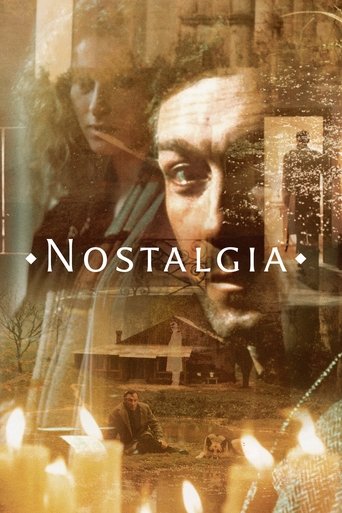
Nostalgia
Ностальгия
1983 · Film · 124 min
Directed by Andrei Tarkovsky
Russian poet Andrei Gorchakov journeys through Italy with his interpreter Eugenia to research the life of an 18th-century Russian composer who once lived abroad. Isolated and consumed by an unrelenting longing for his homeland, Andrei becomes drawn to Domenico, a radical mystic obsessed with spiritual redemption. Through austere imagery and extended temporal rhythms, Tarkovsky examines exile, memory, and the profound melancholy of being unable to belong fully to either place or language.
2 neutralfrom 2 commenters
Where to watch
No streaming data for this title.


2 comments on Hacker News
Excerpt [1] Tarkovsky's "Nostalgia"[2]:
‘What are you reading?’ Gorchakov asks, unexpectedly.
‘Tarkovsky ... Poems by Arseny Tarkovsky.’ Eugenia looks a little taken aback, as though caught red-handed.
‘In Russian?’
‘No, it’s a translation ... A pretty good one ...’
‘Chuck them out.’
‘What for? ... Actually, the person who translated them, he’s an amazing poet, in his own right ...’ she says, as though trying to justify herself.
‘Poetry can’t be translated ... Art in general is untranslatable ...’
[1] http://www.stanford.edu/dept/DLCL/cgi-bin/web/files/skakov_the_im-possible_translation_of_nostalgia.pdf
[2] http://www.imdb.com/title/tt0086022/
Tarkovsky is my favorite 20th century film director bar none. Here's are some reasons why and why you might also be interested in his films:
(1) He described his art as poetry applied to cinema or "sculpting in time," a fundamentally different conceptual idea of the cinematic art that he went to a great length to clarify (in a book of the same name, highly recommended).
(2) His use of color is incredible. Some films, especially stalker, are near black and white with incredibly vibrant and poignant uses of green. This is a bit like Bergman at his best, but even better.
(3) He was deeply religious in a "mystical" sense, with a lot of respect for past traditions, but not in a dogmatic sense and with appreciation for both Christian and pagan elements (see Andrei Rublev for both aspects)
(4) He knew other European traditions extremely well. Ivan's childhood is a meditation on the war with Germany, including shots of Duehrer's prints. Nostalgia involves his time in Italy traditions including Madonna cults and important artwork. Sacrifice has Shakespearean references, Rembrandt, Japanese samurai, and magical traditions. In general, his films are full of long shots of important pieces of Renaissance art with profound meaning.
(5) He spent a lot of time thinking about the integration of technology and the rest of life. Solaris is the futuristic spaceship version of this. Stalker is the apocalyptic version of this.
I think in a century Tarkovsky will rightly be credited as inventing a whole new type of cinema, his way of approaching it was fundamentally in tune with a "mystical" sense and integrated with other forms of visual art (i.e. the long gaze you have at a painting), and the punctuated, rhythmic reading of poetry.