 Hacker Cinema
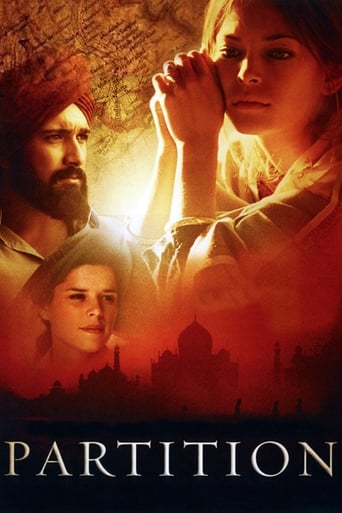
Partition
2007 · Film · 116 min
Directed by Vic Sarin
Determined to leave the ravages of war behind, 38 year old Gian Singh resigns from the British Indian Army to a quiet life. His world is soon thrown in turmoil, when he suddenly finds himself responsible for the life of a 17 year old girl, traumatized by the events that separated her from her family.
2 neutralfrom 2 commenters
Where to watch
No streaming data for this title.





2 comments on Hacker News
> I call it morbid because "not enough people died hence its a success" is a bad argument. What is your cutoff for the number of people to have died for it to have become a failure? How do you arrive at that cutoff?
The cutoff was not given by me. It was given by the nay-sayers including the Supreme Court of India. Who speculated "financial emergency" and "large-scale riots"? Was it people who supported demonetization or those who opposed?
> Yes a relatively smaller percentage than demonetization (but not small by any means). Furthermore, less people were affected by partition but the impact to those affected was much higher. In demonetization, more people were affected but the average impact to those affected was much lower. They might even be the same area under the curve in terms of suffering. But how do we quantify that? Simply saying that "less people were affected yet more people died during partition in contrast to demonetization where more people are affected but less people died" is an incomplete argument. More people are affected by the poor air quality of New Delhi but less people die because of it than the partition, does that mean that the air quality measures that the government has taken (banning unleaded fuel etc.) is a success?
But you are again trying to tie an economic move like demonetization with something inherently negative: pollution. How does pollution compare to the Partition or Demonetization? How does that analogy even make any sense? We are talking about "implementation" of "intent". I gave comparison of Partition because the Partition of India was an "intent" in the same way that the demonetization was an "intent". The "implementation" of the "intent" failed with Partition but not with demonetization. How do I quantify that? See the demonetization exercises carried out by 6 countries before India. It was bloody and ended in either coups d'état or large-scale riots. Both did not happen in India.
> Survivorship bias. You only hear of the ones that got caught. There are so many that got away scot-free.
You are in the realm of speculation here. It is for you to prove that "so many go away scot-free".
> Also, do you always believe or agree with what the Supreme court says or recommends? How do you feel about the mandatory standing for the national anthem before any movie? Should that be something that the state should enforce? Hitler made it mandatory for civilians to perform the Nazi salute towards him.
I agree with mandatory standing for National Anthem irrespective of whether it is before any movie or in any public place. Now you taking it to the other extreme of comparing standing for National Anthem to that of Nazi salute is completely uncalled for. Are you actually comparing Nazi ideology with upholding the Constitution of India? The Supreme Court only upheld the Articles of the Constitution. Read the order of the Court. This is not some Nazi diktat. Please widen your perspective.
> "Why is it "morbid"? Did you call out the OP for associating the death of a 100 people due to an economic move like demonetization morbid?"
I call it morbid because "not enough people died hence its a success" is a bad argument. What is your cutoff for the number of people to have died for it to have become a failure? How do you arrive at that cutoff?
> "The displacement of people during the Partition was of a small percentage of the entire populace. Yet it was not managed properly at all"
Yes a relatively smaller percentage than demonetization (but not small by any means). Furthermore, less people were affected by partition but the impact to those affected was much higher. In demonetization, more people were affected but the average impact to those affected was much lower. They might even be the same area under the curve in terms of suffering. But how do we quantify that? Simply saying that "less people were affected yet more people died during partition in contrast to demonetization where more people are affected but less people died" is an incomplete argument. More people are affected by the poor air quality of New Delhi but less people die because of it than the partition, does that mean that the air quality measures that the government has taken (banning unleaded fuel etc.) is a success?
> "And most of those converting their cash were caught and the rest are still being caught. Did you fail to read the news?"
Survivorship bias. You only hear of the ones that got caught. There are so many that got away scot-free.
Also, do you always believe or agree with what the Supreme court says or recommends? How do you feel about the mandatory standing for the national anthem before any movie? Should that be something that the state should enforce? Hitler made it mandatory for civilians to perform the Nazi salute towards him.