 Hacker Cinema
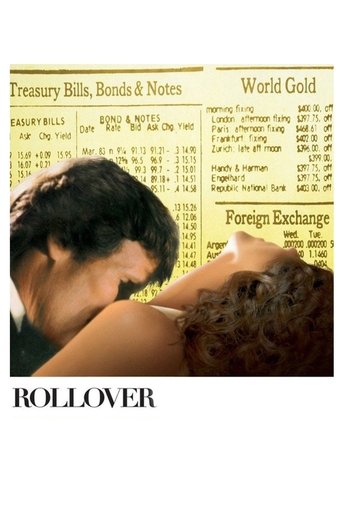
Rollover
1981 · Film · 116 min
Directed by Alan J. Pakula
The wife of a murdered petrochemical company chairman and a banker investigating the liquidity of his new bank stumble upon an international financial scheme that could lead to global economic collapse.
2 neutralfrom 2 commenters
Where to watch
No streaming data for this title.
Videos commenters linked
From YouTube links in the comments below. Most are clips and trailers; “Full” means the uploader says so.






2 comments on Hacker News
As an amateur, you have a lot of advantages over the "professionals".
You correctly mentioned being able to turn to smaller companies and low liquidity situations. Some professional players also self sabotage due to a particular mandate or ridiculous constraints, such as avoiding volatility. Having too much apparently useful information can also be a curse.
You can also choose to just "not play" sometimes. You don't have customers or bosses and you're only competing with yourself. Or rather, you're not competing at all. When things get confusing and very highly valued (as they have been for years now), you can just do nothing. Or at least do less.
Another advantage you have, which is related, is being able to have a very long term perspective. By which I mean a perspective measured in decades, which is the timescale at which the world and its financial conditions truly seem to change.
There's times like the late 70s/early 80s, where stock markets were not just ultra low, but pretty much COMATOSE. People just didn't do stocks. They remembered stocks as that thing from another age. At least in my country, the typical stock owners in that time were families whose patrimonium was tied up in 1 single company that they controlled. Needless to say, volume and liquidity was next to nothing. (By my understanding, conditions like these must have occured at least 4 times in the 20th century. Not yet in the 21st century, not even in 2000-2002 and 2007-2008, but it will.)
In a sort of Upside Down World mirror image of today, investors in the late 70s/early 80s were all about fearing stagflation, when the exact opposite was about to unfold due to central bankers receiving popular carte blanche for brutal anti-inflation shock therapy. They were quite literally lining up around the block to buy gold. Movies like "Rollover" were being made and Grandmaster Flash was rapping about double digit inflation.
Today it's all about "TINA" and low yields and the central banker put, while in reality central bankers are slowly moving back to taking orders from politicians and are walking on egg shells about a 0.1% hike because they suspect they have painted themselves in a corner. Back then some companies where almost literally hiding their profits ("pour vivre heureux, vivons caches") whereas today making a loss is almost something to be proud of.
That being said, even though these are very hard times for value investors, you can always keep searching. Like you say, it's a hobby, like going to flea markets. Personally, for the last few years, I've found interesting stuff going on in (certain) gold mines. No moat and a dependence on the price of a commodity most hated by Buffett. The general atmosphere there is depressing and it's definitely not a crowded place. There were 3 subsequent heavy tax loss selling years (2014, 2015 and 2016).
Yet the sector has been going through a very extensive cleaning period after the 2011-2016 nuclear winter and you can find (fairly) reliably profitable mid tier producers at very nice prices. They will still go up and down with the gold price, so you can't call them real value stocks. But the good ones can stay profitable even with lower prices and therefore do not go down as much as the others. So there is an obvious differentiation and a sizeable margin of safety, as big as it will ever be there. In that sense, they look like value plays to me. I'm comfortable being there.
In a more negative way, I've become interested in South Africa, an increasingly unstable country where 70-80% of the world's platinum and rhodium are currently being mined at massive losses. (Holding platinum and rhodium ETFs is commodities speculation rather than value stocks, but ok.)
Then you'd just create an incentive to sell the share in dark markets. You'd officially still be the owner of the share, but in secret you would have sold your voting right by agreeing with someone to vote on command in exchange for money.
As is said in the 1981 movie "rollover", capitalism is like a force of nature : you can try to fight it, but in the end it always win[1]
And even if somehow you succeed, you would have created capital that can not be bought nor sold, or can only be bought and sold from and to a particular category of investors. You would have introduced a bit of communism in the system (in the sense that in communism, buying or selling capital is forbidden). I guess some people will be happy about that, but I won't.
1. https://youtu.be/m1aQ-XGWors?t=151