 Hacker Cinema
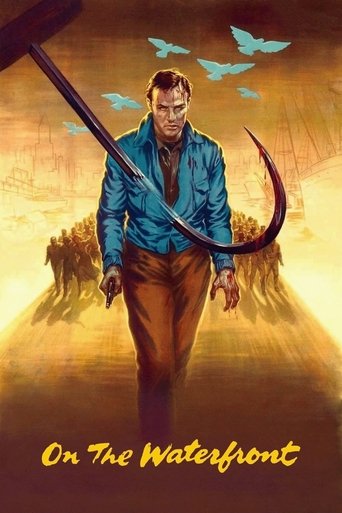
On the Waterfront
1954 · Film · 108 min
Directed by Elia Kazan
A prizefighter-turned-longshoreman with a conscience goes up against labor leaders to expose corruption, extortion, and murder among the union ranks.
6 positive1 negative1 mixed4 neutralfrom 12 commenters
Where to watch
No streaming data for this title.
14 comments on Hacker News
I don't know if that's true.
https://en.wikipedia.org/wiki/The_Wire_season_2
https://en.wikipedia.org/wiki/Boys_and_Girls_(The_Office)
https://en.wikipedia.org/wiki/Norma_Rae
https://en.wikipedia.org/wiki/Cesar_Chavez_(film)
https://en.wikipedia.org/wiki/On_the_Waterfront
https://en.wikipedia.org/wiki/Last_Exit_to_Brooklyn_(film)
But it's true the topic hasn't been en vogue for a while.
Don't forget the classic film On the Waterfront. Considered one of the greatest movies ever made and adapted from "Crime on the Waterfront," a 24-article series by the New York Sun's Malcolm Johnson that received the second prize ever awarded for Local Reporting, in 1949.
> In a vocation where loss of limb (and even life) was not uncommon, prospective workers — in a field disproportionately comprised of working-class African-Americans and whites of Italian and Irish descent who did not benefit from the upward mobility of the G.I. Bill — were forced to offer kickbacks to syndicate representatives at the daily "shape-up," in which prospective workers were forced to compete against each other to secure work irrespective of union membership. At any time, workers could be virtually blacklisted from subsequent employment for arbitrary purposes in the union's "blue books," their jobs often requisitioned by members of the syndicate who were completing prison sentences.
https://www.pulitzer.org/article/underworld-syndicate-malcolm-johnsons-waterfront-articles
I think, based on the anti-union talking points I see, the media is most responsible for anti-union sentiment, whether it's the normal corporate friendly mainstream media or classic films like On the Waterfront where union corruption is a side plot. Complimenting this are books, biopics, news stories, etc. of mythologized biographies portraying some business leaders as people who have pulled themselves up by their bootstraps, when they were really born into a privileged position (see: Gates, Musk, Zuck, etc.).
It is hard to overstate how much Godard changed cinema, even in America. If you don’t believe me check for yourself. Open the best picture nominees between 55’-65’ and watch their trailers. Films like Marty/On the waterfront/12 angry men/To kill a mockingbird/The Caine Mutiny/Sweet smell of success is what movies were like in the late 50s.
The acting/writing was pompous, actors talked like reciting Shakespear. The movies were about heros of impeccable character doing heroic things and there always was a happy ending. Movie shots followed strict guidelines and the creative head of the movie was the producer while the director was akin to a contractor, someone hired to film the scenes.
Starting in the mid 60s there was a radical shift, topping the nominations we have films like Five Easy Pieces, The French Connection, The Godfather, One Flew Over the Cuckoo’s Nest, The Deer Hunter, Dog Day Afternoon, Taxi Driver etc. Actors would act and behave like normal everyday people facing everyday problems. The new Archetype is the Anti-Hero, someone with flaws/vices in their character, someone that viewers can relate to. We see the rise of the director as the auteur, the creative master of a film. Every known filmaking rule is being tested to it’s limits and broken by young experimenting directors.
The catalyst for this change was the French New Wave, a group of young filmmakers tired of the old style of cinema wanting to do films about their own life and experiences. The poster boy for the New Wave was Jean-Luc Godard starting this revolution with his 1960 film Breathless.
Babette's Feast is also Danish, one of the most well-known and highly regarded Danish films of all time. The other 2 are Dreyer films—I've only seen Ordet so far, and I thought it was just amazing. Johannes is an unforgettable character.
It's a pretty great list, far as I can tell. Dersu Uzala (1975, not 1978) must be in my all-time top 5.[0] I loved Bicycle Thieves—The Bicycle Thief is a bad translation. Yes, it's important to the story!—but much preferred Umberto D. Liked On the Waterfront but vastly preferred A Face in the Crowd.
[0] It's my pet theory that Yoda in Star Wars is based on Dersu. There are many similarities. Seems very obvious to me but I've never heard or read anyone else mention the connection. The plot of the original Star Wars was after all based on that of another Kurosawa movie, Hidden Fortress. See e.g. https://www.bbc.com/culture/article/20160104-the-film-star-wars-stole-from
Seven Samurai is not an unambiguously better movie than On the Waterfront. I hate Elia Kazan as much as the next guy for what he did, but he was a historic talent directing historic talent, making snitching on the working man to the bosses seem positively heroic. Foreign things aren't always better.
Avatar and TDK historic points in film. AKA Dancing with Smurfs, and The Movie With More Plot Holes Than The Titanic. Hum, I beg to disagree.
Overall, I got a good laugh from the list. Seriously, this list should be called "things white US kids (of my age, granted) like". Rather than a history of cinema, it belongs more in the "comedy generated by computer" genre. Exhibit one: City Lights isn't there. Exhibit two: Modern Times isn't there. No Le Voyage dans la Lune, no Man With Camera, no Great Train Robbery, Rashomon isn't cool enough to make the list, Vertigo is too weird, and Battleship Potemkin is, like, too commie, you know. The final straws would be Independence Day and It's a Wonderful Life making the list.
I mean, On the Waterfront looks like it's very good (I haven't seen it), but, but, it was released in the same year than motherfucking Seven Samurai!
The writing is atrocious (even by Register standards) but it is a good example of pivotal technology integrations.
As a systems guy I like this story because it shows something which is often characteristic of successful disruptive systems, they get extra-ordinary gains from a modest tweak in the existing eco-system.
The eco-system at the point these were introduced was ships to trucks and trains, with burly long shoremen lifting and carrying things from point to point [1]. So the tweaks were this box, a crane to load/unload them, and a way to attach them to trains or trucks. Originally, and this is important, they simply used flat-bed rail cars or flat-bed trucks. The container was held down by straps. Also some of the original containers had gunnels where they could be hoisted with existing cargo cranes using inexpensive straps. So the 'one' benefit of containers (which got them into shipw) was that they stacked easily and could be secured. Building truck trailers and train cars that could take a container using its latching system came a bit later. But small evolutionary changes in the eco system and it got large jumps in efficiency (time to load, time to secure, etc etc).
If you are going to replace an out of date or inefficient system with a new one, you will do very well if you can change it from within. Nothing worse than a system which makes all the existing investment instantly worthless.
[1] "On the waterfront" is a movie which gives an interesting 'feel' to the way shipping worked back before containers. http://www.imdb.com/title/tt0047296/
I think you took a couple of my comments differently from what I meant. The Louvre has an admission fee which is absolutely trivial considering the treasurs within; it makes no sense to quibble over it, not matter what the money goes to. Likewise having to watch TV adverts or spend a few pounds to see a masterpiece like On The Waterfront, is not something worth complaining about. Secondly, the issue was not that big studios are willing to make bad movies, it's that currently they're also willing to make riskier, less formulaic movies too. That could easily change if movies had little shelf life for future profits.
And to answer your question, I'm perfectly okay with not owning Mickey Mouse. I find it hard to believe anyone would get genuinely concerned over that. (In fact if Disney did not aggressively market and control their intellectual property, probably nobody would even remember Mickey Mouse by now.)
The criticism of film copyright seems very short sighted to me. Are people that cheap that they resent paying a few bucks for a great movie? Copyright protection means producers can take much higher risks in the films they choose to make, because even if something has a bad run at the box office, it's still got decades of potential profitability ahead of it. Why should you get to watch On The Waterfront for free?
<b>but the films that make the most money are rarely bad. The highest grossing films of the last three years have been Avatar, The Dark Knight, and Toy Story 3</b>
Which, even if praised by whoring critics, are all quite bad , formulaic, shit.
They aren't gonna be near (random selection of quality stuff): Citizen Kane, On the Waterfront, Arsenic and Old Lace, Apocalypse Now, 2001: A Space Odyssey, Vertigo et al in any cinephiles list...
I think his point was that watching On the Waterfront was more educational than what is usually done in a public school social studies class. Based on my experience watching lots of movies in my high school history class, I agree.
"On the Waterfront"? Wild West? Watch the movie. Be less skeptical.
One of the reasons I remember Dr. Shultz's class so much was that he exposed us to so much culture in a sea of mass produced crap. We need more teachers like him now as much as ever.
What a fantastic page! I also went to Gateway High School for 6, er I mean, 3 of the best years of my life. I had no idea Paul Graham also went there. What a small world. I was several years ahead of Paul. I discovered his essays a few years ago, and here I am now.
I also had Dr. Schultz for a class called "World Cultures". We watched films like "On the Waterfront" and "High Noon" and discussed them afterward. I remember him vividly. I still have my film project (The History of Art to the tune of Magic Carpet Ride) from that class. I suppose I should have it digitized and loaded onto Youtube. One of these days.
I self published a parody of Mad Magazine about Gateway. Still have the comics about principal O'Toole, and the teachers who influenced me: Laura Barrett Mikesell, Laura Sproull, Ann Bitter, and, of course, Ann Kapisak (geometry) and John Drumm (calculus). Because of that magazine, Mrs. Mikesell strongly encouraged me toward a career in journalism. Fortunately for me, the English department at Allegheny College sucked and the math department excelled, so I've been a hacker ever since.
Funny how a few kind words from a teacher make such a difference for so many years.
Thanks for the memories, Paul. Any chance you're related to Mark Graham, who was our Student Government president? Feel free to contact me off-line edw519 at yahoo.com.
Ed Weissman, GHS '73