 Hacker Cinema
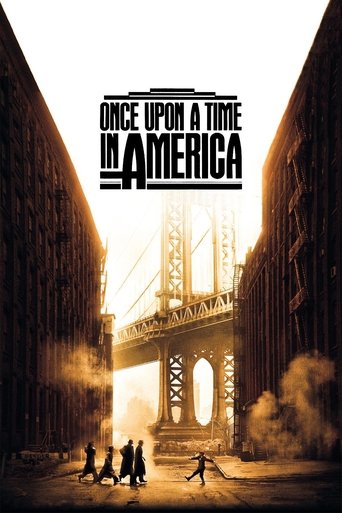
Once Upon a Time in America
1984 · Film · 139 min
Directed by Sergio Leone
A former Prohibition-era Jewish gangster returns to the Lower East Side of Manhattan over thirty years later, where he once again must confront the ghosts and regrets of his old life.
2 positive1 negative10 neutralfrom 13 commenters
Where to watch
No streaming data for this title.

13 comments on Hacker News
In every store demo people go to the TV with the most vibrant colors even if they're unrealistic. You can't even tell which is the color you're expected to see sometimes.
I have the movie "Once Upon a Time in America" in 2 different editions and the colors were remastered, they look very different between the 2 copies. If the source material is already like this, having super color fidelity in the panel is a paper checkmark but not super useful in practice. Maybe the 2000nits brightness in case I mount the TV in direct sunlight.
This will attract a few people who are very focused on these details, and a lot of people who are very focused on the spec sheet.
Hard disagree about declarative "X is Y". It's a failure of weakening attention span. There are plenty of excellent long movies:
- Once Upon a Time in America (1984) 3:49
- Lawrence of Arabia (1962) 3:47
- The Irishman (2019) 3:29
- Malcolm X (1992) 3:22
- The Godfather Part II (1974) 3:22
- The Lord of the Rings: The Return of the King (2003) 3:21
- Schindler's List (1992) 3:15
- Gandhi (1982) 3:11
- The Green Mile (1999) 3:09
- The Deer Hunter (1978) 3:03
- The Lord of the Rings: The Two Towers (2002) 2:59
- The Lord of the Rings: The Fellowship of the Ring (2001) 2:58
- Casino (1995) 2:58
- Braveheart (1995) 2:58
- The Godfather (1972) 2:55
- Django Unchained (2012) 2:45
What I most object to is lazy storytelling for lazy, second-screen audiences lacking in style and subtlety having a robotic, spoon-fed, infantile, unnatural, expository narration quality in every character like it's a commercial for an antacid.
Look at all those top non-American films on that list:
1. Once Upon a Time in America
2. One Flew Over the Cuckoo's Nest
3. The Great Dictator
4. Lord of the Rings
5. Chinatown
If there's one thing you can't associate Charlie Chaplin or Jack Nicholson with, it's Hollywood.
Number 9 on your list is famous non-Hollywood filmmaker Alfred Hitchcock.
It expired at midnight on amazon. on google tv I was able to watch it for free on Jan 1. I did a little more research on the film and related ones.
There's the first 3 movies, https://en.wikipedia.org/wiki/Dollars_Trilogy (A Fistful of Dollars (1964), For a Few Dollars More (1965), The Good, the Bad and the Ugly (1966)).
This movie was in the second trilogy, "once upon a time", Once Upon a Time in the west, Duck you Sucker, and Once Upon a Time in America. And from wikipedia there's a much better and longer original European cut that is 3 hours 49 mins instead of the 2 hours 19 minute cut. I can't figure out how to stream that.
The first line of your comment doesn't seem necessary to make your point.
There is a guideline that says "don't be snarky"[0] and I think it applies here.
Having produced a documentary (and being in the process of creating another one), I can't say that I agree with your view on purpose at all.
The purpose of either documentary or fiction movie is whatever the movie maker aims at. There is no reason for anyone to abide by your standard of "trying to get at the truth" when writing the scenario for Once Upon A Time in America, Jurassic Park, The Simpsons (the movie), or Bowling for Columbine.
I'd say most movies have an intent behind them. Further than that, we're art amateurs trying to interpret the meaning of abstract paintings in a gallery. Maybe the painter wanted to denunce the patriarchy. Or maybe they had food poisoning that day. Who knows.
[0]: https://news.ycombinator.com/newsguidelines.html
It's worth asking before anyone loses their mind about this, who made this change and why? Licensors like Criterion can't and don't "re-edit" (if you can call removing 4 seconds re-editing). Others can and do pretty frequently.
It's decisions about market fit by executives, not a moral crusade (as we have seen, Hollywood execs aren't really the type for that). Sometimes the whole film is affected, as in Blade Runner, Brazil, Once Upon a Time in America, or Kingdom of Heaven. Those movies were "butchered" (to use the language of the histrionic Forbes article). Yet in Leon (The Professional) the director supposedly intended the titular character to sleep with his underage protege. I'm glad someone overrode the sacred "artist's intent" there, and I wish someone had done the same for George Lucas's ill-advised Star Wars editions.
Here someone probably looks at a report and says, OK here are the movies in our pile with more than 20 slurs in them. Let's try to get that number below 10 so we don't have to add a "the language in this film represents the time in which it was made..." warning, that turns a lot of people off.
These decisions get made to maximize shareholder value, and the original film is not lost (except in the case of Star Wars), it's just one of a dozen variant cuts — you think they show the same exact movie everywhere in the world? Ever been to China? Believe it or not art is flexible and resilient. A film can survive a temporary blip while some VPs try to minimize complaints from sensitive viewers. If you disagree with those viewers that is another issue in my opinion.
I wish Kubrick had made the movie on Holocaust that he was planning, but changed his mind on watching Schindler's list. Similar thing happened with his Napoleon initiative.
I also wish he had created an epic crime drama like 'Once upon a time in America'.
For those who enjoy commentary tracks, the 4h11m Bluray doesn't contain the commentary by Richard Schickel (film historian and critic), however the 3h49m version does [1].
This is the proper theatrical release with an optional commentary track.
For the 4h11m version, the commentary was dropped due to a lack of space and also because the commentary doesn't cover the additional scenes.
[1] http://www.blu-ray.com/movies/Once-Upon-a-Time-in-America-Blu-ray/16190/
http://www.blu-ray.com/movies/Once-Upon-a-Time-in-America-Blu-ray/105558/
251 min running time
Once Upon A Time in America should have been a trilogy, it's yet another movie that was undone by its length and the time it was released. Blade Runner is another one that should have probably been spread over two or three movies.
Sometimes I wonder what film history would look like, if only movie directors, producers and distributors had accepted the serial format earlier. It took the success of Return of the Jedi to make it acceptable to spread a story over multiple features, and even then it was considered just a geek thing until Peter Jackson's Lord of the Rings saga. Now Marvel keeps scoring hit after hit with the biggest shared-continuity universe in the business, auteurs have embraced serialization with high-quality TV series, and it's only a matter of time before someone starts purposefully making non-genre continuity-linked trilogies.
> The possession of "extreme pornography", which includes scenes of simulated rape, is to be outlawed.
Can we expect films such as "I Spit On Your Grave" and "Once Upon a Time in America" to become illegal also?
Note: I have not seen Inception, and I plan to see it, so I am not reading your reply too closely. Nolan, on the basis of past work, is an excellent filmmaker, so I'm sure he isn't guilty of the things I talked about, certainly not blatantly. And I agree that you can't apply criticisms without properly understanding the concepts behind them, and the reason they work the way they do. I grew up in an artistic family. My mother was a theatre actress and director, and my father a songwriter and playwright, so I've been steeped in these mechanics in the practical sense, not just the academic, for a long time.
On the point about flashbacks, probably my favourite film, Once Upon A Time In America, is arguably formed out of flashbacks, or possibly even "flashforwards". The effect, especially after multiple viewings, is something like In Search Of Lost Time in they way it creates a sense of nostalgia, in its case for poorly made life choices, unrequited love, and more. So I certainly wouldn't make the accusation that flashbacks are in principle bad, or necessarily cheap, just often so, in average movies.
I am sick of happy endings.
From entertainment point of view, this is great news, as I believe this will let everyone to be a lot more creative. Unfortunately, studios have too much power and control, and not that many directors get the final cut on their movies. As a result, there are many unhappy artists, as their works are greatly influenced, and changed by those in power. Most studios have no respect for the art work and merely look at it as a business opportunity and will change the creative work to whatever that will potentially sell more and make them more money. Therefore, this transition could be the end of all those "Hollywood endings." (Blade Runner, Apocalypse Now, Once Upon a Time in America, American History X, are just a few examples).
I have to mention though that this problem will not be even completely solved with Mark's proposition either. Rebuilding Hollywood in Silicon Valley's image will have its disadvantaged too. I believe doing so will not build Hollywood as today's image of Silicon Valley but rather an image of the Valley in the mid 90's, and the dot-com era. (I am not suggesting there will be a bubble, but its possible, and I don't think it'll ever be as bad as the tech one, since the industry is already mature and the players are very experienced, so the chances of failure are a lot less.) But in terms of the structure of the companies and the process there will be similarities. As we have seen over and over, startups that end up doing whats to the best interest of the VCs (or at least what the VCs believe is to their best interest) instead of doing what the founders would like to do (there are thousands of these stories but my favorites are Jim Clark and Silicon Graphics, and to some extend Steve Jobs and Apple, which proves this could have happened to anyone at any level!). But as there will be a lot more producers compared to the few currently available studios there will be better chances to find investors that think like you, so there will still be improvements.
Hollywood 2.0 But this transition will be a lot faster. As the technology improves and all costs of production, marketing, distribution go down, eventually a lot less capital would be needed to put together a movie, which will lessen the power of the producers and set the creative minds free. (similar to what we are experiencing in Silicon Valley today!).
I can't wait to see three different versions of the same story and movie coming out during the same year. Or the redone of older movies with similar plots but different themes and endings. I can't wait to see the personal touch of many creative people that never had a chance to offer their talents before. And maybe one day in the future I'll be sharing movies with my friends that they have previously seen or know about, but can now see it with my touch on top of it, and from my point of view. Maybe one day critics instead of pointing out what they like or don't like, they can modify the movies themselves and offer their own versions to their viewers (I might be getting really ahead of myself but I get excited when I think like this.) And instead of movie guide you'll check digg.com to see what you should watch today.
But last time anything close to this happened (but not even close to the potentials here) some great talents came out of Hollywood. We saw movies like Easy Rider, and great directors like Scorsese, Coppola, Spielberg, Lucas changing the way we think about movies.
Side Notes: What I mention above does not apply to all categories of movies, as many of them (such as most of TV shows, and reality shows) can be produced today for very little capital. But for the feature length movies, and mostly those that are produced for theaters, you will still need a huge capital for production.