 Hacker Cinema
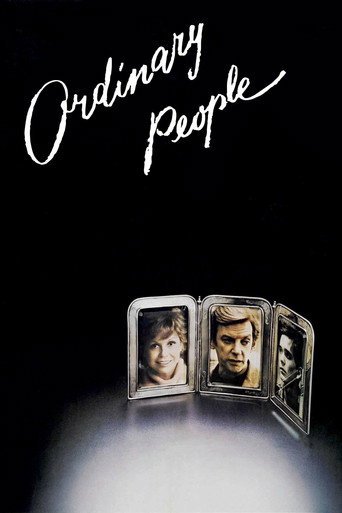
Ordinary People
1980 · Film · 124 min
Directed by Robert Redford
Beth, Calvin, and their son Conrad are living in the aftermath of the death of the other son. Conrad is overcome by grief and misplaced guilt to the extent of a suicide attempt. He is in therapy. Beth had always preferred his brother and is having difficulty being supportive to Conrad. Calvin is trapped between the two trying to hold the family together.
4 positive2 negative5 neutralfrom 11 commenters
Where to watch
No streaming data for this title.

11 comments on Hacker News
Ordinary People, Redford's directorial debut, is one of my favourite movies. A movie that deceptively appears simple but that is wonderfully emotionally deep with great performances from the entire cast. I must give it a rewatch.
"Ordinary People" is an incredible film, with top-notch performances by DS, Mary Tyler Moore, Judd Hirsch, and a young Timothy Sutton. Highly recommend.
RIP Donald Sutherland.
I was not impressed, and this is before I knew who the authors were.
I think it's worth examining, but only to see how right-wing cranks cosplay as scholars.
1) They keep using passive voice, like "Scholars say..." to introduce their critiques. One could be bad writing but multiple times is suspicious. WHICH SCHOLARS??? This is a sure sign of someone trying to obscure the motives and origin of their critique. The white nationalist author identifies himself as an independent scholar, which suggests strongly he really means far-right cranks like themselves.
2) The authors never clearly identify their target. Who are they attacking - popular representations of psychotherapy, or the validity of psychotherapy itself? They introduce the topic with culture war tropes, gesturing vaguely to what elites talk about at "cocktail parties" (what is this, the late 1960s?) and incredibly, the movie "Ordinary People" (1980!).
Anyway, they assert that there is a myth in popular culture and then tear down the most simplistic version of the argument - that therapists are superhuman engineers of the soul. Strawmanning heavily here, and presenting a false dilemma - one can only be self-reliant or only depend on therapy.
But so what. Popular culture gets a lot of things wrong.
3) In any case, by a somewhat crooked road, they proceed from there to some critiques of the effectiveness of psychotherapy, itself. And it's worth considering. All of social and medical science is undergoing a huge replication crisis.
They rely heavily on meta-studies. Unfortunately, those studies show the opposite of what they are claiming. So by various techniques, they try to mathematically weaken the conclusions of those meta-studies, coming up with surprisingly precise numbers about how wrong the studies are. (This, by itself, is already a hallmark of the right-wing crank.)
Is psychotherapy just great all the time? No. I've had my share of therapists that I'd consider pretty awful. But anecdotally I've found that the more academically qualified, the better the therapist is, and the closer they adhere to evidence-based therapies. If the Winegards' critique was true that the field is rotten, it should be the opposite.
I can't help contrasting these author's arguments with a book I happen to be reading right now, The Body Keeps The Score, by Bessel van der Kolk. This is a best seller which may have done more than any other book to inject concepts like trauma into contemporary consciousness.
I'm just in the first chapters, where van der Kolk works in a VA hospital where there are many divots in the wall, due to Vietnam veterans flipping out and punching it, often over trivial frustrations. These are conservative and military people, and they have tried hard to do what the Winegards prescribe - going to church, not dwelling on their past experiences - and they fail, because their trauma keeps reasserting itself. van der Kolk later sees some of the same signs in his civilian patients, and as a young intern assigned to monitor patients on the late shift, hears many confessions of abuse that are never repeated to the doctor in the morning.
The Winegards attack the concept of psychotherapy as if it's quack medicine for trivial ills, the kind you can shrug off with a little grit. And their critique remains at a safe distance from the problem, through their own vague perceptions of pop culture and browsing the internet for meta-studies.
If the Winegards could show some examples of people overcoming trauma by just manning up, praying or, suppressing things and getting on with it, then maybe I'd be interested. Or if they wanted to talk about the eroding of medicalized terms through popularization, like "trauma", I'd be at least partially on board. But they don't, and they won't.
Like all right-wing cranks, they aren't concerned with what you might assume; that is, the health of patients. they're concerned with knocking down "elites". You know you're dealing with a right-wing crank when they characterize their enemy as an elite that is both contemptibly weak and inexplicably strong. They offer no explanation as to how their enemy's cultural power was achieved and maintained. It certainly couldn't have been because it kind of works or because the need is great. It's always because of the masses being hypnotized by messages in the media - like, you know, Ordinary People (1980).
Beware this sort of thinking, because it leads to reactionary solutions.
The Oscars often don't agree with critics, either. I don't think anyone had Ordinary People, Dances with Wolves, Titanic, Shakespeare in Love, Crash, Green Book, even CODA at #1 on their year-end best of list. Best Picture is usually going to favor something that is at least serious enough that the voters don't feel like children for loving it, i.e. they're never going to award a tentpole or franchise entry, sci-fi, fantasy, horror genre-type stuff will only very rarely even be considered, but they're also going to favor relatively inoffensive, unchallenging, often feel good work that isn't particularly novel or ground-breaking, which is more what critics will lean toward. They also have a tendency to reward message movies and films about filmmaking and Hollywood itself, even if no one likes them.
It isn't that movies like The Deer Hunter are slow, necessarily. It's that the scenes are doing things other than advancing "the plot". Things like revealing a hidden character trait or depicting the quality of the protagonist's world. I remember someone telling me that The Zero Effect (1997) was "too slow", when I thought it was moving along at a fast clip; I finally realized it was the difference in what we were getting out of (or looking to get out of) the movie that accounted for our differing perceptions.
Not that that can't be done poorly, either. But The Deer Hunter never struck me as slow, and I'm a kid who grew up with Star Wars as my template. But I got really into what we might call (erroneously) "character-driven" movies in the '80s.
(Dammit, I liked Chariots of Fire, but there was no way it should have taken Best Picture over Reds. Same with Ordinary People and Raging Bull.)
It's funny, I think your Ordinary People vs Raging Bull comment excellently underscores the original article.
Raging Bull is a cinematic masterpiece. As "art as art" it is sublime. It is a love letter to film.
Ordinary People is an emotional masterpiece. As "art as therapy" it is sublime. It is a love letter to humanity.
When people "steal" from Raging Bull it's fairly obvious and usually surface level.
Plenty of people stole from Ordinary People, too, it's just harder to spot because what they stole is more psychological and subtextual.
Just as a simple example, the most iconic televison show of the last 30 years (The Simpsons) cribbed way more from Ordinary People than Raging Bull.
If you look, it's easy to spot the influence throughout the series' run. But there's no single iconic shot like their Raging Bull slo-mo homage in "The Homer They Fall."
What does it even mean, to remember, to steal, art...?
Having seen both, Ordinary People is definitely the better movie.
Goodfellas vs Dances With Wolves: A tie. Sorry, there really are people who really liked Dances With Wolves. I myself saw it again after over 20 years recently, and it's still great in my older age. Most of the criticism I've seen of it is flawed. From an artistic standpoint, it beats Goodfellas hands down - but Goodfellas is much more entertaining.
Looks to be a different source from the OP, but let's go down the chart for 1980 past the top ten:
https://www.boxofficemojo.com/year/1980/
Kramer vs. Kramer (book)
Ordinary People (book)
Popeye (comic)
The Shining (book)
Cheech and Chong's Next Movie (sequel)
Caddyshack (original - franchise starter)
Friday the 13th (original - franchise starter)
Brubaker (book)
The Jazz Singer (remake)
Flash Gordon (sequel/remake)
Bronco Billy (original)
Raging Bull (book - biopic)
Maybe you should go back a few decades until you can find a time when the top 20 were mostly originals. Would have to be before the Star Wars/Jaws blockbuster era, probably.
You'd laugh at me, but I am still using a LiveJournal clone - Dreamwidth. This pre-social network is quite comfortable to be in. It is, so-to say, non-invasive. You'd never see a post from someone you didn't subscribe to. There are no ads. No mental viruses to pick-up. Just what a social media is meant to be for ordinary people to keep in touch with some friends. And of course there is no mobile client to ring a dozen times a hour. I just read my friends list when it is comfortable for me.
And I visit my facebook account weekly, via desktop browser, only to see what's up with my friends hanging up there.
I very seldom do likes, as I know that my likes could show up in my friends' feeds. There are NO notifications from social network or media on my phone. I call it "information hygiene".
And yes, like others mentioned, I've got A LOT of spare time for books, hobbies, movies etc.
Think you mean red-blooded.
"Ordinary People" is a blue-blooded American Hollywood film.
IMDB reports that 2322 movies were released in 1939 alone, is it really surprising that there were a handful of good movies among them?
1980 for comparision, IMDB lists 6007 movies (8000+ if you include TV movies), and contains modern (popular) classics such as Stir Crazy, Superman II, Empire Strikes Back, Airplane!, The Blue Lagoon, Ordinary People, Urban Cowboy. The Shining, Caddyshack, Raging Bull, Friday The 13th, The Fog, The Blues Brothers.
Hmm, looks like 1980 was a much more 'classic' era than the 40s for hollywood, but you wouldn't have heard that from film buffs in the 80s.
Hollywood has always been a great abuser of the 'sling lots of shit at the wall and see what sticks' approach to 'greatness', they're just slinging a lot more shit these days.
Even if we take a really contemporary year and do the same study, we see a pattern of greats no matter what year, take 2005 at random:
Batman Begins, Sin City, V for Vendetta, Revenge of the Sith, King Kong, Brokeback Mountain, Harry Potter/Goblet of Fire, Serenity, Charlie and the Chocolate Factory, Mr & Mrs Smith, Wedding Crashers, Munich, Saw 2, Hostel, Hitchhiker's Guide to the Galaxy, Madagascar, Pride & Prejudice, Land of the Dead.
Ah, but the movie buff will point out that they're not established classics like Gone with the Wind, or Wizard of Oz. Not yet, anyway.
Edit: Btw, for 2005, the number of movies was 28,000+. Is it any wonder that there is a lot of formulaic stuff in there as well?