 Hacker Cinema
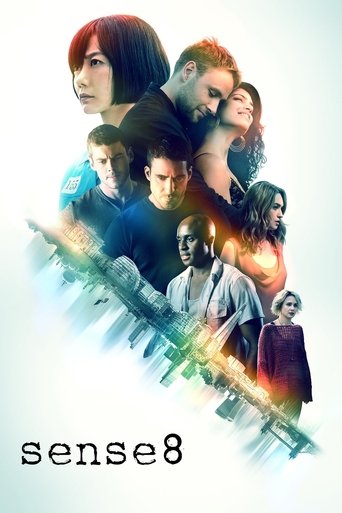
Sense8
2015 · TV series · 2 seasons
Created by Lana Wachowski, Lilly Wachowski, J. Michael Straczynski
One gunshot, one death, one moment out of time that irrevocably links eight minds in disparate parts of the world, putting them in each other's lives, each other's secrets, and in terrible danger. Ordinary people suddenly reborn as "Sensates."
8 positive7 negative8 neutralfrom 23 commenters
Where to watch
No streaming data for this title.




24 comments on Hacker News
This is mostly an issue for content produced to still be on regular tv and streaming, like on Paramount. Star Trek Discovery and Strange New Worlds, for example, are not as dramatic as described above but you can always spot where the adbreak would have been. Cut to black and a re-establishing shot at the least. These are modern shows like you describe but still the TV medium has some influence.
One thing I do notice more and appreciate from streaming (sense8 in particular) is that shows are more varied in their runtime. Episodes being 40 minutes to 75 in length just depending on the needs of the plot, not even finale related or anything
>a sludge of random ravings beating around the bush of expected outcome
I thought this exact thing while trying to read it. "Is he a coward and can't just state his thoughts? They don't seem so assblasting genius he needs so many pages to get there."
I'm from Brazil and most of our classic literature boils down to a cranky rich old man complaining a lot and strawmanning the kinds of people he doesn't like.
If he's a leftist it'd be rich people, if he's conservative it's the degenerate decadent youths.
>Professional critics and their opinions is the worst thing that could've happen to art (edit: in modern times, to be fair I've no idea about the past and its nuances). People like Tarantino killed some of that pompous nonsense, but world is super inertial (and critics had simply adjusted) so we're still there, with "high" and "lowly" arts.
I didn't know it was because of professional critics. A lot of people seem to repeat the same judgement so I just assumed it were organic popular opinions.
I don't know how others engage with books though. With a lot of "real serious" prosaic author's I'll just have no idea what they're exactly describing so I'll just imagine my own version of it. Whenever the language gets too obtuse I literally cannot get everything the author is talking about.
It's weird for instance that there was even a serious critic's discussion about videogames being art.
"But it's interactive"
living is interactive, our train of thought while reading a book is interactive, our train of thought while watching a movie is interactive, our interpretation of anything in a museum displaying contemporary art is very interactive. You'll see two sticks and a bucket and the artist will claim that's his wife.
Why are some mediums (books, sculptures) given much more inherent credit than videogames or movies or hacker news comments? Isn't it all just the meme of prestige?
I feel most comments here, certainly yours, have more thought and ideas behind them in a shorter format than a lot of important books.
Why is the behaviour of analyzing art, for all it's endless self deconstructions, still limited by the museum space or the book/movie/game format and more importantly it's social expectation to do so?
There's a quote from a Netflix series called Sense8 that I love:
"Art is like religion. For the believers, it's everything. For anyone else, it's just a pile of bullshit".
I think if Netflix changed it’s policy of just canceling series to giving them an ending, people would be less pissed.
The ending could just be a limited episode conclusion similar how to they ended sense8.
I think Netflix killed themselves with the focus group. Mostly mediocrity designed to appeal to a large audience, but satisfying no one.
And don't get me started on the "normalisation" of groups X Y and Z, or the diverse stuff.
Sense8 is a decent example. Had everything including out-of-body mind linked group orgies with every available sexual orientation. Lol! And it was entertaining,
But guess what? Wasn't really that great. Haven't bothered watching season 2 or 3 and probably won't.
Yeah, that's my impression too. It's unbelievable that there was right amount of everything in The Matrix.
Cloud Atlas, Sense8, and other movies Lana made after The Matrix just feel a bit cringy and off most of the time.
I was really impressed with Terrence Mann's eye brow makeup (eye brow wigs, probably?) that were a really understated "special effect" to make Brother Dusk feel so related to Lee Pace. It took me episodes to realize that that must have been the one weird trick, but once I'd realized it seemed kind of obvious. His eyebrows look nothing like that in real life or other films/shows. (He was the bad guy in Sense8!)
> The series was great at times and then completely flat for long strips in-between.
Yeah, I'm still not entirely sure why they paced some of the show the way they did. That said they did cover several hundred years, so weird pacing was pretty much the nature/challenge the books gave them to try to adapt to.
It's possibly the sign of a good show that most people I've talked to disagree on which exactly were the flat bits. I love a good, long fly through shot of space scenery and/or "cool planets". I know lots of people that disagree. I thought there weren't enough scenes of Terminus "in action" doing what it was supposed to be (collecting/writing the Encyclopedia Galactica; which I don't think was even properly named anywhere in the first season?). The very few scenes they did include I know dragged for some people, because there is only so much most people can take of arguments about what to include in an Encyclopedia, but I wanted way more of such scenes because instead of showing them the show just kept instead telling you that Terminus was a planet of scientists and knowledge workers and needed protecting rather than showing you what Terminus' part of the plan was and what they were supposed to be doing, and why that was a great work driving them as a community.
Relatedly, I know a lot of people that loved the strange religious in-fighting and monologuing of that "The Mother" religion, and the Emperor trying to take advantage of it to delay the Fall (and likely making the Fall worse in the process) and oof did that drag for me. None of that stuff comes directly from the books. (Isaac Asimov was an atheist for much of his life and waxing poetic about a made up religion even just for worldbuilding purposes was outside of his wheelhouse/comfort zone and he knew it. Given some of showrunner Goyer's other stuff, I think such long monologues are also outside of his wheelhouse, but yet he doesn't seem to know or acknowledge it and just keeps writing them, but that's just my hot take.) Isaac Asimov did invent a fake religion for the books, but (spoilers for stuff to come) more in the way of the Foundation itself using religion as a coarse, gross controlling tool.
You’ll be pleased to know, then, that JMS is showrunner and actively writing the pilot:
> “You cannot step in the same river twice, for the river has changed, and you have changed.” In the years since B5, I’ve done a ton of other TV shows and movies, adding an equal number of tools to my toolbox, all of which I can bring to bear on one singular question: if I were creating Babylon 5 today, for the first time, knowing what I now know as a writer, what would it look like? How would it use all the storytelling tools and technological resources available in 2021 that were not on hand then?
https://twitter.com/straczynski/status/1442621159221043202?s=21
If you haven’t seen his recent work Sense8, I highly recommend it (though practically all content warnings apply in spades). It’s a show about many things, but most relevant to potential success on the CW, it’s a show about young adults from different walks of life coming together to do heroic things and understand themselves through empathy with others. If anyone can find the balance that Babylon 5 deserves, and find a way to make it maximally relevant in a time we need to hear stories of heroic empathy, it’s JMS with everything he’s learned. I’m incredibly stoked.
I looked through this list and at least Lucifer and Sense8 I felt they completed the story they wanted to tell. Especially with Lucifer I don’t think they can extend the series longer with keeping the style but without making ridiciloud new additions to not make it boring and repetetive.
Films don’t go on forever, neither do series. I don’t think putting finished series together with outright cancelled series is fair, and thus I have no idea what all the other items in the list mean.
Although it’s been a total of three years since the final episode of Sense8 aired on Netflix. But the fandom behind the show still lives on. Everything of this is documented there by British book-based academics Deborah Shaw and Rob Stone. The book will be called Sense8: Transcending Television and is going to be released in June 2021.
Babylon 5 is also a useful oddball because so much of its plan versus reality was documented on USENET or in interviews as they happened. As they say "no plan survives contact with the enemy" and in this case the enemies of any 5 year TV plan are numerous, and included among other things network notes, network switches, cast contract negotiation problems, cast health problems, and more. JMS made it very clear he had to have a ton of contingencies in his five year plan and the show had to carry out a number of them.
It's also an oddball because even JMS hasn't been able to replicate it with nearly the same degree of success. B5 follow-up Crusade was pitched with a 3-5 year plan and barely survived a half season. (Supposedly B5: Legend of the Rangers was pitched as a 5 year plan including cleaning up Crusade plot-lines at least "sideways" and that barely got a pilot movie.) Sense8 was pitched to Netflix (appropriate to consider for this overall thread) as a 5 year plan and got 2 seasons and wrap-up movie (though seemingly had a lot fewer contingency problems than B5's early seasons in the 2 seasons and a movie that it did get).
This goes both ways. Writers clearly set things up that way in the hope this will put pressure for more episodes, but cliffhangers are just really bad writing done against rather than for the plot. Hopefully cliffhangers die thanks to streaming and the risk of non-renewal!
That said, I like how Netflix handled sense8. The plot was clearly getting more and more absurd and season 2 had a massive cliffhanger for season 3. Then it was cancelled - but still they produced a final somewhat absurd but satisfying movie-length final episode that tied all lose ends. That was probably a contract term and not perfect, but it worked out better than a third season or no end at all.
I have to concur with this 100%, most true crime shows from Netflix have felt padded, something where I feel like if the podcast Criminal can make an enthralling episode about an event, the TV versions should be adding a lot more for the 10 hour version. In fact, the only "true crime" series I can think of actually completing is American Vandal, which was not only engaging but laugh out loud hilarious as it mocked itself. I'm truly curious to see if they can capture it in a season 2 without it being a repeat of the same. Of course, there could be some personal taste and behavioral patterns that endear the audible versions of that format more compelling (I usually listen to podcasts during times when I'm not able to be distracted with a phone, articles and texts, such as when I'm driving, yard work, or walking the dog). It could just be that the format for TV relies far more on imagery and visual cues when produced for the screen. I do know that I really haven't seen a real true crime TV series keep me engaged beyond an episode or three, which probably just means I fall out of a different "taste cluster", but there are just some shows that can use visual imagery to enhance a non-fictional topic (Vox's Explained comes to mind here). Unless there is a lot of in-depth information, and a way to make it salient to the story, it's hard for me to value the time commitment.
Likewise, even fictional shows with short seasons can feel tedious at times, which for me, many happen to be British shows, though not all (I enjoyed Safe, but got really bored during Collateral and The Fall, both of which I've heard great things, but much of the storylines just ended up feeling as if scenes were there to "enhance the tension", but served some other purpose). Again maybe super personal and cultural, but I do love long format television, just please give me a reason to keep caring about the outcome without having to wind down some plot rabbit hole).
I might just be impatient and a typical American who is affixed with getting "a hook" somewhere in the first 3 episodes, or I'm probably going to give something else a try. And there are quite a few really good foreign series that I enjoyed, (such as The Rain and 3%) and then some domestic and international shows that put me in the same taste cluster as shows like Dark, The OA and Sense8 that really just never connect. I'm not sure if that's a padding issue per se, but I guess anything that you're not really getting into just feels tedious after a while.
I hope this isn't considered devolving the thread but that episode of Radiolab mentioned above certainly made it seem, to me, the issue was about censoring movie makers.
If you're on the left you more likely than not like Michael Moore movies. They are often very political. Should they be banned? That was the topic that came up in Radiolab.
Citizens United, inspired by Michael Moore's movies, decided they wanted to do the same thing. Someone decided Citizens United didn't have the same rights to release movies with a political message as Michael Moore and the studios that funded and distributed his movies. The Supreme Court I think saw the problem. Where does it end? Is Transformers political speech? Is Sense8 political speech? Is Milk?
I don't know how to solve the issue of getting money out of politics but I can at least see the argument that deciding which movies are political and which are not is not as easy as it sounds. Maybe Michael Moore's movie should have been prevented from release within N months before the election? I think that was the actual law used to prevent Citizen's United's movie coming out even though Moore's came out within the same type of time frame before an election.
Actually I suspect that this is what it's changed. It's likely that Netflix has abandoned the long tail. They are now focusing on shows that have immediate, short term mass appeal.
Previously Netflix was able to invest in "quirky" shows that had strong appeal to a small percentage of its user base. The classic examples here are indeed Sense8 and Marco Polo. These shows were not blockbusters but they had a strong and loyal following and that should be highly valued by Netflix. Particularly when it comes to original content and as a subscription service, Netflix should be primarily focused on loyalty above all. These are the shows that keep viewers subscribed and make unsubscribing painful.
But the economics here quickly become complicated as the culture evolves. In a world where (a) many (most?) people are already have a Netflix account (b) there are now many competing streaming services each of which have their own exclusives and (c) the concept of "television" itself is gone, now you just have "screens" all over the place and (d) there is an explosion (probably bubble[1]) of original content and amateur content and (d) there is an arms race for talent driving up salaries across the board... the end result is that Netflix is now engaged in a month-by-month war not just to defend the many subscribers it has accumulated but also to take (and retake) subscribers who may have been drawn away to other competing steaming services that have access to historic brands. Netflix no longer has the luxury of gradually building a large, deep catalog that appeals to small segments of the market. It must offer everything, or at least something extremely compelling, to all users, every month, or those users will churn and be drawn away by competitors.
Netflix is likely moving towards the blockbuster model. In this light it starts to make sense why Netflix is dumping hundreds of millions on feature films and also focusing on big shows that can command huge audiences. The blockbuster model is driven by a series of big events carefully scheduled throughout the year to get users to show up in large droves when you need them for something they don't really need. Competitors are doing the same. The streaming business meets the blockbuster model and now you've got to produce a blockbuster every month to keep people coming back.
Sense8 got axed because it was a $1 million niche show. The same reason they passed on The Expanse. at $700k an episode. They are both wonderful television, but the masses want Survival so that's the garbage we get. At least Netflix and HBO still show actual TV.
If these count, I enjoyed:
- The Expanse (season 2)
- Sense8 (season 2)
- Alien Covenant
Watched Sense8 (over here in Germany) for the last couple of days on NF. Every episode has a disclaimer at the beginning „This show contains product placements“.
From first view: Ben & Jerrys, Pepsi (?), Sennheiser
If you want to see slow paced, Sense8 takes the biscuit. I count about 10 minutes of actual plot over the entire season, primarily concentrated in the first and last episodes. It's obviously meant to be a character-driven story, but each of the characters is a two-dimensional stereotype.
TLDR; I don't think religion is the reason for Matt Murdock's not having serious relationship.
Your main point seems to be lack of explicit sexual content on DareDevil. You are tying that with Matt Murdock's (loose) Christian faith. I feel somewhat differently about DareDevil and it's story line.
[1] In season 2, Matt had relationship with Electra and they _do_ have sex in the boxing gym. Creators of the show did not show it _very_ explicitly.
[2] Matt's discussions with Father Lantom in the Church is more spiritual rather than religious, IMO. They discuss about morals, right/wrong etc. Notice that Lantom always uses "God" and not "Jesus" (AFAIR). I don't think anything Father Lantom says is picked out of Bible or looks like preaching. Just his observations on life. I am a Hindu and I totally related to what he was saying. Never felt he was preaching or giving sermons. I feel, you can rename Matt to something else and put a Temple of Mosque there and still all that Father Lantom says will be appropriate (story line wise).
[3] Matt is very clear in his priorities. Given his "other life", he simply cannot afford to have a serious relationship. He states it at some point with Claire Temple (Rosario Dawson). His will "weakens" in season 2 and begins relationship with Karen Page before Electra comes in and sours it. With all this background, and no serious relationships between other characters, having an explicit sexual scene seems contrived and needless.
[4] The original content from Netflix in the Drama section has about 10 series. I watched 4 of them to a certain lengths. The amount of explicit content, particularly sexual content, is too much for me. Many times I feel there is absolutely no need for it (especially with Marco and Sense8). In that light, I feel DareDevil is much better for me.
Sorry, my comment is too long than I intended. And it digressed from OP and more on DD's story line.
This might not quite be what you're looking for but the Netflix aeries "Sense8" had very similar concepts of humanity and identity.
The movies "Revolver" and "MR Nobody" might also be up you alley.
I really liked the book "Seveneves". It is definitely near future. Think "The Martian" style hyper realistic SciFi in space. It's decided into 3 parts. The first two are incredible, though I think the author let himself go in the 3rd. Still a wonderful book though.
If this is indeed forced by content creators, I think it is counter productive. They will just give more incentive to Netflix (and Amazon and others) to create they own content, as third part content lose them money.
Perssonal view: the "Original Netflix Content" sign already give me a more value perception. Between a recycled TV show and a new one by Netflix, I always chose the new on by Netflix. So far I watched all of: Daredevil, Jessica Jones, Making a Murderer, House of Cards, Narcos, Sense8, Bloodline, Orange is the new black, Master of None, Better Call Saul.
And I'll probably keep watching the next seasons of all of them.
Outside of Netflix, I only follow the very best ones (IMO): Game of Thrones, Breaking Bad (that's over) and Walking Dead.
What this means? I consume only the very best hits that these other content creators produce. For casual, day-to-day entertainment, that covers 90% of the time, I stay with Netflix.
"For one monthly price, members around the world will be able to enjoy Netflix original series including Marvel’s Daredevil and Marvel’s Jessica Jones, Narcos, Sense8, Grace and Frankie, and Marco Polo, as well as a catalog of licensed TV shows and movies. In 2016, the company plans to release 31 new and returning original series, two dozen original feature films and documentaries, a wide range of stand-up comedy specials and 30 original kids series -- available at the same time to members everywhere."
This implies to me that their original content is globally available, while licensed content will still be regionally restricted (and I don't see a way they could do anything else). Unless I'm missing something in the announcement?
> I'm not sure I can get past the Sense8 insult.
A fellow whose entertainment tastes lie really close to mine found Sense8 unwatchable. Based on the couple of recommendations in this thread, I might give a couple of episodes a watch, but there are TERRIBLE shows that people -for whatever reason- think are GREAT.
tl;dr: Taste is subjective, and terrible entertainment gets mocked? :)
Edit: Just read the article and I have to ask: "What Sense8 insult?"
Not long ago I found a quiz which purported to measure how much of a "millenial" the test taker was, ultimately it boiled down to three main characteristics of "millenials", one of which was whether or not they watch TV. Younger people just don't watch TV conventionally much any longer. They may watch TV shows, but they do so using computing devices and the internet, not cable or broadcasts. The internet will only get better for that, and people will increasingly be abandoning conventional TV service.
More so when you consider that more and more of the highest quality and most popular video content has shifted away from the traditional model of regularly aired shows and schedule based content consumption to more plot driven content that is designed more for on-demand viewing. The shows people are watching the most and talking about the most are increasingly of the type that have fewer episodes per "season" and are more story driven. And many of the most popular shows today are only available online (House of Cards, Daredevil, House of Cards, Narcos, Sense8, etc.)
A lot of teens and younger folks aren't even watching traditional television style content. They're watching "streamers" and other video content on youtube. As they get older they may start watching more episodic content but I doubt they'll magically morph into traditional couch potatoes. That era is, I think, firmly in the past.