 Hacker Cinema
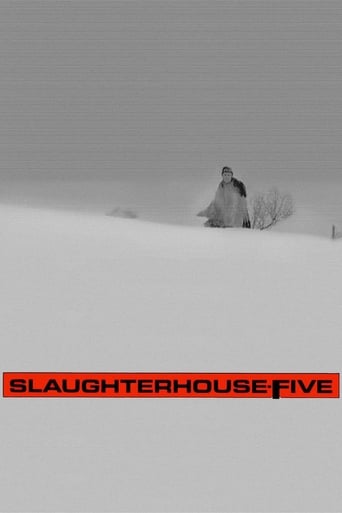
Slaughterhouse-Five
1972 · Film · 100 min
Directed by George Roy Hill
Billy Pilgrim, a veteran of the Second World War, finds himself mysteriously detached from time, so that he is able to travel, without being able to help it, from the days of his childhood to those of his peculiar life on a distant planet called Tralfamadore, passing through his bitter experience as a prisoner of war in the German city of Dresden, over which looms the inevitable shadow of an unspeakable tragedy.
2 positive1 negative3 neutralfrom 6 commenters
Where to watch
No streaming data for this title.


6 comments on Hacker News
>"Banned" in this case means that the usual person or people who choose what books to include are being overridden by a party with more clout.
I believe that the party with the most clout is the one that controls the frame. So yes, some parents may keep Slaughterhouse Five out of libraries. Meanwhile those same parents become strawmanned villains in mainstream movies like Footloose. So I don't think pulling a book is that effective when it winds up on a "you can't read this" list.
Fun read. Haha I also love the idea of being a mathematical braid. Arrival is a great film, but my favorite fictional take on this kind of thinking is still Slaughterhouse-Five.
Listen: Billy Pilgrim has come unstuck in time.
Both Kurt Vonnegut and Neal Stephenson seek to plumb the intersection between technology and religion, between science and popular culture - but where Vonnegut adheres to the literary traditions of the Western Satirical Canon, Stephenson choose to plough a far more meta-referential narrative path that is weighted by all the detrimental issues associated with Young Adult fiction without representing any of the strengths of the genre.
This is fairly understandable when you look at their respective backgrounds. Vonnegut was a Combat Infantry veteran, earning a Purple Heart in World War 2. He was interned in Dresden, where he survived the Allied bombing of the city in a meat locker of the slaughterhouse where he was imprisoned - emerging to find an alien landscape not unlike the moon. This was, in fact, the eponymous 'Slaughterhouse Five' from which his magnum opus takes its name.
His use of satire, gallows humour and science fiction was rooted in the tradition of the golden era of Science Fiction - namely, the use of these literary devices to try and make sense of a seemingly uncaring and alien world and society that was changing with unprecedented rapidity.
You see Joseph Heller doing very similar in 'Catch 22' when utilising similar narrative devices like non-chronological timelines, omniscient 3rd person narrators, and satirical paradoxes to describe and to try and make sense of his own brutal and often paradoxical experiences serving in the Korean War.
Stephenson, in contrast, is mired in the self-referential and meta posturing of late 80s American University culture - as befitted his first and possibly most insightful book 'The Big U' - a scathing indictment of the homogenisation of the American University system as it geared towards research over pure academia.
The book he is most lauded for - Snow Crash - is in many ways a poor facsimile of Gibson's Neuromancer. Even the title, which Stephenson contends was a result of his computer crashing with a malformed bitmap that '...looked vaguely like static on a broken television set—a 'snow crash...' is lifted conceptually from the opening pages of Neuromancer - "The sky above the port was the color of television, tuned to a dead channel.".
The plotting characterisation and story beats when not directly lifted from Neuromancer, are reinterpreted chunks of Philip K Dicks 'A Scanner Darkly' and the 'The Three Stigmata of Palmer Eldritch' respectively, and what little innovation he brings to the world building is mired in a comic book aesthetic, versus the film noir salience of Neuromancer.
Many would content that this is the point - that Stephenson is playing with the tropes of the Cyberpunk genre. Unfortunately this doesn't explain away his stylistic choice (or sheer lack of ability) to avoid huge explanatory passages that destroy any semblance of pacing or advancing a narrative midway through the book. This, in many ways, is indicative of the 'tell, don't show' fumbling of Cory Doctorow in the way he punches down to his predominantly YA audience.
Thanks for boosting this book parent. I didn't read it in 2022, but it's my favorite Vonnegut book.
(Slaughterhouse Five is overrated, most folks just saw the movie and the same folks who listed it on their profiles back during the G20 used to yell at me for listing "Post Office" because apparently Bukowski is problematic -- like, Jesus lady I know, that's why I didn't list Women or Factotum... then they'd cry me a (usually figurative) river when I'd shoot back why do you claim to stan Emma Goldman if you won't date someone who owns a firearm since it's not propaganda of the deed if you get your ass tackled like Squeaky Fromm, and why don't you list literally any Nabokov novel than "Lolita" as your favorite piece of Russian literature?)
Second vote for Slaughterhouse Five - the "war backwards" section of the book, to me, is one of the most beautiful passages in any novel I have ever read.
http://www.goodreads.com/quotes/279125-it-was-a-movie-about-american-bombers-in-world-war
This reminds me a lot of one of my favorite parts in any book:
It was a movie about American bombers in the Second World War and the gallant men who flew them. Seen backwards by Billy, the story went like this: American planes, full of holes and wounded men and corpses took off backwards from an airfield in England. Over France a few German fighter planes flew at them backwards, sucked bullets and shell fragments from some of the planes and crewmen. They did the same for wrecked American bombers on the ground, and those planes flew up backwards to join the formation.
The formation flew backwards over a German city that was in flames. The bombers opened their bomb bay doors, exerted a miraculous magnetism which shrunk the fires, gathered them into cylindrical steel containers, and lifted the containers into the bellies of the planes. The containers were stored neatly in racks. The Germans below had miraculous devices of their own, which were long steel tubes. They used them to suck more fragments from the crewmen and planes. But there were still a few wounded Americans, though, and some of the bombers were in bad repair. Over France, though, German fighters came up again, made everything and everybody good as new. When the bombers got back to their base, the steel cylinders were taken from the racks and shipped back to the United States of America, where factories were operating night and day, dismantling the cylinders, separating the dangerous contents into minerals. Touchingly, it was mainly women who did this work. The minerals were then shipped to specialists in remote areas. It was their business to put them into the ground, to hide them cleverly so they would never hurt anybody ever again.
The American fliers turned in their uniforms, became high school kids. And Hitler turned into a baby, Billy Pilgrim supposed. That wasn't in the movie. Billy was extrapolating. Everybody turned into a baby, and all humanity, without exception, conspired biologically to produce two perfect people named Adam and Eve, he supposed.
(Slaughterhouse Five by Kurt Vonnegut)