 Hacker Cinema
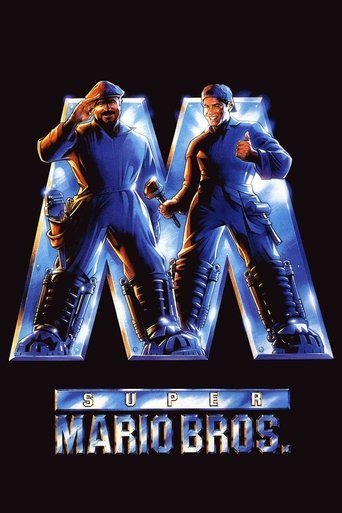
Super Mario Bros.
1993 · Film · 105 min
Directed by Annabel Jankel, Rocky Morton
Mario and Luigi, plumbers from Brooklyn, find themselves in an alternate universe where evolved dinosaurs live in hi-tech squalor. They're the only hope to save our universe from invasion by the dino dictator, Koopa.
2 positive7 negative11 neutralfrom 20 commenters
Where to watch
No streaming data for this title.


21 comments on Hacker News
The 1993 movie Super Mario Bros. features both a major and minor antagonist clearly modeled after Donald Trump. He was a well known, highly referenced figure for DECADES before he entered politics. Where are you getting this idea that nobody in 2008 could have been thinking about Donald Trump?
He was literally in the middle of his 13-year run on Network tv. If he hadn't won the presidency, that would be talked about as the apex of his time as a public figure.
The super mario bros movie, 1993. I’ll die on this hill
I have instead opted for a headshot of the goomba from the 1993 live action super Mario bros. Movie which typically gets me requests to change my headshot as people find it disturbing. Perhaps your idea is a better one. Haha.
The 1993 movie Super Mario Bros. already did that to me.
Fun fact: the creators of Max Headroom were the creators behind the original 1993 Super Mario Bros movie with Dennis Hopper, Bob Hoskins, and John Leguizamo.
The making of that film is a bit crazy. Part of the issue was, Disney bought the distribution rights shortly before filming was supposed to start, and demanded all these rewrites. Probably also demanded that the stripper scenes be cut. :P
Hoskins claimed that he and Leguizamo started drinking every day before, and between, takes.
I should have said, "re-allowed." But yes, and after that first movie, Nintendo really didn't want to let anyone else near their IP for a long, long time.
The Acquired episodes on Nintendo are great btw, and cover this extensively:
https://www.acquired.fm/episodes/nintendo
https://www.acquired.fm/episodes/nintendo-the-console-wars
From Wikipedia:
Released on May 28, 1993, Super Mario Bros. was a critical and financial failure, grossing $38.9 million worldwide against a budget of $42–48 million. Though appearing on several lists of the worst films ever made, it has developed a following over the years,[9][10] and has been reappraised by some as a cult classic for being "so bad it's good".[11][12][13] In 2013, a webcomic sequel was produced in collaboration with Bennett. After Super Mario Bros., Nintendo would not license another film based on the Super Mario game series for 30 years, until an animated reboot titled The Super Mario Bros. Movie was released on April 5, 2023.
https://en.m.wikipedia.org/wiki/Super_Mario_Bros._(film)
Only recently? They've had non-game products for decades. They had branded breakfast cereal back in the late '80s, the Mario, Zelda, and Captain N cartoons, the first Super Mario Bros. movie was released in 1993, etc.
It's in the article
> Once regarded as a notoriously hard company to work with, it has clearly learned its lessons. Increasingly, it’s partnering with others to boost revenue from its vast catalog of intellectual property, from Pokemon Go maker Niantic Inc., to Nintendo-themed areas at Universal Studios theme parks across the world.
This isn't entirely true though, many are aware of the terrible animated Zelda show in the 90s, and the Super Mario Super Show and original Super Mario Bros. movie.
I think this is probably a similar story to early Ghibli partnerships with western media — their early distributors didn't "get" movies like Princess Mononoke and tried to completely butcher the initial US release. This put Ghibli off of partnerships for a while, but they eventually re-approached and are doing wonderful dubbing work with Disney.
I got into Pinball because my work had a handful of machines in our breakroom. This author is not joking about how different an experience it is playing pinball when you don't have to worry about pumping in quarters or being elbowed out by the next player. Pinball machines from the 90s on are reasonably complex games. They have levels, modes, and lots of goals to attain. Multiball is a reward
> I’m fortunate enough to live near the biggest publicly accessible pinball arcade (Pinball Hall of Fame)
In danger of being rude, I'd say the Pinball Hall of Fame is about worth the price of admission (it's free to enter). Maybe I visited on an off day, but it seemed to be just a warehouse full of privately own machines, about half of which were operating. My local pinball place (Next Level Pinball Museum, outside of Portland, OR) has a very large collection which spans the history of Pinball from very early games to machines that have HD video displays on the backboard.
I strongly recommend if you've never given it a try, find a pinball place that'll let you pay a flat fee for admission and spend some time on some games. My personal favorites:
- Attack From Mars
- Cactus Canyon
- Medieval Madness
- Creature from the Black Lagoon
- Star Trek (based on the Abrams movies)
- Super Mario Bros (the full size table from 1992)
> Repetitive use of same IP over 30+ years, 100%. Its like Fast N Furious or other movie franchises that just publish a slightly different version on some cadence.
Go play the original Super Mario Bros, then Mario N64, then Mario Sunshine, then Paper Mario (wii edition), then Super Mario Galaxy, then Super Mario Odyssey. Sure all those games have Mario in it, but they’re only the same in the sense that the Mandalorian takes place in the same galaxy as Star Wars Ep 4. I would never compare this franchise (or Zelda) with Fast and Furious or even something like CoD. And I don’t know how you can call the IP repetitive when the only constant in all the games I listed is Mario. It’s not like FIFA that updates every year with a new roster and the exact same game.
The reason I love playing these game is because they do innovate and create completely new games even if it’s the same franchise.
Just revisited the 1993 Super Mario Bros. movie, which has always held a special place in my heart. I've written a review to practice my writing, discussing its strengths and weaknesses, as well as its status as a cult classic. Any constructive feedback is welcomed!
> Sometimes tight control over IP is a good thing.
Nintendo learned this the hard way in the early 90s with the Super Mario Bros movie. I guess The Legend of Zelda wasn't cartoon wasn't enough to cause a stir.
If you're interested in a wild background story about IP, go watch Secret Galaxy's video on Captain N The Game master. It's fascinating: https://www.youtube.com/watch?v=-81eImgppDY
> After all, could you really, badly, critic a 30’s movie because it is not shoot in HD?
1930s films did "shoot in HD". Most films were either 16mm or 35mm, both of which have more than enough fidelity to represent video at 1080p or higher without loss of quality. Here's a copy of Wizard of Oz on 4K UHD: https://www.amazon.com/Wizard-Oz-Limited-Anniversary-Collection/dp/B07WT62PPT
A more realistic take is could you criticize 1920s films for not shooting with sound, and the answer is yes, absolutely. Films went from almost entirely silent to almost entirely talkies in roughly 3 years because of massive, unprecedented, and immediate commercial pressure to do so. Audiences ate up even mediocre talkies and shunned silent works now considered classics. The only reason colour film adoption wasn't similarly fast was because of Technicolor's monopoly.
Flash forward to the 1990s, where cinema as a medium was very sophisticated. Now look at blockbusters beginning to use CG rather than animatronics. The airplane in Air Force One. Jar Jar Binks in Phantom Menace. Hell, take the 1997 re-releases of the Star Wars trilogy which inexplicably added garbage like CG Jabba the Hutt. The purple stuff in The Langoliers. Even going back to Lord of the Rings, even going back to the Hobbit, even going back to "early" Marvel films there are tons of moments where CG is jarring. The Polar Express -- an excellent and heartwarming Zemeckis film -- is mostly known because no one likes the dead-eye CG. Yes, absolutely, technical barriers have affected peoples enjoyment of film and still do!
In video games the most obvious period of time that is conspicuously a donut hole is the Playstation 1 / early 3D era. The PS1s 3d games featured really quite nauseating affine texture warping due to a lack of hardware correction support. Here's one video of many talking about this: https://www.youtube.com/watch?v=x8TO-nrUtSI Early 3d controls are atrocious -- the "tank controls" of Resident Evil are famous for this -- because controllers initially didn't have analogue sticks and when they did, they didn't yet have basic paradigms around how to best use them. The Nintendo 64 was built around analogue control, which is why Mario 64 works so well, and yet it has a completely rotten camera system because there's only a single analogue stick and the c-buttons aren't a good substitute. And that's the PS1/N64. If you go back to the earlier era of 3D, especially on the Super Nintendo, you find low framerate, awkward controlling messes with flat polygon shading. Try playing an unmodified copy of StarFox or Stunt Race FX, I dare you.
No one is saying to throw Casablanca out with the bathwater, just as no one is going to throw Super Mario Bros, out with the bathwater. I'm not saying that technical issues mean we should never play old games or watch old movies. I'm saying that it shouldn't be surprising that people do count technical issues as part of the reason why they prefer newer stuff.
I also think the article misses widely when it pretends that "old ways" of making games don't exist today. Games are made in now-dead genres, with now-dead mechanics, all the time. They have commercial budgets at least as large as they ever did and large, warm communities. In many cases, the original teams working on games in the 1980s and 1990s still make games. I can't find an example in the article where you can't find similar games to play today.
The article mentions that isometric games would be anathema today. Disco Elysium is one of the most acclaimed games of the last few years. Wasteland has two recent sequels, both well liked. Hades is also one of the most acclaimed games of the last few years. Age of Empires IV retains a basically isometric perspective for an RTS. Diablo Immortal just launched and Diablo 4 is coming. Huh?
The article mentions unnamed youngsters not liking the real-ish time mechanics of Titanic Adventure Out of Time, or the difficulty of the puzzles, feeling that they're too punishing. I doubt it. Majora's Mask (1999) is considered an excellent Zelda because of its time mechanics. Dead Rising (2006) was one of the first major hits of the HD era of video games and it's on a fixed timer. Final Fantasy XIII-3 (2013) uses a similar mechanic, and while the game is often criticized for being terribly written nonsense, it's not because of the mechanic.
Or if not the time mechanic, then needing to take notes? Hollow Knight is maybe the most critically acclaimed indie game of all time and most people play it with a fan wiki open, to say nothing of From Software (Dark Souls, Elden Ring) suddenly becoming the apex of prestige developer. Point and click adventures are still quite popular: The Return of the Obra Dinn is widely considered among the best games of the 2010s.
The article claims unnamed gamers today are reacting negatively to the visual choices of the new Monkey Island. This just seems entirely untrue. The reaction across the internet, including on gaming forums, reddit, and here, was overwhelmingly positive. A few people said "okay, this style reminds me a bit of the not-great LucasArts Singapore modernizations of the first few Monkey Islands". This does not presage a great backlash against the game, it's just people shooting from the hip, the vast majority of anyone who cares to comment is excited even if they have concerns about the visuals. And anyway, 99% of the people commenting are greybeards like the rest of us, not young people.
Overall I can't find much here that resonates with me.
This is something which didn't come through in my original post, but I feel one of the major problems here is that people are trying to compare video games to other mediums such as theatre, movies, and books. In other words, video games are an art form which is different enough that direct comparisons to other art forms may be misleading. Now I realize that we are talking about the general quality of plot in games, and not the wider debate regarding whether video games constitute art. That said, imagine the complaint that music is not art because it lacks a proper plot. Video games have aspects of other mediums, but the interactive nature of games means that they will never really be directly comparable.
For example, in film school you might study aspects of film which are somewhat oblique to the quality of the actual storytelling in the film. Such as: cinematography, and the framing of characters in the shot. Video games have analogous things, such as level design, game design, etc. A famous example is how the first level of Super Mario Bros. teaches you that mushrooms are beneficial, by making the player's first interaction with one mostly unavoidable. Modern games have more complex game designs, and of course these designs represent a complex communication between the game creators and the players. A lot of nuance an information is conveyed this way, and it can potentially amount to art. Much like the art of cinematography cannot exist in books, the art of game design cannot exist in other mediums.
Video games can also teach you things which movies and books cannot, (at least potentially) and this can be performed via game design. For example, when I was a child, people would exclaim "life's not a video game!" I heard this quite a bit, and I believe most people meant: the things you do have consequences, and you won't get very many second chances. Now this is frankly not really correct. Yes, the things you do have consequences, but almost everyone gets multiple second chances throughout their life. For example, if I fail at one task in a workplace, I usually get multiple chances to improve and correct my error. Even if I fail overall at a job, I will likely have future chances to prove myself at other jobs. Some mistakes can be fatal, of course, but for most of the actions I take, I can plan on success by trial and error, repetition, and iteration. In other words, exactly like a video game. Interestingly, it was video games which first taught me this. I had a friend who by all accounts was objectively not as talented at video games than I was. We'd play together, and I'd best him at nearly everything we touched. However one day he wanted to take on a challenge in a game which I felt was above my skill level. I was certain he'd never be able to succeed, because I was certain I could never succeed. But, he had something I didn't at the time: persistence. He kept trying and failing, and trying again. He never became discouraged or emotionally frustrated, and slowly he iterated on his failure and eventually succeeded. (To be clear here, when I say "iterate on failure," I simply mean to attempt a task, fail at it, and attempt it slightly better the next time.) I learned a very important lesson that day, and have been re-learning it ever since: part of success is persistence, and things which seem impossible are often simply daunting. Later in life, Dark Souls and other From Software games reinforced these lessons, and of course much more importantly, I applied these lessons to my everyday life and learned not to fear failure, and to iterate on failure until it became success. I bring this up specifically because I remember years ago reading an interview with a celebrity who felt that video games could not be art. I believe it was Roger Ebert, but I'm not sure. In either case, the argument was made that art teaches you something, something about human nature, something about being a person. It's possible I'm misremembering the argument, (I can't find it online) but my point is the same. Video games taught me something about being a person which other mediums failed to teach me.
> Consider that you can fall in love with those same characters and that storyline independently of the video game itself. In other words you can delineate between the video game and the story/music/visuals.
You can pull Mario out and put him in a movie, but it's not quite the same, is it? The character was created for the medium. The original Super Mario Bros, for example: classic work of art. The music is iconic. The character animation and mechanics are a joy and clearly had a sweeping, long-lasting influence on society. You would not have had that emotional connection with a fat plumber from Brooklyn without that experience. It's inseparable from the medium.
You can also pull a character from a novel (or other art form) and put them in a video game. I just played Witcher 3 recently: A beautiful in-depth, expansive game with a gripping storyline that was pulled from a book series. Is the book series no longer art because it jumped mediums? Nonsense. The experience of reading the story and playing the story are completely different. I treaded thousands of miles in an expansive virtual landscape and played the role of Geralt as I did so. I experienced his romances, fought his battles, and shaped the story and outcome based on decisions I made in the game. And I experienced art (voice acting, cinematography, architecture, landscaping, character design, etc) that would otherwise not exist without the game as a package. It doesn't make the book any less of an art form. It's all art.
Anyways I could go on and on with examples. Clearly not all games are created equal, just as not all paintings are created equal. And they do not all fit into neat, sport-like or Pong-like categorizations.
It was a tongue-in-cheek reply of course, but there's some truths to it. Just like 4K resolution doesn't make movies better, adding raytracing or fancy shadows doesn't turn a bad game into something that's more fun than, say the Super Mario Bros. (1985, 31KByte) on NES (2KB RAM) which sold 40 million copies.
We need to question ourselves every now and then why we are adding things like cutting edge graphics to games (and adding complexity in general). Which is what this article is about.
I have to agree. I figured it's because every day I become an even grouchier, old man, but I'm getting sick of people ruining my childhood memories with half-baked money grabs that can't even be bothered to try and live up to the legend they leverage. The chances of a Zelda show or movie living up to the mystique it held for me as a kid is practically zero point zero. I respect Nintendo for knowing where their strengths are. Maybe they learned something from the Super Mario Bros television show.
They have, silent hill. All the other bad game movies, doom, the later resident evils, and super mario bros really didn't tap in on what made those games great in the movies. They just parroted the story and hope it would translate well.
The Super Mario Bros movie is a treasure of a terrible film.
Even reading the production retrospectives is hilarious. And the fact that Dennis Hopper is in the movie is priceless.
Then definitely do not watch the 1993 Hollywood Super Mario Bros. movie, which is Mario in the real world complimented with really weird and distributing makeup/prosthetics: https://www.youtube.com/watch?v=wtMZKYnLg5c
There's no reason you can't mix the two, though. At my startup, we're building narrative driven games (like the old-school graphic adventures), reworked to feel more TV-like. So we're really trying to be careful about the whole passive vs active issue.
Our take is - let the viewer be as passive as they want. We're making a narrative-heavy experience, just like films and TV. But we're adding an interactive twist so the viewer can change how the story unfolds. And there's no reason we can't let the viewer just hit play and watch the story unfold as-is. We encourage them to jump in, of course, but that's it - otherwise, the story goes along it's glide path till the end of the episode. And when they're done, maybe they'd like to watch it again, but make a decision part way in to see how it effects the story.
A more mainstream example would be some on Nintendo's most recent work. They've done a great job embracing the casual audience, and really pushed it in the most recent Super Mario Bros for the Wii - it actually included the ability for the game to play itself when players get stuck:
http://wii.ign.com/articles/994/994640p1.html
Passive vs Active is tricky balancing act, and we're probably going to need to iterate on this a few times before we get it just right. But we definitely think the balance can be struck in a way that'll resound with a casual audience more apt at consuming TV then video games.