 Hacker Cinema
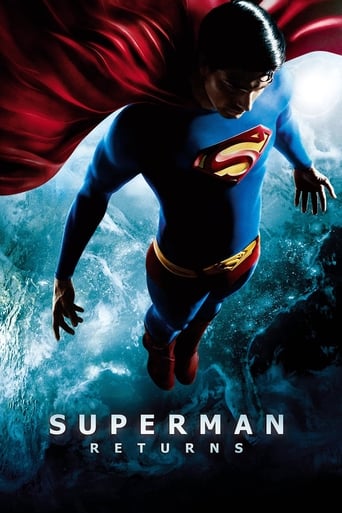
Superman Returns
2006 · Film · 154 min
Directed by Bryan Singer
Science FictionActionAdventure
Superman returns to discover his 5-year absence has allowed Lex Luthor to walk free, and that those he was closest to felt abandoned and have moved on. Luthor plots his ultimate revenge that could see millions killed and change the face of the planet forever, as well as ridding himself of the Man of Steel.
2 positive1 negativefrom 3 commenters
Where to watch
No streaming data for this title.


3 comments on Hacker News
I wish more movies would be done like Superman Returns.
It was plain old 2D except for a handful of scenes where they flashed an icon in the corner to tell you to put on your glasses. You put them on for a minute, saw some cool 3D effect in an action scene, and then you took them off before you got a headache and before it affected the rest of the movie.
The other day I watched Superman Returns and Man of Steel back to back. Spoilers follow, but I think I have a point.
The symbolism in Superman Returns was pretty obvious. In addition to the patriotism carried by the colours of his costume, he's obviously a kind of modern-day Superjesus: he's a superhuman only son sent to Earth to protect (save) all of mankind. There's even the entire death and rebirth aspect: he is beaten, then stabbed as the final blow with a lethal weapon (like the spear of destiny), he falls (in a posture reminiscent of Jesus on the cross) and (nearly) dies before being rescued. Then he dies again, staying in coma (for days?) before rising again.
The symbolism is there, it's easy to spot if you are looking for it but it blends in nicely enough that you can watch the film without paying any attention to it. It's subtle enough that you can argue whether it's symbolic or not and what is or isn't intended to carry a metaphor. After all the film is intentionally corny and mostly sees itself as a sequel to the famous Superman series that preceded it by a few decades.
Then there's Man of Steel. It doesn't even try to hide its symbolism. Kal-El asks a priest in a church for guidance whether to surrender himself in front of a stained glass window showing Jesus asking Yahweh for guidance whether to surrender himself. Kal-El drops out of the spaceship to save mankind in a static Jesus pose. His father's hologram ("His" "Spirit") says that he sent his only son to save mankind. And so on and so forth. Not to mention the facepalm-inducing moments where Kal-El points out how all-American he is despite being an (immigrant) space alien. The American/Christian symbolism is so obtuse it was even used to market the film to Christian audiences. It's less of a hidden allegory and more of a religious pamphlet.
What I'm trying to get at (other than Superman Returns clearly being the superior, if underrated, Superman movie and Man of Steel being a US-Christian circle jerk) is that there is a range. Some works of literature go out of their way to rub their symbolism in your face. In others it is present but more nuanced. In some it is subtle put still easy to find if you look for it. And in some any symbolism is merely a projection of what you are trying to find in it.
I would agree that most of the symbolism students of literary criticism tend to spend their energy on falls in the last category where you can show a work to handful of critics and get a lifetime's worth of different interpretations.
But as much as I personally despise the field as a whole, some works do carry intentional symbolism. And some works unintentionally provide symbolism when read in certain contexts.
When you look at "old" literature (i.e. literature that has long outlived its authors), most of the literature that has survived to the modern day is literature that provided meaning across the various generations. It's a legitimate question to ask "why" and "how" -- even if literary studies as a field tends to be more obsessed with the "what".
My family has an obsession with Superman too. Basically for the same reason that the author states; he always does the right thing. Unrealistic, but then again I've always had a problem with people shouting "unrealistic".
When I was in high school, we used to read these miserable, loathful stories about people having affairs (The Awakening), or committing suicide (Ethan Frome), or murdering each other for fun (The Most Dangerous Game), or a variety of other unpleasant topics, and I would get sick of these books and ask the instructor why we couldn't read a happy book once in a while. "That's not how real life works," she quipped. Yeah, but real life isn't that freaking depressing either. And occasionally in real-life, amazingly happy things do happen and I want to hear about them. Why would I want to read a book that captures the mundane, the ordinary, the boring plight of a human life that I can easily experience myself? I would much prefer to read about the extraordinary.
I have high hopes for this Man of Steel movie this summer. So far I've liked every Christopher Nolan film I've seen. On the other hand, I thought Superman Returns was an absolute disaster. Clark was a flat, nonchalant character without much of a moral direction. The script didn't even follow the comics very well. Lex Luthor came across as a buffoon. The citizens of Metropolis were generic and forgettable. And Lois was rather whiny in my opinion and had a child with Clark before they even got married. I don't remember that happening in the comics.