 Hacker Cinema
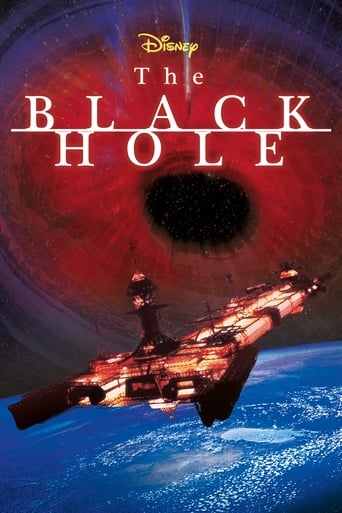
The Black Hole
1979 · Film · 98 min
Directed by Gary Nelson
AdventureScience FictionAction
The explorer craft USS Palomino is returning to Earth after a fruitless 18-month search for extra-terrestrial life when the crew comes upon a supposedly lost ship, the USS Cygnus, hovering near a black hole. The ship is controlled by Dr. Hans Reinhardt and his monstrous robot companion, but the initial wonderment and awe the Palomino crew feel for the ship and its resistance to the power of the black hole turn to horror as they uncover Reinhardt's plans.
1 positive2 negative13 neutralfrom 16 commenters
Where to watch
No streaming data for this title.


16 comments on Hacker News
Would a flop been able to give us such classic lines as "In, Through, Beyond"?
according to this list, the first was Treasure Island 1950 with a couple more before The Black Hole.
https://doctordisney.com/disney-movies-list-of-years-running-time-ratings/
I think the message is quite easy to understand as it's written but maybe that's not the message you want to convey. The message you're conveying makes no logical sense and doesn't seem to have any basis in testable scientific methodology. Your writing style is that of a "science communicator" and not a scientist proposing a hypothesis. As most science communicators, so much gets lost and because you have no actual scientific references it comes across as pseudoscientific nonsense with no backing whatsoever. You say the same equations work but failed to show it and failed to show it at the extremes. If the same equations work then you also have to ask yourself are you describing something different or just plugging in different values? Also I have my doubts that the equations actually work since you say that there is no speed limit. The speed of light is something that is fairly well understood. It's a measurable thing The time dilation that comes with it is also a measurable thing. Your last paragraph says there is no speed limit which would break all of the equations.
If you understand what scientists are saying, no one is saying that dark matter got removed from the universe. The inability to detect something does not indicate that it is not there it only indicates that we have not found a way to detect it, but it's effects are clearly measured so a term is given because it is unknown what it is I mean.
These terms of dark matter and dark energy have been seized upon by "science communicators" which oftentimes poorly explain complex topics. Then their poor explanation is seized upon by others and the understanding gets further diluted down.
There was a time when black holes were this spooky thing as well that were poorly understood. Astrophysicist could clearly understand that something was there that they could not understand or comprehend but they could measure the effects of it. Given time they were able to clarify it and come up with theories to explain it. This is the state we are in with dark matter and dark energy. These are terms given to something that they know is there because all of the evidence points to something being there but they have no ability to detect it other than to see it's effects on other things.
Without you putting together some hypothesis that can then be tested and verified independently what you have is sci-fi technobabble. It can be the basis for interesting storytelling like in the movie Black hole or Interstellar, but it's nothing more than fictional dreaming.
Honestly, string theory is more plausible than anything you've proposed.
Definitely confused the photo in this article for Maximilian from the movie "The Black Hole" (1979) for a moment there.
I'm starting to get the feeling that there might be shenanigans going on around Sam Altman.
Next thing you know, we're going to find out that his name isn't even Sam Altman, OpenAI isn't open, and all the workers have been replaced with robots a la Disney's Black Hole movie from the 1980s.
This is a really awesome list - I'm proud to have seen all but two of them.
But I would also note that the 70s gave us both Star Wars ('77) and Alien ('79). Of the two of them I actually think Alien is the most significant because it was the turning point where we lost the rubber suits, army guys, professors making long winded explanations, and hormonal teenagers and started getting the darker and more serious sci-fi.
Disney's The Black Hole also came out in '79 and it is an enjoyable movie if you don't know anything about physics. It is a serious attempt at sci-fi and kept me on the edge of my seat when I first saw it.
Day the Earth Stood Still and Forbidden Planet are ‘required’. Haha. Robinson Crusoe on Mars is great.
The Black Hole is a Disney movie.
How about some TV?
Classic: Battlestar Galactica, Buck Rogers, need I mention, Star Trek?
Current: Lost in Space, …
(Yikes. If 2001 is slow and boring, Solaris (1972) is watching paint dry. Sheesh)
… age appropriate is difficult, ahaha. You could also try your local library, the might have DVDs of TV shows and staff usually have kids section, and classics separate.
That's what Disney depicted in The Black Hole movie from 1979.
The dialog is terrible, acting is meh, argument seemed dumbed down into a kid's movie level and, yet, it explores sentient AI and artificial life, the concept of intelligent software agents acting on the user's behalf, and touches the concept of uploading oneself to a machine and into a simulated reality.
A bit like The Black Hole - Disney didn't know what to do with it.
IIRC, Bonnie Mc Bird's original screenplay was a bit more fantasy-like in that the hero "fell into the computer" by some sort of accident.
Other interesting movie from the time would be Electric Dreams, which also touches the topic of sentient AI, but in a romcom setting with a delightful soundtrack.
Watership Down and the Secret of Nimh were my two favorite movies as a young child in the early 80s, followed closely by the Dark Crystal and maybe Aristocats and the Black Hole.
Other movies of the time like the Rescuers and the Fox and the Hound and Labyrinth and such were a disappointment compared to these...
“Compurobot”¹ and “George”² were both obviously based on the design of V.I.N.CENT³ from Disney’s 1979 (live action) science fiction movie The Black Hole.
1. http://www.theoldrobots.com/compurobot1.html
2. http://www.theoldrobots.com/compurobot3.html
3. https://www.imdb.com/title/tt0078869/mediaviewer/rm3661245184
If you instead ask, "could we fail to notice if a black hole was near enough to collide", the answer is probably not, at least in this epoch of the universe.
Most astrophysical black holes will tend to have accretion disks that are very bright.
Even if there are really isolated, almost non-accreting black holes in deep space, they will visibly distort (by Einstein lensing) the image of distant light sources behind, and there are many many many of those. We can already in principle use microlensing to find ones that are at the margins of the Milky Way, at distances of tens of kiloparsecs. They will in general be easier to spot at closer distances.
Eventually, thanks to the expansion of the universe, black holes in deep space might not have much to lense: background galaxies will stop being visible (many are already so red and dim that when Einstein-lensed by a black hole they will not be naked-eye visible), so you may be surprised by a black hole that is plainly visible if it is between you and the Milky-Way-Andromeda merged galaxy but has almost nothing to magnify when you are between it and the Milky-Way-Andromeda galaxy. This is not something to worry about for the next many billion years.
Additionally, if you have reasonably sensitive instrumentation in your spaceship, you are even less likely to be surprised even if a black hole isn't at all naked-eye visible; black holes, even highly isolated ones in the distant future, will still interact with the relic fields like the Cosmic Microwave Background, and can be detected by those interactions.
> sucked into
Black holes don't reach out and grab things gravitationally, really. In general, if you treat them as Eulerian flow observers (as in fluid dynamics) they mostly deflect the trajectory of the "fluid" passing them (tangentially to the horizon), except for the fluid that flows directly onto the horizon or (tangentially) very close to it. In the case of a "fluid" of light, the deflection results in Einstein lensing, although light flowing close enough will be drawn into an orbit that (probably) ultimately leads inwards to the black hole. In the case of "fluids" that are massive -- gas, dust -- the speed at which the flow passes the black hole will always be less than that of light, but the flow is still deflected. Finally, in the case of larger objects like rocky planets or even stars, again their trajectories past the black hole will be deflected, and the result is similar to a hyperbolic orbit. Only the fluid which is aimed very well risks being swept up into an orbit, although some fluid can always be "aimed" directly at the black hole's notional surface (the event horizon), in which case it is on a one-way journey.
A "close call" in a space ship for a very large black hole might produce a large deflection and a significant time dilation, but otherwise is not especially dangerous. A close call for a small black hole might produce enough tidal stresses to compromise the structural integrity of the ship, but otherwise is also not especially dangerous. The more important dangers of black holes would be the intense radiation from their likely accretion disks, and again, that's readily detectable at long distances.
One could consider an analogy with a planet with an atmosphere: if, on a tangential course, you zip by the planet at sufficient distance, you get a pretty view. If you zip by at smaller distances, you might get what rocket scientists call a gravitational boost, but otherwise are probably fine. But if you zip by at smaller distances still, you might collide with the upper atmosphere, which might damage your spaceship (or incinerate it). You generally need an intersecting course to actually hit the rocky surface, although the atmosphere's effects may be relevant for non-intersecting courses. Black holes don't have a rocky surface, but the accretion structures around them can serve as a dangerous atmosphere.
In general, except in binary (and triple and so on) systems where the BH has a stellar partner, black holes tend to grow pretty slowly because not much falls directly on them, things that come close enough to have their trajectories bent into an orbit can stay in orbit for a long time, and not very much tends to come close enough to be drawn into an orbit in the first place. They don't act like the one shown in Disney's _The Black Hole_, for example (the human characters in that film would die of radiation poisoning, mostly, since their ships do not have many-metres-thick lead walls to block the X rays that would be streaming out of the bright accretion structure; turning off the Cygnus's magical station-keeping engine would mostly cause it to fall into a quasi-Keplerian orbit that could be stable for a very long time, so the film did get it kinda right that the Cygnus would need to be steered (with full engines!) directly towards the black hole).
Finally, this entertaining transcript is a bit more chatty-colloquial, and raises some additional points: https://www.nasa.gov/connect/chat/black_hole_chat.html (it might also raise some additional questions, though! For instance, "theoretically could stand at the event horizon point of a blackhole and not be sucked in" doesn't go into how to do this by e.g. constructing a scaffold around the BH that one could use as a platform to stand above it.)
Give me all the Disney things
This would totally be worth $10/month to have access to the entire Disney catalog; the entire "Disney Vault", all the content from the 60s, 70s, and 80s; all the Wonderful World of Disney; all the classic Disney movies (the entire catalogs of the likes of Fred MacMurray, Annette Funicello, Tommy Kirk, Keenan Wynn and other contract Disney actors from those eras; movies like The Black Hole, Apple Dumpling Gang, The North Avenue Irregulars and other stuff that, if it's available at all, is only currently findable used on VHS); all the animated Disney movies; all the Mickey Mouse and Donald Duck shorts; all the Mickey Mouse Club episodes, all the tween-centric episodic shows, etc.
This would potentially be worth more than $10/month.
If it's just going to be the popular animated feature-length movies, it's not worth $10/month. And they could still screw this up by not having the entire animated movie catalog available for random streaming, but rather only a subset available at any given time.
Disney has a truly massive archive of quality, family content, much of which hasn't been seen for decades and few people even know about or remember. It would be a shame if it continues to rot in obscurity in their vault.
As a big fan of Jodorowsky (L'Incal is one my favourite graphic novels ever), I think we could also unequivocally say that whatever he had made would not have been very faithful to the book. It's quite possible that Dune fans would have been even less happy with Jodorowsky's film than Lynch's.
We also have to remember that this was before Star Wars and Alien. Most scifi at the time was, with some honourable exceptions (2001: A Space Odyssey, Silent Running, The Andromeda Strain, Solaris), pretty silly, childish, often campy stuff: The Black Hole, Buck Rogers, Moonraker. Pulp origins aside, Star Wars introduces a level of violence, maturity and realism to the genre that stood out at the time, and closer to that of contemporary adult 1970s productions like Apocalypse Now, Easy Rider and so on.
For all the considerable talent involved in the Dune adaptation, it's quite possible — and this eases the pain over the loss of the project a bit — that it would have been closer in tone to something like Zardoz or Flash Gordon, i.e. a big, colourful, but ultimately also a bit silly extravaganza. Even O'Bannon's Alien script was also pretty pulpy and silly until Ridley Scott, David Giler and Walter Hill hammered it into shape.
Star Wars, 1977 (the Death Star diagram), The Black Hole, 1979 (the wireframe model of the titular black hole-- drawn on a plotter!), etc. By 1986 we'd already had two entire films based around CGI-- Tron (1982) and The Last Starfighter (1984).
Interstellar? How about 'black hole'? http://www.imdb.com/title/tt0078869/
A lovely review. It also helps strengthen my understanding of why "The Black Hole" sprang to mind when I watched the Dr. Who episodes 'The Impossible Planet/The Satan Pit'