 Hacker Cinema
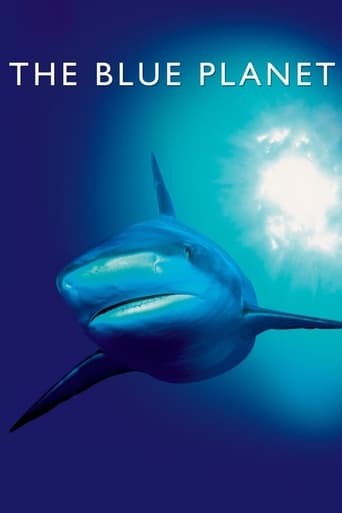
The Blue Planet
2001 · TV series · documentary · 51 min episodes · 1 season
Created by Andy Byatt, Alastair Fothergill
Sir David Attenborough narrates this critically acclaimed series that dives deep into the marine environment of Planet Earth. Although two-thirds of the world's surface is covered with water, scientists know less about the oceans than they do about the surface of the moon. This limited series travels from various coasts to the poles to examine watery denizens ranging from the gigantic blue whale to microscopic coral polyps.
10 positive3 neutralfrom 13 commenters
Where to watch
No streaming data for this title.





13 comments on Hacker News
Or they communicate in languages we cannot understand.
Even among human languages the sounds of some languages sound all the same to humans who are not native speakers of that language.
Chinese for example has a million words that all sound like "shi" and other tonal languages like Vietnamese are also indistinguishable to English natives etc. Japanese people treat R/L the same.
Elephants and dolphins have been known to assign unique names for each other.
Octopuses and other cephalopods communicate by changing the color of their skin, EVEN WITH SOME OTHER FISH! BBC's Blue Planet has an episode where an octopus and a grouper fish coordinate via color to trap prey.
Ants and other insects communicate via pheromones and "smell".
Are you seriously going to stick to a human-chauvinistic stance that only we have a "language"?
Anything by Adam Curtis. Is he right? Is he wrong? What is going on? He makes some strong arguments at a system-level and of an interdisciplinary nature that really make you think. Despite how people like to write him off, he is likely not too far off the mark most of the time.
Samsara and its kin are engrossing, if not quite stressful. They show you how insane humanity is in rather raw form.
The BBC's Blue Planet, Planet Earth, and Life series are masterclasses in ecological storytelling.
Exit Through the Gift Shop is about as subversively hilarious as you can get.
I'll need to look it up later, but there's a really good documentary about the people who still hand-make Steinway pianos in New York.
I think there's a series called The Planets (?) that covered a lot of the various probes that were sent out.
There's some documentary about the various moon programs, covering Mercury, Gemini, Apollo, etc. It was a series. I can't remember the name or immediately find the one I am thinking of.
There's been a lot of fascinating animal documentaries I have lost track of.
I do on _very_ rare occasions.
Why? I'm fortunate enough to have gigabit symmetrical fiber, so streaming isn't an issue. That said, when viewing content on higher quality TVs and sound systems, there's a very perceptible improvement in both video and audio quality compared to streaming. For example, on my 65" LG C9 OLED with a Klipsch Atmos system, the difference is immediately noticeable.
Even with dedicated streaming hardware like new generation Apple TVs, which offer 4K streaming with Dolby Vision/Atmos, it still doesn't quite compare to physical media. Ditto for the native LG apps with identical options.
Of course, there are downsides. Good luck finding UHD content on physical media. Redbox doesn't offer 4K discs in my area, and local stores rarely have physical media in stock. Even with physical media, there's other annoyances--e.g. the Xbox One X produces a loud hum as the disc spins, not to mention the delay when seeking/skipping around.
That said, for rarified material such as Blue Planet (or anything by Attenborough)--or movies known for their sound quality like Mad Max--physical media can be sublime.
Our 3.5 YO doesn’t really have any device time (though she likes playing with a calculator, and typing on an neo alphasmart), and she absolutely loves reading. But we recently introduced nature documentaries (blue planet, planet earth). And yup! She throws little tantrums at the end. We’re all super engaged as we watch them together, and I think they’re a good supplement to her kid encyclopedias and stuff. The tantrum are less severe if I preface the viewing with, “when this is done, we’re going to turn it off and do x.” It helps to prepare her for what to expect, rather than be surprised by “no more!”
Would any of you say it's definitely worth watching, to someone debating whether to spend the 90 min?
Some of the reviews are pretty mixed, saying that the film's message is confused by conspiratorial threads and off-putting journalistic style.
Or, if you're already aware of the problems with industrial fishing, is it a pass/not much of an eye opener and not mandatory watching?
Watching episodes of David Attenborough's Blue Planet might have done more for me already to appreciate the value of sea life than what I imagine is lots of footage of industrial fish markets, processing facilities, etc. But maybe knowing the ugly side is important.
Iplayer launched as a new TV box, yet they failed to capitalise on the launch of Blue Planet, that came just before it. if made an exclusive, Sir David Attenborough alone would gather everyone’s attention. Great TV shows, crime dramas, but no publicity or cover from the media whatsoever, until it reaches netflix and the likes. Quite sad tbh :( or just lack of vision
We pay the licence fee to fund the BBC. They make some amazing documentaries (Planet Earth, Blue Planet etc). They also have radio stations, all advert free. Being advert free is rare these days.
This is the blathering of spoiled rich kid on vacation.
> In London, Paris, Berlin, I hop on the train, head to the cafe — it’s the afternoon, and nobody’s gotten to work until 9am, and even then, maybe not until 10 — order a carefully made coffee and a newly baked croissant, do some writing, pick up some fresh groceries, maybe a meal or two, head home — now it’s 6 or 7, and everyone else has already gone home around 5 — and watch something interesting, maybe a documentary by an academic, the BBC’s Blue Planet, or a Swedish crime-noir. I think back on my day and remember the people smiling and laughing at the pubs and cafes.
This is so farcical it's not even worth trying to rebut.
> How many whales are there on earth? How many lions? 50,000 at most. You could put a bullet in the head of every lion on earth tomorrow and it would be a drop in the ocean compared to the hundreds of millions of farm animals that would be killed _on that same day_. And the lions at least wouldn’t have spent their lives packed 10 to a square foot in a barn dying to sickness.
I can't really keep repeatedly refuting generalizations like this. Please re-read the emphasis I've been placing on the sorts of facilities I'm defending.
> There are some incredible, highly regarded documentaries (planet earth, blue planet) that do far more for educating people about animals than viewing that animal in a cage ever can. If zoos actually created any sort of compassion in visitors for animals then we wouldn’t be having this argument — all they create is fascination in a select few species we’ve deemed to be interesting enough, and what use is that to the animals being tortured on a scale millions of times greater.
They've done much more than what you've described. Please re-read my post.
Here's a great start since I'm principally focusing on one facility which can be a model for others, in case you need a particular reference: https://nationalzoo.si.edu/conservation
If you can, I'd encourage you to read it with an open mind.
You’re ignoring my point. Every single day the average person will actively benefit from the direct, quantifiable harm of individuals animals — your lunch, your dinner, there’s probably at least one animal’s suffering associated with it. Every year tens of billions of animals are slaughtered after spending their lives in inhumane conditions.
How many whales are there on earth? How many lions? 50,000 at most. You could put a bullet in the head of every lion on earth tomorrow and it would be a drop in the ocean compared to the hundreds of millions of farm animals that would be killed _on that same day_. And the lions at least wouldn’t have spent their lives packed 10 to a square foot in a barn dying to sickness.
There are some incredible, highly regarded documentaries (planet earth, blue planet) that do far more for educating people about animals than viewing that animal in a cage ever can. If zoos actually created any sort of compassion in visitors for animals then we wouldn’t be having this argument — all they create is fascination in a select few species we’ve deemed to be interesting enough, and what use is that to the animals being tortured on a scale millions of times greater.
Exotic animals are just a tool used to support an entire species cognitive dissonance.
Some of Blue Planet was filmed in aquariums. It's an open secret that David Attenborough documentaries use footage of captive animals to create a narrative.
However, they don't kill the captive animals, which is the key difference.
Reminds me of second episode of this documentary (2001): https://en.wikipedia.org/wiki/The_Blue_Planet
I agree. I have a lot more respect for quiet agnostics like Sir David Attenborough+. To the best of his knowledge, there is no God, and if there is likely God used evolution as a tool for creation. But he never insists that everyone believe it as fact, or that anyone who doesn't believe is ignorant. He simply says what he thinks is true.
+the gentleman who narrated Earth an Blue Planet, as well as the "BBC Life" nature documentary series.