 Hacker Cinema
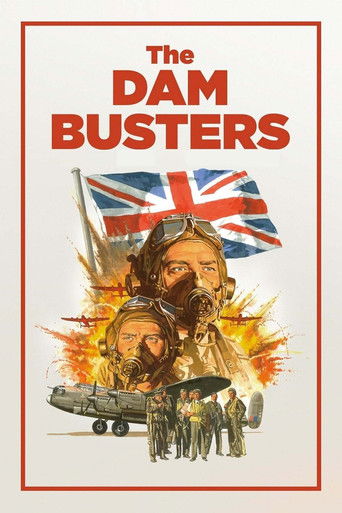
The Dam Busters
1955 · Film · 124 min
Directed by Michael Anderson
The story of the conception of a new British weapon for smashing the German dams in the Ruhr industrial complex and the execution of the raid by 617 Squadron 'The Dam Busters'.
2 positive14 neutralfrom 16 commenters
Where to watch
No streaming data for this title.
Videos commenters linked
From YouTube links in the comments below. Most are clips and trailers; “Full” means the uploader says so.


17 comments on Hacker News
I've seen documentaries on the dam busters, but not the flick. I should check it out.
It's not just the helmet.
I will maintain that Star Wars was quite possibly the best WWII movie of all time, although purely as an allegorical and referential work. In the timeless tradition of tailoring your story to your audience, the whole film is packed with references and ideas from other WWII movies, people, and events. Although, it also borrows from just about everything else - a true artifact of its era. For the Boomer post-WWII era, I believe drawing from familiar material like this is one of the keys to its success.
After all, a story about "a young hero and laser swords" doesn't hold a candle to "a bunch of underdogs blow up a gigantic space station filled with space Nazis." I don't know about you, but I know which of those I'm going to see 10 times.
> The attack on the Death Star in the climax of the film A New Hope is similar in many respects to the strategy of Operation Chastise from the 1954 British film, The Dam Busters. Rebel pilots have to fly through a trench while evading enemy fire and drop a single special weapon at a precise distance from the target to destroy the entire base with a single explosion; if one run fails another run must be made by a different pilot. Some scenes from the A New Hope climax are similar to those in The Dam Busters and some of the dialogue is nearly identical in the two films. These scenes are also heavily influenced by the action scenes from the fictional wartime film 633 Squadron. That film's finale shows the squadron's planes flying down a deep fjord while being fired at along the way by anti-aircraft guns lining its sides. George Lucas has stated in interviews that this sequence inspired the 'trench run' sequence in Star Wars.
https://en.wikipedia.org/wiki/Star_Wars_sources_and_analogues#Film_and_television
> The stormtroopers from the movies share a name with the Imperial German stormtroopers and the Nazi German Sturmabteilung (lit. Stormtrooper). Imperial officers' uniforms also resemble some historical German Army uniforms and the political and security officers of the Empire resemble the black clad SS down to the imitation silver death's head insignia on their officer's caps (although the uniforms technically had more basis with the German Uhlans within the Prussian Empire[71]). World War II terms were used for names in Star Wars; examples include the planets Kessel (a term that refers to a group of encircled forces) and Hoth (Hermann Hoth was a German general who served on the snow-laden Eastern Front).[61] Lucas himself has drawn parallels between Palpatine and his rise to power to historical dictators such as Julius Caesar, Napoleon Bonaparte, and Adolf Hitler, saying the films exist as an examination of how democracies allow themselves to become dictatorships.[72] The space battles in A New Hope were based on filmed World War I and World War II dogfights.[5]
https://en.wikipedia.org/wiki/Star_Wars_sources_and_analogues#Modern_and_early_modern_history
War historian Antony Beevor discussed that stereotype thusly:
''Patriotism also permeated those British war movies of the 1950s and 60s – The Dam Busters, Reach for the Sky, The Cruel Sea, The Heroes of Telemark, The Battle of the River Plate, Cockleshell Heroes. It camouflaged itself in self-deprecation, but the rousing march music in the finale always braced our belief in the rightness of our cause. We have long made fun of all the period cliches, unable to believe that anyone talked like that. But when researching my new book Arnhem: The Battle for the Bridges, I found that German officers really did say to the British paratroopers taken prisoner: “For you the war is over.” One of my favourite remarks, recorded at the time by a junior doctor, is the reaction of Colonel Marrable, the head of an improvised hospital in the Netherlands, when Waffen-SS panzergrenadiers seized the building. Still puffing gently on his pipe, he says to his medical staff: “Good show, chaps. Don’t take any notice of the Jerries. Carry on as if nothing has happened.” I have always been doubtful about the notion of “a national character”, but a national self-image certainly existed during the war and for some time afterwards.''
https://www.theguardian.com/film/2018/may/29/antony-beevor-the-greatest-war-movie-ever-and-the-ones-i-cant-bear
There's been a disappointing lack of nuance in the HN discussion of this topic.
The particular changes that were made to the altered editions strike me as quite stupid, for the most part.
However, there is nothing new about media being edited to remove offensive language. It may be pointless and stupid in many instances – but it's not the sign of some incoming cultural apocalypse.
I can easily think of less recent examples:
* Charlie and the Chocolate Factory. The book was edited (within Dahl's lifetime) to change the depiction of the oompha loompas as black slaves.
* Biggles. The Wikipedia article mentions that "...later editions had to be somewhat edited in line with changing norms of acceptability, especially regarding race..."
* Under Drake's Flag. I remember reading a heavily edited version of this as a child in the 90s. I haven't read the original, but I think G.A. Henty was, err, less than entirely progressive on issues relating to race and colonialism.
* The Dam Busters movie. The n-word (used as the name of a dog!) is usually edited out or overdubbed (https://www.theguardian.com/media/2001/jun/11/itv.broadcasting).
Each change has to be judged on its merits. What I think is silly is the pretense that these changes to the Dahl canon signal a new phase in the culture wars or some new era of censorship. Kids today actually have access to a much wider variety of literature than at any point in the past.
> I mean jesus christ, you'd have to be born under a rock to not know that Star Wars is a cross between a spaghetti western and a samurai flick.
And WWII movies (633 Squadron and The Dam Busters, most prominently) and a splash of sword-and-sorcery fiction (the "magic exists but is rare to the point of being near-mythical and not really thaaaaat powerful" thing is some straight Conan shit, as are some other elements and flavors in the setting—from the stories, that is, not the movies, which came too late to influence Star Wars, though, fittingly, James Earl Jones is in both).
Star Wars' greatest contribution to cinema—and it's a big one—is pioneering the multi-genre pastiche. That thing Tarantino does? Like, his whole career basically? Star Wars cleared the way for that. Proved it could work and result in a good film, proved it could make money. The most successful later entries understand that formula and lean hard into the genre-mashup and freely ripping off other works thing. Mandalorian's full of that, for instance (to the point that you can make a meta-game of watching it, playing "name what they ripped off")
The Death Star sequence (specifically the trench run) was based on, and sometimes lifted scene for scene from the 1955 movie "The Dam Busters." [0,1].
Substitute these experimental "bouncing bombs"[2] for Luke force-bending proton torpedoes and you have the end of Star Wars.
[0]https://www.starwars.com/news/the-cinema-behind-star-wars-the-dam-busters
[1]https://youtu.be/lNdb03Hw18M
[2]https://en.wikipedia.org/wiki/Bouncing_bomb
> Star Wars spacecraft fly around as if they were aircraft in an atmosphere, which isn't surprising given that older war movies were an inspiration for its battle scenes.
Indeed, the following youtube [1] shows how much the original Star Wars borrowed from old WW2 movies, in particular, from "The Dam Busters" [2], 1955.
[1] https://www.youtube.com/watch?v=lNdb03Hw18M
[2] https://www.imdb.com/title/tt0046889/
>How did sci-fi get so disconnected from the actual future?
The original Star Wars was made in 1977, and based heavily on World War 2 combat films (much of the space combat and the trench run on the Death Star was lifted - sometimes shot for shot - from a film called "The Dam Busters.") For reasons of continuity and tone, that mechanical aesthetic can't ever change much throughout the franchise, or else it wouldn't "look" like Star Wars.
But the point is that it's exciting, it's visceral, the archetypes of the fighter pilot and joystick and of buttons that do important things make sense to the audience, and as a result those scenes can convey emotion though the use of familiar visual language.
Sci-fi was never "connected" to the future, and it was never (or at least, never explicitly) about attempting to accurately describe or predict the future. Yes, you could have replaced the ships and pilots in Star Wars with remote or AI controlled drones, not colored in the blasters, etc, and it might be more realistic, but no one would enjoy watching it.
People do enjoy dogfights (and spaceships that bank when they turn) and space wizards with laser swords doing flippy shit and punching each other with telekinesis, though.
Some of the dialogue for the Death Star attack scenes were taken directly from "The Dam Busters", a WWII movie depicting the Allied attack on a heavy water producing German controlled damn that required specialized weapons to be delivered in a highly specific attack run.
They didn't but we did blow up dams in WWII. In fact, the death star run in Star Wars was based on a WWII movie called the dam busters: https://www.youtube.com/watch?v=lNdb03Hw18M
Your first link is to one of a series of articles linking Star Wars to: Lawrence of Arabia; E.T.; the Seventh Voyage of Sinbad; The Good, The Bad, and the Ugly; Empire of the Sun; and possibly others. They can't all be major influences!
The start of the YouTube video puts the exposition of the attack from one film next to the exposition of the attack from the other. Is that really such a strong similarity? I'd guess a lot of war/action movies have a here's-how-it's-going-to-go-down scene. Some of the other pairings are closer - I think I buy the one with the line about the number of guns.
So, I see a Dam Busters reference, and that's interesting! But I'd need more convincing that it's used for storyboarding.
Nope.
http://www.starwars.com/news/the-cinema-behind-star-wars-the-dam-busters
https://www.youtube.com/watch?v=lNdb03Hw18M
I really enjoyed watching The Dam Busters[0] as a kid. Pretty amazing technical feat, given the circumstances.
[0]: http://www.imdb.com/title/tt0046889/
Another very obvious influence on Star Wars, and specifically the attack on the Death Star, was the UK 1955 movie "The Dam Busters" about the real life WW2 Operation Chastise.
There are amusing clips on YouTube of Star Wars visuals and the The Dam Busters audio and vice-versa - the similarity is pretty close.
Edit: Correction 1995 -> 1955
Then again, that first Star Wars movie is mostly taken from Kurosawa's The Hidden Fortress (https://en.wikipedia.org/wiki/The_Hidden_Fortress), right down to the personalities of the robots... I gather The Dam Busters and perhaps other films of that sort (none of which I've seen) get a lot of credit for the end.
Not sure what the grand parent is referring to. The one instance I can think of capital city = coruscant.
On a related note, I recently watched the Dam Busters. I was shocked to see the origins of the death star trench run in an old b&w WWII movie.
The Dam Busters (1955 - http://www.imdb.com/title/tt0046889/ ) is excellent. You can see real-world examples of the hacker problem-solving mindset right from the start of the movie and it continues on throughout.
(PC Warning: One of the main characters has an unfortunately named black dog, which I suspect is the reason this superb film is only rarely seen).