 Hacker Cinema
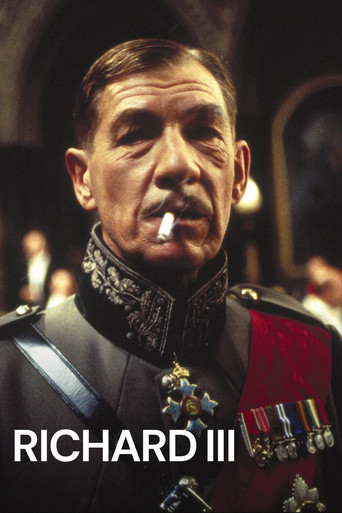
Richard III
1995 · Film · 104 min
Directed by Richard Loncraine
Having helped his brother King Edward IV take the throne of England, the jealous hunchback Richard, Duke of Gloucester, plots to seize power for himself. Masterfully deceiving and plotting against nearly everyone in the royal court, including his eventual wife, Lady Anne, and his brother George, Duke of Clarence, Richard orchestrates a bloody rise to power before finding all his gains jeopardized by those he betrayed.
4 positive1 negative2 neutralfrom 7 commenters
Where to watch
No streaming data for this title.
9 comments on Hacker News
It's hard to take Macbeth seriously as a history... what with the witches and all. His source is a piece of propaganda that makes Richard III look like a documentary.
As a drama, the fact that the Macbeths appear to have zero children is very important. Fathers and sons are recurring themes -- Duncan's rebuff of Macbeth as the next King, Macduff and his son, Siward and Young Siward, etc.
The absence of a descendant for Macbeth is evocative, especially given Lady Macbeth's line that she has "given suck". It doesn't get a lot of attention past that one, but it appears that within the context of the play, they had a child who died young.
These are facts about the play that inform an actor and director making character choices. They're free to ignore them and focus on other things. (Honestly, it's not clear that Shakespeare really thought that through, either.)
Simon Russell Beale's Falstaff was superb IMO. Hiddleston as a good Hal. Jeremy Irons was, well, Jeremy Irons
I rather enjoyed the first four. the latter three with Benedict Cumberbatch as Richard III were rather weak. Especially when you look at Olivier's film.
That was fun to read, even though I would disagree with much of the article. I generally like the comedies least, the OP likes them most, but it's nice to see people talk about Shakespeare in an article linked here. A couple of comments I would make:
* "People will think I’m crazy, but yes, I’m placing Henry IV above Henry V." I doubt many people would think you're crazy, the Henry IVs are generally considered better and for the reason mentioned: Falstaff.
* On performances of Richard III: "I liked two different performances for different reasons. The 1995 major film puts the play in the World Word II era. It’s solid and does well standing alone. The BBC production has linked casting with the three parts of Henry VI, which allows one to enjoy it in full in its broader context. It’s also well-performed, but obviously has less spectacle and a lower budget." -- you really need to watch the 1955 version for Laurence Olivier's performance.
Also on editions: The Riverside Shakespeare is great. https://www.goodreads.com/book/show/1036552
> Branagh's Henry V and Much Ado About Nothing were my gateway.
Branagh's Henry V and Polanski's Macbeth were my gateway.
Don't miss the 1995 Richard III adaptation with Sir Ian McKellen. The 2004 film version of The Merchant of Venice is also worth seeing, if only for Al Pacino and Jeremy Irons.
> Why do people die from erotic self-asphyxiation? Because we have a compulsion to escalate and to push things further. We need novelty. We need new stuff. We go mad if it's just the same thing over and over. At least that's true for most of us. Not everyone takes it all that far, but when you invest a significant amount of time doing one thing in particular, you're always going to want to take it to greater heights.
> And that's the thing about critic reviews: they represent movie fans suffering from the cinematic equivalent of erotic self-asphyxiation. Old, tired cliches and predictable plots? No. They want something they haven't seen before. Art movies are incredibly weird, and film critics love them.
I think thismisunderstands art movies, film critics, and art in general (though there are exceptions). As someone who has learned to understand arts on very roughly that level, including film (an 'admission' that always gets a negative reaction!) it's not that you want more and different, like a hit of heroin, it's that your perception changes and you see things that you didn't see before. I first saw Richard III when I was in high school and let's say I didn't love it! I saw it more recently and it was mind-blowing; it soared to heights I didn't imagine, one after the other (though not a happy story way!). It was the same play - I wasn't getting something more or new - I just perceived so much more, from the language to the characters to the insights to the virtuoso writing. That change in perception is fundamental human perception and applies to anything in which we gain experience and expertise.
When you first drink wine, you cannot distinguish much between different bottles. You literally cannot taste all the flavors, see the colors, and perceive the other sensations that someone with more experience and expertise can. I'm sure you experience it with your profession or hobbies. If you sail boats, you perceive things that beginning sailors do not - and not meaningless things, but things that have a real impact. The same with reviewing code, UX, automobile engines, audio speaker sound, athletic performance, etc. etc. - whatever you have a developed perception of.
Human perception is far more than sensory input; what you 'see' is processed through your brain, including neurons that change based on usage and training, and also through your experience - you recognize your family on a perceptual level, for example (afaik).
The generic, quality critic sees things that you and I don't. I try to learn to see those things too, because when I do, they can be wonders. Just like wine tastes even better, car engines are far more moving, etc. when you develop that perception, so do the experiences of films, paintings, theater - I see colors (metaphorically, but literally sometimes) that I didn't earlier in life, so beautiful I didn't imagine they existed.
'Art films' sometimes cater to more developed perceptions and ignore others, which can make them seem wierd - there is (usually) something there to see, I promise (there are superficial genre art films, as with everything else). It's also true that you appreciate different innovations, such as a film that uses an old technique in an ingenius and powerful way, which you wouldn't notice if you didn't know about the technique, which is somewhat about finding something new, as you say.
I don't think a plain English adaptation is very helpful. His work isn't about the story, but the language. The work is poetry, both literally and figuratively, and a plain English adaptation is like somebody telling you about their favorite song.
Better, I think, is to see a good film adaptation. Shakespeare was never intended to be read, but to be performed. There's a lot in the text that isn't apparent until you've studied it closely, but a good performance will bring it right out in the open.
A few films that I'd suggest to get started with:
https://en.wikipedia.org/wiki/Henry_V_(1989_film) https://en.wikipedia.org/wiki/Much_Ado_About_Nothing_(1993_film) https://en.wikipedia.org/wiki/Richard_III_(1995_film) https://en.wikipedia.org/wiki/Titus_(film) https://en.wikipedia.org/wiki/Coriolanus_(film) https://en.wikipedia.org/wiki/Romeo_%2B_Juliet https://en.wikipedia.org/wiki/Hamlet_(2000_film)
These are all good, accessible versions of his plays. You don't need to be an expert to understand and enjoy them. (They're very roughly in order of my favorites, if that matters to you.)
I won't guarantee you'll like them. There's really nothing wrong with that. People get snobby about Shakespeare, and they shouldn't. It's OK to say, "Yeah, it's not for me". But under all the snobbery, there really is great text and great performances that people genuinely enjoy. If you're interested in that, these films are the places I'd start.
What we get today is the anti-hero. The inheritors of the tragedy are movies like Fight Club, The Godfather, etc. Shakespeare used the anti-hero very well: Richard III, Othello, and Macbeth all resonate very strongly with modern audiences.
I'm not entirely sure I'd put Hamlet in that category, and really points up what you're saying. Hamlet is tragic in the Greek sense, a concept we rarely get today. Hamlet's more heroic than anti-heroic: he's got a body count but he's not vicious about it. He at least wants to be a good person -- not just by his own lights but by what he thinks others expect of him. (Unlike the more vicious anti-heroes, who don't see themselves as evil but aren't averse to having other people see them that way.)
The interesting point underlying this rather silly discussion:
The genre of "tragedy" is nearly forgotten today, while having been extremely popular throughout history.
In most modern fiction we have a hero which is supposed to be virtuous and sympathetic ("likable"). If they have flaws they will either be insignificant and endearing, or the hero will overcome these flaws through the arc of the story. The villain is the antagonist in the story, and is a bad guy, but is eventually defeated by the hero through the strengths of the personal qualities of the hero. The hero is often a "nobody" in the beginning but achieves some respect and status at the end, while the bad guy gets justly punished for his evil deeds.
A tragedy is a completely different genre. In a tragedy we have a great person which is brought down by destiny and their own flaws. The protagonist of a tragedy is not supposed to an ideal of virtue. The author of the article seem surprised that Hamlet is not idealized but rather acts both stupidly and unfairly. But look at the other tragedy protagonists - Richard II, Richard III, Macbeth, Othello, King Lear, Romeo and Juliet. They are all severely flawed and make disastrous mistakes. We are supposed to empathize with these characters, not sympathize.
On the other hand the they are not getting "justly punished" either. Richard III is clearly an evil man, but Othello is the manipulated victim. Romeo and Juliet is not doomed through their own actions but through the destiny of their families which they are not able to escape. And poor Ofelia. A tragedy is not moralistic in the way that everyone get their just desert - destiny can be completely unfair.
So how could anyone designate Hamlet as the "worst villain" compared to someone like Macbeth or Richard III? Probably because the writer thinks Macbeth and Richard III are supposed to be "bad guys" but Hamlet is supposed to be a "good guy", and his flaws therefore are less acceptable. E.g if a bad guy is sexist, we consider it consistent with his badness, but if a good guy is sexist we consider it as if the author condones sexism, which is more problematic. But this is reading Hamlet if it was a Hollywood movie, not a tragedy.
So why have tragedy gone out of fashion to the extend that a person writing about Shakespeare does not understand the genre? Probably because in modern society we believe in meritocracy and the pursuit of happiness. We are supposed to take control over our own destiny, and so cannot believe that we have flaws which cannot be overcome, or in an unfair destiny which we have no say over.
Mamet's opinions about acting (and directing) are a crock of shit
They are. Proof by counterexample: go watch Ian McKellen perform Richard III (1995 film). Here's a YouTube clip of a few opening scenes: http://www.youtube.com/watch?v=ke5-SUDrHMU. This is simply brilliant stuff. Now imagine actors, no matter how good, merely reading the lines — without an overriding concept for the show, just reading the text and moving just enough to make the action make sense. Laurence Olivier's 1955 Richard III is rather like that; good mostly because the play is awesome, not because it's a good movie or a good production.