 Hacker Cinema
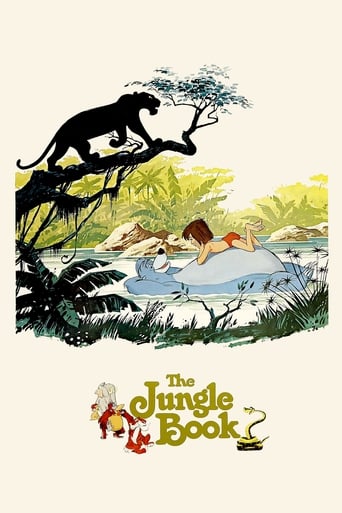
The Jungle Book
1967 · Film · 78 min
Directed by Wolfgang Reitherman
The boy Mowgli makes his way to the man-village with Bagheera, the wise panther. Along the way he meets jazzy King Louie, the hypnotic snake Kaa and the lovable, happy-go-lucky bear Baloo, who teaches Mowgli "The Bare Necessities" of life and the true meaning of friendship.
5 positive2 negative8 neutralfrom 15 commenters
Where to watch
No streaming data for this title.
15 comments on Hacker News
Would be be worse off as a society without Snow White, Pinocchio, Bambi, Jungle Book, Mary Poppins, the Herbie series, and any of the many more recent films?
If anything these films are a great example of why copyright terms should be long, because those films are still culturally relevant today, 60-80 years after they're made, and that people are still willing to pay for them over newer films shows that the creators and their families still deserve to continue to get royalties from them.
Sure, film companies often make a quick buck from sequels, but it's interesting that copyright on characters is distinct from copyright on works.
If anything it's surprising that you're arguing something other than the usual issue that's brought up around Disney, which is that their older works frequently took stories that were specifically out of copyright, and then they vigourously pursued copyright on the films they made from those stories.
Disney can do whatever it wants if it restores and releases a 4K version of the theatrical cuts of the original trilogy, something the fan base has wanted for decades at this point. I won't hold my breath.
Very large companies are generally very bad at consistently producing original content because everything in a corporat eenvironment skews towards not taking any risks. Big companies want a repeatable formula. It's why we get to many sequels and reboots with depressingly few new properties. HBO has been the exception to the rule. I would've also said Apple TV tends to corporatize content into being inoffensive. Modern Family (even though it wasn't an Apple production) is kind of like the perfect Apple TV content. But we have things like Severance and Silo so maybe there's hope.
Anyway, the retconning and corporatization around Star Wars has been depressing to watch. The whole "Han shot first" was a line in the sand more than 30 years old that seemed to stem from George Lucas's desire for a lighter classification for the films. The Phantom Menace of course was very much aimed at a younger audience even though the plot revolved around a tax treaty dispute of all things.
The sequel trilogy was for me, as an original Star Wars fan, deeply depressing. I honestly haven't even watched the last one where Carrie Fisher did her best Mary Poppins. And honestly the whole prmise of midichlorians (from the original trilogy) and inheritance of Force ability was really offensive and against the original spirit of Star Wars. I mean as anyone example of corporatization the name "Rey" was chosen to be easily pronounceable in many languages.
Look where we started. The inspiration for Star Wars was the Viet Cong resisting American imperialism in Vietnam (direct from George Lucas) [1].
Disney produced beloved classics like The Jungle Book, Aladdin and Snow White. In the 2000s, they seemed unable to continue this creativity and it became an amalgam of Pixar and the MCU (and later Lucasfilm). Pixar was a culturally antiestablishmment company started by Steve Jobs (yes, yes, he bought a London computer graphics division). The MCU took decades of creativity in the superhero space and basically turned into 2000s era patriotic films. You can guess why the timing.
Oh it's worth adding the Star Wars originally had an expanded universe that was kinda managed by Lucasfilm. Disney abandoned this on purchasing Lucasfilm and some fans were very upset. This included Chewbacca having a wife and family back home. It was all fan fiction, basically.
Disney could very much use the Star Wars milieu to tell stories relevant to our times. The 2025 Superman movie did this for example. and it made some people very upset. But Disney absolutely will not do that. So I really don't think it matters what they try and do.
[1]: https://screenrant.com/star-wars-george-lucas-vietnam-war-inspiration-explainer/
This seems a great idea conceptually, but in practice, from mine one sample data, its ways to limiting and simple for a toddler.
My child just turned 3, she can already turn on the NVIDIA Shield, go into Jellyfin and put a movie playing.
The movie is always Shrek or Jungle Book though, so I still didn’t have to put parental restrictions. But she can already choose them from the favorites list.
Jungle Book - Walt Disney was involved with this, they started animating in 1965.
Rest of the films you mentioned - The Disney Renaissance the parent parent’s comment mentioned - starting with The Little Mermaid in 1989, and it seems generally accepted this lasted for 10 years?
https://en.m.wikipedia.org/wiki/The_Jungle_Book_(1967_film)#Rewriting
https://en.m.wikipedia.org/wiki/Disney_Renaissance
Walt Disney died in 1966. There were less but still many notable traditionally animated films (or films which blended some modern technology with hand drawn cels) since then.
The Jungle Book - 1967
Little Mermaid - 1989
Beauty and the Beast - 1991
Aladdin - 1992
Lion King - 1994
It's likely more a question of what you grew up with. When I was a kid I remember heavily disliking many of the earliest Disney animated movies like Pinocchio/Dumbo/Bambi but I absolutely adored the animated Robin Hood, Sword in the Stone, etc.
Pawpaws are referenced in the song "Bare Necessities" from the 1967 Disney "Jungle Book" movie. Because of that I always assumed there were an exotic fruit that only grew in India or some faraway tropical land.
https://www.disneyclips.com/lyrics/lyrics2.html
I was well into my adulthood when I learned they grow right in my home state here in the US.
The original Jungle Book holds up extremely well for me. I can't think of very many movies that are better.
Man, I still sing the, "Bear Necessities" song to myself as a 40 y/o and it's been so long that I can't even remember seeing the original movie. Didn't they put out like 2 additional Jungle Book movies? I can't think of a reason to watch them.
Having grown up with Tail Spin also very much helps the staying power of anything Baloo.
I'm kind of surprised to hear you say that. While my kids certainly like some older movies, a lot of them are incredibly slow and boring. Especially for me! Jungle Book, a movie I loved as a kid, has nothing on most of the newer releases, which are far more entertaining IMO.
Going back even further, mine loved Jungle Book more than anything recent. Now that's staying power!
Anymore, we'll just wait for them to hit streaming. As GP mentioned, the latest movies just haven't seemed very good. Not up to par with the likes of Moana and Frozen, at least.
Mickey Mouse has changed several times over since the death of Walt Disney. Books and plays are adapted to film, often without the input of the author, and a film adaptations almost always require significant changes. Sometimes the changes aren’t even necessary— they’re purely stylistic in order to modernize the story.
In fact, most of Walt Disney’s films were books adapted and changed and “modernized” without the consent of the original author. Rudyard Kipling’s The Jungle Book is disgustingly racist and imperialist. Disney modernized the story significantly by removing many of those themes (although adding a few “modern” racist tropes of their own).
No one calls those adaptations “cultural vandalism” though.
You're right about the age of Snow White, but things aren't always that rosy for Disney. When they made a film from Kipling's The Jungle Book, that book was 73 years old. If Walt (who took strong personal interest in the project) felt comfortable making money by adapting a work that old to a new medium, why shouldn't I feel comfortable adapting his even older older works?
(Yes, this is a Tu Quoque argument)
It isn't just about "stealing." Allowing works to enter the public domain actually encourages more works to be created. People are free to remake and remix works in the public domain.
Think:
A REAL lot of old Disney movies (Alice and Wonderland, Jungle Book, Pinocchio...)
Pride and Prejudice with Zombies
That Romeo and Juliet movie with Leonardo DiCaprio and guns.
A Christmas Carol in play form (it lends itself really well to live theater, I suggest seeing it!)
West Side Story (inspired by Romeo and Juliet)
Clueless (based on Jane Austen's 1815 novel Emma)
The anime/manga Lupin III was inspired by the French gentleman thief Arsène Lupin, created by Maurice Leblanc. Japan didn't enforce copyright at the time of its creation but the Leblanc estate got mad once Lupin started being sold in North America. Some foreign releases changed his name as a result. In 2012, Leblanc's original Arsène Lupin entered the public domain in France
See this video for a different perspective: http://www.youtube.com/watch?v=tk862BbjWx4
Also read the copyright clause in the Constitution!
http://en.wikipedia.org/wiki/Copyright_Clause
Article I, Section 8, Clause 8 of the United States Constitution, known as the Copyright Clause, empowers the United States Congress:
To promote the Progress of Science and useful Arts, by securing for limited Times to Authors and Inventors the exclusive Right to their respective Writings and Discoveries.
"To promote the Progress of Science and useful Arts" is the goal and purpose of copyright, as written by the founding fathers, not "financially benefit" especially not forever.
I'm looking forward to them asserting copyright over the Jungle Book characters. Sure, Disnet made their movie the year after Kipling's copyright expired, but it's the Disney movie versions that people know and love, not the versions from some old book that nobody reads any more.
That reminds me, I should download Jungle Book from librivox, I need more books to listen to.
>I know that Disney stops people from taking Walt's original concepts. But is that a bad thing? What concepts did Disney steal? None: he made his own. Other people can do that too.
This is completely wrong. Nearly every famous early work of Disney's was "stolen" from others. Among the more famous are Snow White (1937), Fantasia (1940), Pinocchio (1940), Dumbo (1941), Bambi (1942), /Song of the South (1946), Cinderella (1950), Alice in Wonderland (1951), /Robin Hood (1952), Peter Pan (1953), Lady and the Tramp (1955), Mulan (1998), Sleeping Beauty (1959), 101 Dalmatians (1961), The Sword in the Stone (1963), and The Jungle Book (1967).
The first iteration of Mickey Mouse, called "Steamboat Willie", was copied directly from Buster Keaton's "Steamboat Bill."
This is an excerpt from one of Lawrence Lessig's speeches about the topic: "It was a parody, a take-off; it was built upon Steamboat Bill. Steamboat Bill was produced in 1928, no [waiting] 14 years--just take it, rip, mix, and burn, as he did [laughter] to produce the Disney empire. This was his character. Walt always parroted feature-length mainstream films to produce the Disney empire, and we see the product of this. This is the Disney Corporation: taking works in the public domain, and not even in the public domain, and turning them into vastly greater, new creativity. They took the works of this guy, these guys, the Brothers Grimm, who you think are probably great authors on their own. They produce these horrible stories, these fairy tales, which anybody should keep their children far from because they're utterly bloody and moralistic stories, and are not the sort of thing that children should see, but they were retold for us by the Disney Corporation. Now the Disney Corporation could do this because that culture lived in a commons, an intellectual commons, a cultural commons, where people could freely take and build. It was a lawyer-free zone."
To address your second point, "the idea of capitalism" does not necessarily require giving anyone permanent, state-enforced monopolies of anything, no matter how well written it is. Any justification for copyright has to stem from a benefit to society. Strong arguments can be made for giving creators temporary monopolies of a limited scope, but permanent monopolies are bad for both innovation and the public.