 Hacker Cinema
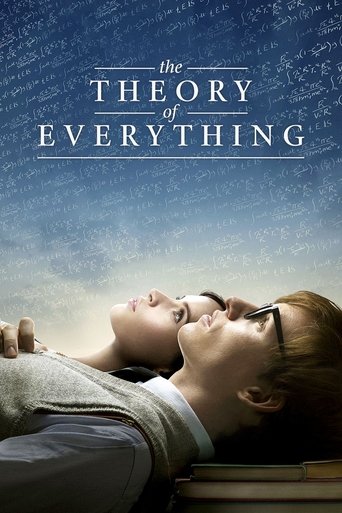
The Theory of Everything
2014 · Film · 123 min
Directed by James Marsh
Once a healthy, active young man, Hawking received an earth-shattering diagnosis at 21 years of age. With Jane fighting tirelessly by his side, Stephen embarks on his most ambitious scientific work, studying the very thing he now has precious little of – time.
4 positive1 negative3 neutralfrom 8 commenters
Where to watch
No streaming data for this title.


9 comments on Hacker News
This sounds amazing, like the many scenes from science-themed movies that feature two scientists, often an elder and a younger. The younger is scrawling out the solution to some near-intractable problem on the blackboard, while the elder guides and goads, perhaps pointing out a flaw in the proof or an overlooked detail. I believe Good Will Hunting and Theory of Everything had scenes like this.
Regrettably I've squandered my youth and it's too late for my chance at the blackboard, solving something really hard under the eye of a judging but patient mentor. So now I code webshit for a living. Congrats on that doctorate, man.
The Martian’s Daughter written by his daughter who was also an intellectual.
https://www.press.umich.edu/4655298/martians_daughter
Given the success of “The Imitation Game” and “The Theory of Everything” I’m disappointed that no one has made a compelling movie about Von Neumann who I think is a far more interesting character both mentally and in terms of personality.
I’m a longtime podcast listener. The podcasting world did change a lot. The last two years the companies I’ve worked for both decided that it would be a great idea to release something for marketing purposes.
The reason why podcasting works was because it was its own little internet within the internet. People with great stories, content that was just different en often more specific and niece then sites and video.
We’ll see where it’s going to end up, but I do worried about the current fight of who is going to be the podcasting platform. The power for me was the sense of independence the creators had making it feel more like a labor of love then a marketing machine.
Some of my current favorites:
S-town: powerful storytelling, makes you wonder how much power the storyteller has. It’s a non fiction story about an interesting individual, explaining more would be a spoiler.
White vault: thriller show, starts off a bit clunky with the voice acting. But as a horror lover the story itself is well written and it just works so well as a podcast.
Benjamin walkers - theory of everything: it’s on a league of its own. The creator is just as historied as the brains behind the npr and gimlet podcasts. It’s interesting because you start to understand that the lines between what is truth and what is fake is so thin. I think there is even an episode over this exact subject.
The big loop: great fiction storytelling most similar to the truth podcast but it takes more tune to tell the story, the little bit of extra space give the story a much deeper dimension.
Darknet diaries: fiction podcast about hackers, gentle deep dive in the hacker world with some amazing stories. The author really does understand the world and you just feel the amount of research that goes into each episode.
If you watch the movie about his life, "The Theory of Everything", they make it really clear how much she held him together.
I liked the movie, "The Theory of Everything", which allowed for more people to learn about this phenomenal human being. [1] I also liked his appearances in shows (like The Big Bang Theory). We would've looked forward to a lot more from him! He will be missed!
[1]: https://en.wikipedia.org/wiki/The_Theory_of_Everything_(2014_film)
There is another one - The Theory of Everything (2014) http://www.imdb.com/title/tt2980516/
You're absolutely right. But the movie is not meant to be a documentary about the math, it is meant to be a story about his life. The same goes for Theory of Everything, Imitation Game, and A Beautiful Mind. The different here is that what math they show is actually correct.
I was also disappointed that the discussion afterwards put so much emphasis on him as a person, and not on the actual math, but I don't hold that against the film itself. Movies about artists and authors have never been about their works of art either: the movies are about their lives, and I think it is appropriate for cinema to be used as a medium for biography rather than as a medium for education.
Huh. I was at the same showing and didn't care for it much. The movie only rarely touched on the mathematics and instead focused on his life and personal troubles. At least Theory of Everything and Imitation Game actually showed a bit of work happening. The closest we get in this movie is a bit of argument about primes and then a little of his partitions work (at an extremely consumable level, so much so it was boring). I kept thinking "Hmm, I wonder why they felt hiding mathematics and making it a personal biopic was better than getting people interested in the actual math?".
In my opinion, Carl Sagan's books remain a much better "popular interest in X" method. Explain things to people, sometimes slowly or incompletely, but avoid the hero worship.
I was lucky enough to see The Man Who Knew Infinity this past weekend at the San Francisco International Film Festival. And I'd just like to say that it is a truly beautiful film, and I encourage everyone to go see it.
After the showing, there was a panel discussion with the director, composer, producer, two actors (Stephen Fry!), and three consulting mathematicians who helped the production. One of the topics that came up was the recent (finally!) interest in Hollywood for making movies about technical people. Since the dawn of cinema, we've made movies about artists, writers, and poets. But it is only recently that we've started making movies about scientists (Stephen Hawking) and mathematicians (Alan Turing).
In my opinion, this movie puts both The Theory of Everything and The Imitation Game to shame. It is much more moving and beautiful than both, and it doesn't fall into the either the trap of overly simplifying the math, nor of overly dramatizing his life. If you have any interest in math, science, or computer science (much of which is underpinned by his work in number theory), I highly encourage you to go see this film.