 Hacker Cinema
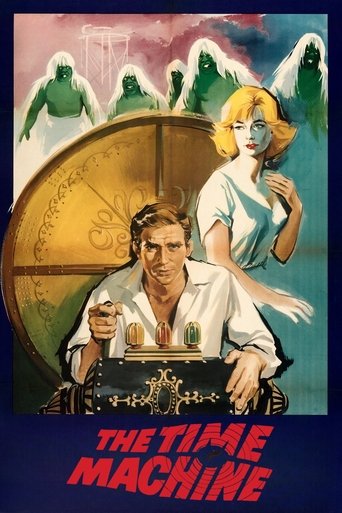
The Time Machine
1960 · Film · 103 min
Directed by George Pal
ThrillerAdventureFantasyScience FictionRomance
A Victorian Englishman travels to the far future and finds that humanity has divided into two hostile species.
3 positive6 neutralfrom 9 commenters
Where to watch
No streaming data for this title.



10 comments on Hacker News
The dystopian era of SF movies started in 1972 with Silent Running.[1] That was the first "grubby future" Hollywood movie, and is an obscure but notable milestone in cinema history.
There was early dystopian SF. H.G. Wells' The Time Machine ends with a dystopia. E. M. Foester's The Machine Stops (1909) was way, way ahead of its time.
Vashti’s next move was to turn off the isolation switch, and all the accumulations of the last three minutes burst upon her. The room was filled with the noise of bells, and speaking-tubes. What was the new food like? Could she recommend it? Has she had any ideas lately? Might one tell her one’s own ideas? Would she make an engagement to visit the public nurseries at an early date? — say this day month.
To most of these questions she replied with irritation — a growing quality in that accelerated age. She said that the new food was horrible. That she could not visit the public nurseries through press of engagements. That she had no ideas of her own but had just been told one-that four stars and three in the middle were like a man: she doubted there was much in it. Then she switched off her correspondents, for it was time to deliver her lecture on Australian music.
The clumsy system of public gatherings had been long since abandoned; neither Vashti nor her audience stirred from their rooms. Seated in her armchair she spoke, while they in their armchairs heard her, fairly well, and saw her, fairly well. She opened with a humorous account of music in the pre-Mongolian epoch, and went on to describe the great outburst of song that followed the Chinese conquest. Remote and primæval as were the methods of I-San-So and the Brisbane school, she yet felt (she said) that study of them might repay the musicians of today: they had freshness; they had, above all, ideas. Her lecture, which lasted ten minutes, was well received, and at its conclusion she and many of her audience listened to a lecture on the sea; there were ideas to be got from the sea; the speaker had donned a respirator and visited it lately. Then she fed, talked to many friends, had a bath, talked again, and summoned her bed.
Social media. 1909.
[1] https://en.wikipedia.org/wiki/Silent_Running
[2] https://en.wikipedia.org/wiki/The_Machine_Stops
> I've watched way too many movies depicting americans wearing shoes not only inside their home but in bed
This indeed is how Hollywood popularly depicted Americans, as wearing shoes to bed, in the bathtub or shower, while swimming, and so on. There's the famous line the the Humphrey Bogart / Katherine Hepburn film "A Time To Stand" where the robbers tell Bogie they're going to clean him out, and he says "you can take whatever you want, but you're not getting my shoes!"
There was an episode of This American Life where they delved into Hollywood's preoccupation with people never (ever) taking off their shoes, and one of the things they go into is how Johnston & Murphy (old shoe company) was one of the biggest funders of the original Silver Age studios. It was maybe the first instance of product placement, right up there with cigarettes. Of course Congress eventually got involved in the late 50s and pushed the shoe industry out, paving the way for movies like George Pal's "The Time Machine" which scandalously showed Yvette Mimiuex's bare feet. The French were laughing at us, though, with directors life Truffaut and Godard already showing casual barefootedness in their experimental shorts ("La Pantoufle Perdue" being the best-known and most influential).
https://en.wikipedia.org/wiki/The_Time_Machine_(1960_film)
The Time Machine starring Rod Taylor is a charming film from Nineteen Sixty based on the HG Wells book of the same name from 1895. Might not be a bad idea for your 12 year old to read the book too, only perhaps after watching the movie.
I asked ChatGPT. It gave me bunch. I got some I've never heard of. I think I'll look into them.
<ChatGPT>
list 50 interesting movies that explore AI.
The Matrix
Ex Machina
Blade Runner
The Terminator
I, Robot
The War of the Worlds
A.I. Artificial Intelligence
Transcendence
The Fifth Element
2001: A Space Odyssey
WarGames
Westworld
The Machine
Her
The Iron Giant
Automata
The Truman Show
The Prestige
The Martian
The Fly
The Bicentennial Man
Surrogates
The Day the Earth Stood Still
Limitless
Robocop
Electric Dreams
The Island
The Time Machine
The Circle
The Arrival
The Host
The Stepford Wives
The Brain that Wouldn't Die
Frankenstein
The Invisible Man
Metropolis
The Thing
Jurassic Park
Independence Day
Gravity
Artificial Intelligence: AI
Avatar
The Hitchhiker's Guide to the Galaxy
The Matrix Reloaded
The Matrix Revolutions
Inception
Interstellar
The Time Traveler's Wife
The Butterfly Effect
The Future.
</ChatGPT>
Well-written, reflective piece of science history. People's reactions are seldom mentioned.
It got me thinking about what H.G. Wells (surely!) had to say on the topic. (Of course.) I ran across this:
"H G Wells coined the term “atomic bomb” in his 1914 novel The World Set Free, which depicted a mid-20th-century war fought with radioactive bombs that exploded – and then kept exploding, poisoning the area with radiation."
[https://theconversation.com/even-before-hiroshima-people-knew-the-atomic-bomb-45271]
The article links to the Gutenberg copy of the novel, which includes a 1921 preface by Wells.
[https://www.gutenberg.org/files/1059/1059-h/1059-h.htm]
I've been listening to an audiobook of 'The Time Machine'. It's not there but: In his 1960 movie, George Pal's screenplay wrote-in a stop in 1966 for the Time Traveller - so he could experience the explosion of a 'nuclear satellite'. I suspect that scene was derived from TWSF, in which "The bomb flashed blinding scarlet in mid-air...."
This is definitely the smartest video I've seen in years, perhaps ever.
Questions I have: If the apple were traveling back in time would it essentially be falling away from the earth instead of falling into it? Would traveling forwards in time like George did in The Time Machine 1960 film (or the unnamed protagonist of the book), would essentially get crushed by ramming himself into the earth? I like these notions because it helps relieve me of grandfather paradoxes of time travel and make me dream of travel to the stars without having to forever say goodbye. Also like the fact that it doesn't require an extra incomprehensible dimension like in the case of warp bubbles.
Indeed. I'll continue to enjoy George Pal's 'Time Machine' film, despite the fact that I haven't seen any store-window mannikins for a couple of decades.
A great story is great despite its setting, not because of it. 'Moby Dick' will continue to be powerful despite the expiry of whale-hunting; 'Sherlock' still spellbinding despite the extinction of persian slippers, pleasant landladies and street-cabs. Quite sure there'll never be an AI character quite as interesting.
Website overloaded... here's a cache.
http://webcache.googleusercontent.com/search?q=cache%3Ahttps%3A%2F%2Fweb.law.duke.edu%2Fcspd%2Fpublicdomainday%2F2017%2Fpre-1976
"What books would be entering the public domain if we had the pre-1978 copyright laws?"
Harper Lee, To Kill a Mockingbird John Updike, Rabbit, Run Joy Adamson, Born Free: A Lioness of Two Worlds William L. Shirer, The Rise and Fall of the Third Reich: A History of Nazi Germany Friedrich A. Hayek, The Constitution of Liberty Daniel Bell, The End of Ideology: On the Exhaustion of Political Ideas in the Fifties Arthur M. Schlesinger, Jr., The Politics of Upheaval: The Age of Roosevelt Dr. Seuss, Green Eggs and Ham and One Fish Two Fish Red Fish Blue Fish Scott O’Dell, Island of the Blue Dolphins John Barth, The Sot-Weed Factor Jean-Paul Sartre, Critique de la raison dialectique
"Consider the films and television shows from 1960 that would have become available this year."
The Time Machine Psycho Spartacus Exodus The Apartment Inherit the Wind The Magnificent Seven Ocean’s 11 The Alamo The Andy Griffith Show (first episodes) The Flintstones (first episodes)
Also listed: songs from 1960 (e.g. Elvis's "It's Now or Never"), and copyrighted scientific research from 1960 still behind paywalls (e.g. 1960 papers on the structure of hemoglobin and myoglobin).
You just described the plot of The Time Machine by H G Wells.
I also recommend the movie (the original).
>quantum computers should be able to eat though any of today's crypto
Please read:
Wikipedia:One Time Pad
or
"My crypto assumes RH(Riemann hypothesis)" if it can be broken, RH is proved. Thank you `quantum quack quack quamputer!
Or if you actually believe this
Wikipedia: The Time Machine(film)
Grrrrrrrrrrr...