 Hacker Cinema
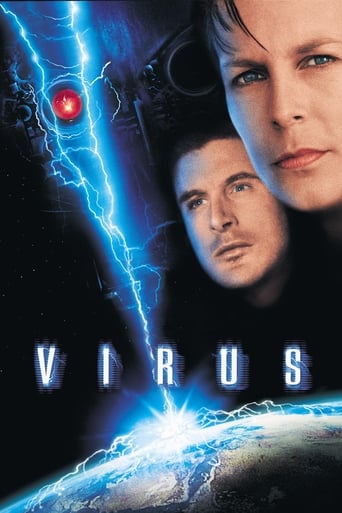
Virus
1999 · Film · 100 min
Directed by John Bruno
When the crew of an American tugboat boards an abandoned Russian research vessel, the alien life form aboard regards them as a virus which must be destroyed.
2 positive2 negative1 mixed3 neutralfrom 8 commenters
Where to watch
No streaming data for this title.


10 comments on Hacker News
This would make for a great movie. It would be like the movie Virus, but more about robotic survival after humans are gone.
The first movie I really remember seeing him in was Virus. By all accounts it is a pretty bad movie, but I liked it a lot as a kid and it scared the crap out of me.
https://www.imdb.com/title/tt0120458/
Virus was an awful movie, not redeemed by the honorable efforts of those among its actors who understood there was nothing about it that needed taking seriously.
There is an automatic response system ARS in place. On both sides. Tit for tat was still a thing decades ago, until it was mathematically proven to be not a good strategy.
Movie recommendation: https://letterboxd.com/film/virus/ The better japanese version is also on youtube.
Virus (1999)
An American tugboat crew finds an abandoned Russian research vessel. Very good special effects and overall a pretty unique movie, but poor execution. I guess it doesn't stand the test of time but I liked the oppressive atmosphere when I was young. Watch this if you liked System Shock.
Let's be honest: It prevented some and created others.
We got a wealth of free tools that allowed us to create things like Slashdot without crippling license fees and we got a wealth of cheap IoT and poorly programmed devices that can DDOS and bring down GitHub.
In the 1990s the fear was that Microsoft would take over everything. Now the concern is that Linux will show up in places it has no business being, collecting data it doesn't need, and connecting to services that aren't necessary, all in what should be simple, dumb appliances like your refrigerator or washing machine.
The kinds of hacks that were absolutely, hilariously laughable in movies like Virus are now quite plausible. Blender went berserk and set the kitchen on fire? Who would've guessed that's actually practical now, given a sufficiently Internet of Thingsy appliance.
I can't help but think of the movie Virus[1], which scared the living shit out of my 10-year-old self.
---
[1] http://www.imdb.com/title/tt0120458/
Native Russian speaker here - I often laugh during movies when they show Russian writing. 90% of the time, it's random gibberish.
The only time when the gibberish didn't seem random was during the movie Virus - there's a scene where they are choosing which language to display a control panel in, and one of the options is "Ebonics" - and the Russian underneath is just a random mix of letters, while the other Russian labeling was completely accurate.
New iteration of an old problem. Not sure if I was the "Kodak spokesman" he referred to.
---
Movie Answer Man
Roger Ebert / February 7, 1999
Q. In your recent review of "Virus", you commented: "It didn't help that the print I saw was so underlit that often I could see hardly anything on the screen. Was that because the movie was filmed that way, or because the projector bulb was dimmed to extend its life span?" A dirty secret is that movies are under-lit in most theaters. Films are produced with the intent that they be projected at the brightness of 16 foot-lamberts. Field research by Kodak found that they are often shown at 8-10 foot-lamberts, well under the SMPTE standard for brightness. To get theaters up to this and other standards, Kodak is introducing the Screencheck Experience program. The under-lighting of screens may be acceptable for a few movies--lest you see the entirety of their badness--but in general it unnecessarily degrades the theater experience. (Carl Donath, Rochester NY)
A. I've seen thousands of movies and I believe the Screencheck Experience program would only confirm that "Virus" was severely deprived of foot-lamberts when I saw it in a Chicago theater not a million miles from the Water Tower. Martin Scorsese, who travels with a light meter, once told me movies are projected at the correct brilliance in New York and Los Angeles, because that's where the filmmakers live, and they squawk. In a lot of other places, he said, the theaters turn down the juice to save on the replacement costs of expensive bulbs.
New incarnation of an old issue.
---
Movie Answer Man
Roger Ebert / February 7, 1999
Q. In your recent review of "Virus", you commented: "It didn't help that the print I saw was so underlit that often I could see hardly anything on the screen. Was that because the movie was filmed that way, or because the projector bulb was dimmed to extend its life span?" A dirty secret is that movies are under-lit in most theaters. Films are produced with the intent that they be projected at the brightness of 16 foot-lamberts. Field research by Kodak found that they are often shown at 8-10 foot-lamberts, well under the SMPTE standard for brightness. To get theaters up to this and other standards, Kodak is introducing the Screencheck Experience program. The under-lighting of screens may be acceptable for a few movies--lest you see the entirety of their badness--but in general it unnecessarily degrades the theater experience. (Carl Donath, Rochester NY)
A. I've seen thousands of movies and I believe the Screencheck Experience program would only confirm that "Virus" was severely deprived of foot-lamberts when I saw it in a Chicago theater not a million miles from the Water Tower. Martin Scorsese, who travels with a light meter, once told me movies are projected at the correct brilliance in New York and Los Angeles, because that's where the filmmakers live, and they squawk. In a lot of other places, he said, the theaters turn down the juice to save on the replacement costs of expensive bulbs.