 Hacker Cinema
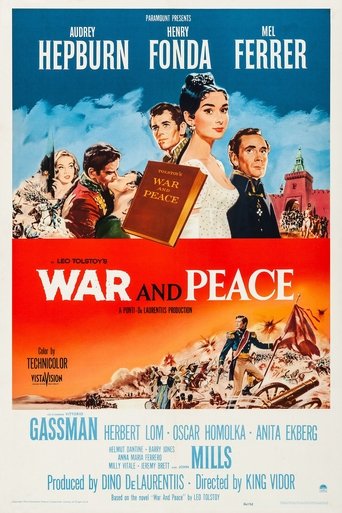
War and Peace
1956 · Film · 208 min
Directed by King Vidor
The love story of young Countess Natasha Rostova and Count Pierre Bezukhov is interwoven with the Great Patriotic War of 1812 against Napoleon's invading army.
3 positive7 neutralfrom 10 commenters
Where to watch
No streaming data for this title.



10 comments on Hacker News
I listened to the audio book version of War and Peace. I think it was something like 25-30 hours. The audio format helped keep the pace going and also it helped with the names. Although for some things, the audio format made it harder to look up in the dictionary, like I kept hearing agitant instead of adjutant, so that part didn't make sense in a lot of the military scenes. I agree with the parent that the book was very engaging, parts even felt like I was watching a movie, e.g. the drunken party tying a bear to a police officer, the foxhunt scene, the duel, the battles like when Petya gets shot, and the burning of Moscow. I even liked the abstract ending when Tolstoy relates human history to calculus so that each individual person has an infinitesimal but real contribution to history.
> "Ivan Vasilievich Changes His Profession" was made in 1973 on a budget that was modest even by Soviet standards. It looks like a cheap TV movie
To be fair, it looks just like any other Soviet movie from that era ("The Diamond Arm", "Afonya", "Shurik's Adventures", etc.), with the exception of the few that were considered "mega projects' by the government ("War and Peace").
re your username, The War and Peace films are probably the most accurate films based on novels I have ever seen. Everything was recreated down to the smallest detail, the smallest microexpression written by Tolstoy
War and Peace is fairly interesting, in the sense the battle scenes really detailed and action packed, even more than can be shown in movies.
This is a national meme in Russia. War and Peace is mandatory reading in schools, but it's always only 3-4 students in class who really read it. Most students just skim through ("read diagonally", as we say), use summary or watch the movie.
Some Russian books are heavy going because of the often use of several 'different' names for their characters: you get the surname alone, the first name and patronym (parent's name), the first name alone, and the colloquial use of the first name all referring to the same person. As an example, using an English name: you might get "Smith", "James, son of Michael", "James", and "Jimmy", all of which can equally apply to a person called "James Smith".
But the classic Russian writers are famous because of their writing, same as French, English and American authors are.
Some of the most famous Russian books include 'Anna Karenina', 'War and Peace' and 'Doctor Zhivago', and these three have been made into Russian and/or Western films. Like all films, the film versions often cut out whole swathes of the original story, but can give an outline of what the books contain.
I think the wide variety of characters and entourages is something that novels can pull off way better than film, as https://news.ycombinator.com/item?id=24746574 observed. Screenplays are not as dense as novel pages, and even so they're unlikely to run over 120 pages.
====
"War and Peace" has also spun off an entire genre of jokes:
Natasha Rostova is at ball. First Prince Bolkonsky asks to dance. Natasha says, "Why, Andrey Nikolayevich, there is some cake on your moustache." Bolkonsky begs leave to go clean up.
Then Pierre Bezukohov asks to dance. Natasha says, "Why, mon cher, someone has spilled wine on your sleeve." Bezukhov begs leave to go clean up.
Finally Lt. Rzhevsky asks to dance. Natasha says, "Why, Poruchik, there is some mud on your boots." Rzhevsky quickly answers, "Don't worry your pretty little head, Mam'zelle, that's not mud, it's shit. Anyway, after it dries it'll fall off all by itself."
====
Bonus clip: https://www.youtube.com/watch?v=NFPIGNua5WM&t=78
Books are also dangerous. Because the amount of effort you have to invest in a book is quite large people tend to develop biases around a book.
It's a strange phenomena. The more effort someone invests in something the higher their bias towards it. Much is the same for books.
I know of no human who has read every detail of the books war and peace or Moby dick with their own free will and came out saying that the plot was total crap. It's literally because the energy placed into finishing the book is so high that the bias is even higher.
Movie adaptations of said books will likely have terrible plots even when the plots are literally identical to the books. The only thing missing from the movies is your bias.
Note that this does not mean I am saying books are bad. They do offer things that online articles fail to offer. Just wanted to note that almost no one mentioned the dark side of investing so much time into books.
>Derrida takes a really simple concept and then dresses it up in so much complicated irrelevant nonsense that you have to take 30 minutes to deconstruct and understand an essay, that could be sufficiently restated in perhaps a paragraph of clear English.
Can you give an example? Because I've read Derrida (and other continental and US philosophers) and I've not seen that.
It should be easy. Just post an essay of his, and then your paragraph of clear English that "sufficiently restates" it.
I find that most people conflate "sufficiently restates" with something like Cliffs Notes.
Or with "seeing the movie" (e.g. War And Peace) instead of reading the book.
Or even worse with some general "plot", like: "War and Peace is the story of some families in Russia when Napoleon invades and a guy that tries to kill him" as opposed to the whole philosophical, artistic, literature, poetic etc content of the book.
I'd read a story written as a dataflow diagram if it made good use of the format.
War and Peace has been made into a movie at least half a dozen times.