 Hacker Cinema
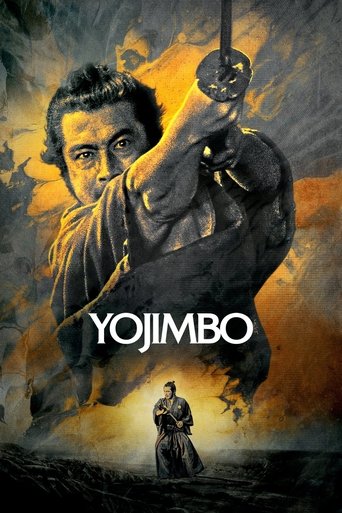
Yojimbo
用心棒
1961 · Film · 110 min
Directed by Akira Kurosawa
A nameless ronin, or samurai with no master, enters a small village in feudal Japan where two rival businessmen are struggling for control of the local gambling trade. Taking the name Sanjuro Kuwabatake, the ronin convinces both silk merchant Tazaemon and sake merchant Tokuemon to hire him as a personal bodyguard, then artfully sets in motion a full-scale gang war between the two ambitious and unscrupulous men.
3 positive1 mixed7 neutralfrom 11 commenters
Where to watch
No streaming data for this title.

13 comments on Hacker News
More of a trope about the styling and colour palatte of now classic films set in Mexican territories (but often filmed elsewhere):
Spaghetti westerns were a series of western films pioneered by Sergio Leone in the 70’s mostly starring Clint Eastwood. They have a very specific style to them. Mostly shot on anamorphic widescreen, they developed a language using editing and framing for confrontations between the gunslingers as well as using and updating Akira Kurosawa’s style. A lot of them are straight up remakes of Kurosawa films (A fistful of dollars is Yojimbo, Magnificent 7 is 7 samurai). The films had a bit of a sepia look to them but that mostly came from the art direction and the wide open desert spaces they shot at. They would use a handful of shots from the west here and there but most of them were actually shot in southern Spain with Italian and Spanish crews. Widescreen aspect ratio, tight closeups (chin to eyebrows), quick cuts timed to the music (provided by the great Enio Moricone). The Good, the Bad and the Ugly is seen as the masterpiece of the series (known as the man with no name series). Another major one is Once Upon a Time in the West. Tareantino is heavily influenced by this stayle and pays direct homage to him on both Kill Bill Vol 2 and Hateful 8. This might be able to give you a slightly more modernized rendition of Leone’s style. from: https://old.reddit.com/r/colorists/comments/rs7igu/spaghetti_western_look/
but you can find similar comments across many film boards.
Hosting video is expensive; a Twitch streamer (Thor) mentioned that an 8-hour stream at 1080p with 8,000 viewers costs Twitch nearly $5,000, while 720p still costs around $1,300.
Personally, I prefer 720p. It's easy to play on any device, the file sizes are much smaller, and the quality is fine. I don't need 4K for most content and save it for exceptional visuals like Godfrey Reggio's Trilogy or Yojimbo — one of the most visually stunning movies I've ever seen in high resolution. My preference also reduces hosting costs for platforms, at least from my account.
Social media constantly pushes high-res, addictive content, but alternatives like Fediverse exist. After adjusting to these communities, I deleted my X account and rarely use Facebook. On Fediverse, server operators encourage efficient file sizes (and types,) unlike Instagram or TikTok.
The network effect drives people to the few social networks, but I'm not convinced people actually want what they're being given. Repeating for emphasis: I'm not convinced this is what people want!
There's a whole bunch of his films I'd put squarely in my all-time list. Ikiru, Ran, Seven Samurai, Yojimbo, High and Low, Dersu Uzala, Rashomon. It's one masterpiece after another. Try watching Seven Samurai and Ikiru back to back to really appreciate the genius of Takeshi Shimura as an actor.
Ennio Morricone single-handedly "invented" the typical style of Italo Western film music. US-American Western film music used to be lush orchestral scores, instead Morricone used electric guitars, whistling, screaming, Mariachi trumpet playing, various percussion instruments, etc. The music for "A Fistful of Dollars" was something people have never heard before.
However, I can see a similar approach in Masaru Satō's music for Kurosawa's Samurai movies with its sparse instrumentation and inclusion of jazz elements. The whole score is in stark contrast to the music of earlier Jidai-geki movies, which also favoured large sweeping orchestral music.
Given the fact that "A Fistful of Dollars" was basically a remake of Kurosawa's "Yojimbo", I have been wondering if Morricone had been influenced by Satō in any way.
This happens every time I go to Japan Society in NYC to see an old Japanese film.
I guess it's because it takes effort to get some of those films in good quality or because someone that represents the restoration company is sometimes present, but I don't understand why we're clapping after seeing Yojimbo or some other common film that has been easily available in HD for quite a long time.
Anyway, "Americans clapping after X" has been a meme for some time.
I'm going to take an unpopular stance here but I must disagree, at least to the extent that whilst details were done relatively well (although no better than, say, Total Recall's recent remake) the photography was not.
Here's a simple example: the chase scene to the water [1] vs [2]. In the first, you have a whopping 3 layers of background, the white water, the dark slum, the city in the back (and perhaps an extra layer of city) giving the scene immensity and depth. Even the proportion in which these layers cut the screen (each increasing in height and implied size with distance) help give further depth. The main character is clearly contrasted (including earlier [3]) and thus easily followed, with the eye naturally falling upon the action.
The drawing is neat and the spirit carries over to the sound: the fight is punctuated by long periods of silence both of the ear and of movement ("Music is the space between the notes." - Debussy - to say nothing of the enormous importance of empty space in both Chinese and Japanese art e.g. [5]).
I'll let you take a look at the movie version and see if you can find an understanding of these elements.
Here's an unrelated example of what I mean by the spirit being done well: [4]. Listen to both the steamroller-like momentum, and the way in which the lower voice emerge from the texture about halfway. It is actually incredibly difficult to play like this reliably despite the relative technical ease of the work, Gilels almost makes it sound like he took one, maybe two breaths only (a subtle change of texture splits the work).
[1] http://www.mangauk.com/gallery/albums/album-19/lg/gits_124.png
[2] http://sm.ign.com/t/ign_nordic/video/g/ghost-in-t/ghost-in-the-shell-water-fight-clip_en8r.640.jpg
[3] http://images.static-bluray.com/reviews/10635_4.jpg - literally framed!
[4] https://www.youtube.com/watch?v=Yu06WnXlPCY
[5] http://www.theartwolf.com/landscapes/hasegawa-tohaku-pine-trees.htm
More examples: https://i.ytimg.com/vi/yHfLyMAHrQE/maxresdefault.jpg
http://thecabot.org/wp-content/uploads/2017/04/the-godfather-1.jpg
https://a.ltrbxd.com/resized/sm/upload/bn/hi/lo/wd/yojimbo-1200-1200-675-675-crop-000000.jpg?k=092168c692
http://moviemezzanine.com/wp-content/uploads/spirited-2.jpg
http://i.imgur.com/DQuW037.jpg
https://i.ytimg.com/vi/K0c2HJ4AO6o/maxresdefault.jpg
Even though already perfectly enjoyable, I'm thinking Kurosawa films like Seven Samurai and Yojimbo. Man that would be something.
> It's a matter of if you think about it for a bit it makes no sense, it's logically impossible.
Let's take a look at a dictionary definition of culture: "the way of life, especially the general customs and beliefs, of a particular group of people at a particular time" (http://dictionary.cambridge.org/dictionary/british/culture)
Now, note the "particular group of people" part. A person can be a member of more than one group. Some groups are sub-groups of others; some overlap with others.
For example, I am an American, and as such I have been brought up in American culture, with many of the traditions and ideals that that entails; Thanksgiving, the 4th of July, a strong belief in civil liberties, and a love of strawberry rhubarb pie.
American culture is also a subset of Western European culture, with influences from Catholic and Protestant branches of Christianity, so while I am not myself Christian, I celebrate Christmas and Easter and have many Christian influences on my values and life.
However, I am also a member of other cultures. My most recent ancestors to travel to the US were Scottish; and so Scottish culture is also part of my culture, but not most other people in the US. I wear kilts to weddings, and have an uncle and cousin who play bagpipes at weddings and funerals. That's a part of my culture, but that is not a part of overall American culture.
I'm also a software engineer and computer geek, and involved in free software, advocacy for civil liberties online, advocate for strong encryption and privacy, and the like. This is a particular subculture that tends to promote strong protections for individual privacy and liberty, while openness and transparency on behalf of institutions such as corporations and governments. This is not part of mainstream American culture, but it is part of my culture; and this particular subculture spans multiple countries as well, so in many of these ways, I have more cultural values in common with a Brazilian or German who is also involved in these communities than I do with the average American.
There are many other subcultures I could describe myself as a member of. And the same goes for anyone you ask. "Culture" is not one big, monolithic thing with clear boundaries. Because it is a set of customs and beliefs shared with a group, that set can be larger or smaller, and stronger or weaker, depending on how big of a group you choose.
> And if "multiculturalism" whatever that is, is so great, you'd think someone would have come up with support for that notion by now beyond "Ethnic food!"
Food is a pretty fundamental part of any culture. As something that is necessary for sustaining life, it's something that everyone does. In almost every culture I've seen, meals are a large part of fostering community, of strengthening social bonds. You have meals with family, with friends, with coworkers. "Breaking bread" is a term rich with culture connotations of mutual trust, peace, welcoming, because sharing food with someone is so important; and the same holds in many other cultures, one of the most generous and welcoming things you can do is invite someone to your table and share your food with them.
So don't be so quick to dismiss "ethnic food" as an important part of multiculturalism. Food is in many ways the heart of of a culture, and exploring the food culture of another people can be a strong way to share something with them.
However, multiculturalism can extend far beyond that as well.
The musical heritage of America is quite strongly multicultural. Ragtime, blues, jazz, R&B, and hip-hop all have their roots in black culture in the US, but have had enormous influences in white culture as well. Of course a large amount of American musical traditions comes from Western European classical and pop traditions as well, and then there are a variety of folk traditions, such as Celtic, that have been integrated into the mainstream through bluegrass and country music.
But there's a lot more than just that. A large number of cultures have made substantial impact on film in America. Many of our "Western" genre is actually a product of Italy; but that in turn influence Akira Kurosawa in Japan, with Samurai westerns such as Yojimbo. His work has also influenced Western work, where The Magnificent Seven is a western remake of Kurosawa's Seven Samurai, and his The Hidden Fortress is one of the major influences on Star Wars.
Let's see, getting back to day to day life, Jewish culture has also had a fairly large impact; from Yiddish, we get words like "schmuck", "chutzpa" and "klutz". We also get bagels (oops, back to food again),
On the musical front again, some of the best American music like Gershwin's Rhapsody in Blue had roots in Western classical tradition, jazz, and klezmer, traditional Ashkenazi folk music.
I could go on, but man, detailing all of the positive effects of multiculturalism on American society could fill up hundreds of volumes of books, not just a single comment on HN.
> A murder seems to be ipso facto a hate crime.
That is not what is meant by the term "hate crime." Simply redefining a term that has a particular meaning to mean something else does not really add to the discussion.
I'll quote from Wikipedia:
> In both crime and law, hate crime (also known as bias-motivated crime) is a usually violent, prejudice motivated crime that occurs when a perpetrator targets a victim because of his or her perceived membership in a certain social group. Examples of such groups include but are not limited to: ethnicity, gender identity, disability, language, nationality, physical appearance, religion, or sexual orientation.
A "hate crime" is not simply any violent crime. It is a crime in which the attacker was motivated by their perception of the victim's membership of some other group.
There are several things that can motivate a criminal to commit a crime. Poverty, greed, hatred of a particular group, hatred of a particular person, sheer anti-social tendencies, and I'm sure many other motivating factors. Only one of these falls under the term "hate crime" as it is commonly defined; those crimes in which hatred of a particular group of people is a primary motivator.
If you look at the statistics I cited in a previous comment, while it is true that black on white murder happens more often than white on black, white on white murder far surpasses either (and likewise, black on black). No amount of arguing about the black on white vs. white on black levels of crime will make these intraracial crimes go away, and the levels of intraracial crime is a very strong signal that racial animus is not actually the motivation for the majority of crime that occurs.
The reason it is important to look at the motivation behind a crime, and not just the statistics about whether a crime happened, is that the motivations can help tell you the best way to reduce that type of crime in the future.
Hate crimes, in the sense of any crime committed on behalf of membership in some group, can be particularly dangerous because they can lead to either prolonged violence between those two groups, or ethnic cleansing or genocide. These types of crimes, when allowed to escalate, have escalated into some of the greatest atrocities of a last couple of centuries. Breaking the chain of hate-motivated violence by discouraging the use of rhetoric of hate, by changing laws that institutionalize disparities between these groups, and by applying harsher penalties to those crimes committed for these reasons, are some ways to deal with these types of crimes.
Crimes committed due to a hatred of a particular person, however, are fairly different. They are usually based on some aspect of those people's relationship; perhaps an abusive domestic relationship, a cheating spouse, or the like. Here, there isn't some group-based animus, but a dysfunctional personal relationship. Here, the better way to deal with the problems are to provide better outlets for change than violence; provide shelters for people to escape from abusive relationships, allow divorce, as it it preferable to violence or murder.
Crimes that are committed due to poverty, to people having as sense of hopelessness and no further opportunity but to turn to crime, are another kind of problem. Here providing better social services, better education, better access to affordable housing, and the like can all help take that pressure off that can push people over the edge.
In all of these cases, the actual perpetrators of actual crimes do need to be punished; there needs to be deterrence as well. However, on a societal level, there can be many things done to reduce the temptation and pressure to engage in criminal behavior. And even on the individual level, knowing someone's motivation for a crime can be important in rehabilitating them and reintroducing them back to society.
The story behind the remakes is pretty interesting all by themselves:
John Sturges' The Magnificent Seven (1960) was based on The Seven Samurai (1954)
When first released in America, the title for Kurosawa's film was "The Magnificent Seven", it created a stir and the rights for "The Seven Samurai" were bought for US$250 from the Toho Corporation, Toho entered into the contract under the pretense of being the sole copyright owner. Over the following 30 years, several lawsuits followed since Kurosawa hadn't received royalties and hadn't given consent to remakes, the end result of which was that Kurosawa and other principals were paid back royalties, but were countersued and Toho Corp ended up having to pay $50000 to MGM (who also gained the rights to any future remake of The Seven Samurai set as a Western). I guess in the real world, the Bandits end up winning after all.
Sergio Leone's A Fistful of Dollars (1964) was based on Yojimbo (1961).
Leone didn't acquire the rights to Yojimbo, he just went ahead and made the film, which was surprisingly successful. Kurosawa reportedly said, "I’ve seen your movie. It’s a very good movie. Unfortunately, it’s my movie." Leone is supposed to have settled out of court for 15% of worldwide residuals plus $100,000.
"The film begins with two bedraggled peasants, Tahei and Matashichi (Minoru Chiaki and Kamatari Fujiwara). Through conversation, they reveal that they had intended to fight alongside the Yamana clan, but turned up too late, were taken for soldiers of the defeated Akizuki clan, and forced to bury the dead. After quarreling and splitting up, the two are both captured again and forced to dig for gold in the Akizuki castle with other prisoners.
After an uprising, Tahei and Matashichi escape. Near a river they find gold marked with the crescent of the Akizuki clan. They thereafter travel with the General of the defeated Akizuki clan, Makabe Rokurōta (Toshiro Mifune), while escorting Princess Yuki Akizuki (Misa Uehara) and what remains of her family's gold to a secret territory. In order to keep her identity secret, Yuki poses as a mute.
During the mission, the peasants impede it and sometimes try to seize the gold. They are later joined by a farmer’s daughter (Toshiko Higuchi), whom they acquire from a slave-trader. Eventually, they are captured and held by Rokurōta's rival, who later unexpectedly sides with the Princess and Rokurōta.
The peasants stumble upon the gold, but are later captured, whereupon Rokurōta explains Yuki's true identity, and states that all of the gold has been used to restore her family's domain. The peasants are then dispatched, taking a single ryō. In the final scene, Tahei gives this to Matashichi to protect; but Matashichi allows Tahei to keep it."
Ok. Inspired, sure, you can see some parallels. Based off, no :) (at least not as The Magnificent Seven and For a Fistful of Dollars are based off Seven Samurais and Yojimbo).
Kurosawa has a wide range of styles - which is why I like to compare him to Kubrick, although Kurosawa usually stays within Edo period contexts while Kubrick also had a wide range of themes. My favorites so far are Seven Samurais, Yojimbo and Dreams. Don't be afraid of watching one of his films from the 50ies - because of their relatively quick pace, clear themes and modern looking cuts I find them highly enjoyable, not just as an educational experience, but with a genuinely high entertainment value even today. From an educational standpoint it's amazing to see the strong influences he had on Star Wars for example.
By that argument, no director could have been said to have ever created a film. The cinematographer did the photography, the scriptwriter did the writing, the SFX department did the effects, etc.
Woz did a spectacular job with the Apple I design, but it wasn't the only kit available at the time. And even then he used off-the-shelf parts like the MOS 6502. Matter of fact, a kit that slightly predated the Apple I was the KIM-1, which also used the 6502. Difference was that the KIM-1's designer Chuck Peddle also designed the 6502 processor (yep, the one Wozniak used).
Steve Jobs kept going throughout the years, long after Wozniak stopped: the original Mac, the NeXT computer, NeXTSTEP, Mac OS X, iPod, iPhone, iPad, iOS, all of these were as much the creation of Steve Jobs as Yojimbo was Akira Kurosawa's creation or 2001: A Space Odyssey was Stanley Kubrick's film.
I'll check some of these I haven't seen out. He's got a Hitchcock and Kurosawa film on there, and they're two of the finest directors of all time. Rashomon is actually one of my least favorite Kurosawa films, but it's still great - I just much more greatly like Ran (English: "Chaos", his best film), Ikiru ("Life", it drags towards the middle but the government council scene at the end is incredible), Kagemusha ("Shadow", wow what an incredible premise - really an overlooked masterpiece when looking at his career), and of course Seven Samurai. Then you've got Yojimbo which is an interesting story but kind of campy, and Rashomon which is a great piece of storytelling and a great piece of directing, but just isn't as satisfying of an experience as Ran, Ikiru, Kagemusha, or Seven Samurai. If I was recommending Kurosawa to a new viewer, I'd say watch them in that order, and then perhaps Rashomon.
I haven't seen all of Hitchcock's films, but it's something I've been meaning to do. The thing both of these directors (Kurosawa and Hitchcock) have in common - they're both absolutely obsessed with presentation. They don't waste a single scene in their movies. In their better films, Kurosawa and Hitchcock don't even waste a single shot - everything is perfectly constructed for a very specific reason. Really incredible experiences to watch them, and highly recommended for people who love movies, stories, or simply just art.