 Hacker Cinema
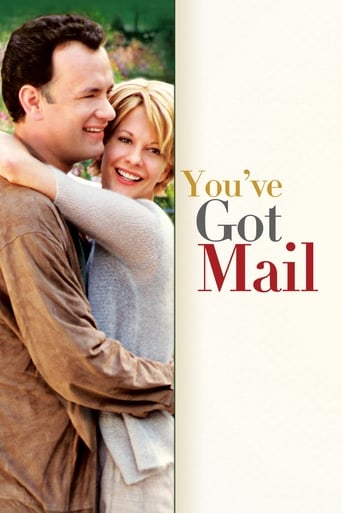
You've Got Mail
1998 · Film · 119 min
Directed by Nora Ephron
Book superstore magnate Joe Fox and independent book shop owner Kathleen Kelly fall in love in the anonymity of the Internet—both blissfully unaware that he's trying to put her out of business.
1 negative12 neutralfrom 13 commenters
Where to watch
No streaming data for this title.
14 comments on Hacker News
AOL was your ISP - you would connect via your telephone line instead of cable/fiber. Your modem would call their number and establish a connection. No one else could use the phone while you were online.
When you connected, it would load the AOL application which contained most of what AOL offered - built in AIM (AOL instant messaging), a web browser, group chats, keyword search, email, etc.
You were still connected to the internet and could use alternate browsers, but most people stayed inside the AOL app and ecosystem. Keywords were a time before search, where companies could buy keywords (from AOL) and then when people searched them they would show up. It was kinda a separate system from DNS that AOL tried to profit from.
You had competitors like Prodigy and CompuServe offering similar dial-up + custom app offers.
You wouldn't use the AOL app without having AOL dial-up service (although I recall them offering it separately late in its life, bring your own internet). People thought "AOL" was the internet. You might recall the classic "You've got mail" movie. That was from the AOL app which loaded after connecting.
aside: It's crazy how AOL could have become Facebook. AIM chat was the main focus - but AIM had "profiles" which you could customize, and I did - even with daily status updates. Modern Facebook is basically the reverse - profiles with a chat attached.
I always assumed that voice was one of those fake UI they do in the movies, in the movie "You've got mail".
The social web was blogs. That kind of peaked around 2008 and fizzled out after Google Reader was shut down a few years later. Which would be around the time Twitter and Facebook emerged. Before that you had things like various messengers ICQ, MSN, AOL, etc. that are long forgotten. And before that you had NNTP, which some people might still remember is where all the action used to be in the nineties. Before the web took off, you had things like gopher. But that never really took off and kind of was squeezed in between the early web and the BBSes of the nineteen eighties. Several of those things were popularized in popular culture (movies, etc.). You had War Games in the eighties. You've got Mail in the nineties. The social network. Etc.
In short, the social web has been around for decades in various forms. Mastodon has yet to make any impact in popular culture. I wouldn't necessarily call Mastodon very modern. It lacks basic security features (like content signatures or end to end encryption) and it's based on a random thing that W3C standardized some decades ago that never really took off otherwise. It wouldn't be too hard make it a bit more modern. But there's an odd resistance against doing sane things like that in the mastodon community. It's a very conservative community looking backwards at the past and not the future.
We had a ubiquitous continental data network back then. You can see it in operation in the old historical film, "You've Got Mail". The floppy installation disks were so plentiful they probably form a sedimentary stratum future geologists will use to identify the era.
'98, on the other hand seems really late for sending an email. America was online at that point. In fact, in '98 the concept of email was so ubiquitous that we got "You've got mail" [1] as a movie.
[1] https://en.wikipedia.org/wiki/You%27ve_Got_Mail
(1) You are correct in that placing both of those questions into Google doesn't quite get you anywhere near the answer that I imagine ChatGPT gives you (as you point out). Although, Google does "infer" which Bush you are talking about, there isn't a clear "this person is older" answer, you have to dive into the wiki pages basically to get the answer.
(2) Counter. I asked it the other day "how many movies were Tom Hanks and Meg Ryan in together" and the answer ChatGPT gave was 2 ... not only is that wrong it is astonishingly wrong (IMO). You could be forgiven for forgetting Ithaca from 2015. I could forgive ChatGPT for forgetting that one. But You've Got Mail? That's a very odd omission. So much so I'm genuinely curious how it could possible get the answer wrong in that way. And for the record, Google presents the correct answer (4) in a cut out segment right at the top, a result and presentation very close to what one would expect from ChatGPT.
I don't know about other use cases like generating stories (or tangentially art of any kind) for inspiration, etc. But as a search engine things like ChatGPT NEED to have attributions. If I ask the question "Does a submarine appear in the movie Battlefield Earth?" it will confidently answer "no". I _think_ that answer is right, but I'm not really all that confident it is right. It needs to present the reasons it thinks that is right. Something like "No. I believe this because (1) the keyword submarine doesn't appear in the IMDb keywords (<source>), (2) the word submarine doesn't appear in the wikipedia plot synopsis (<source>), (3) the film takes place in Denver (<source>) which is landlocked making it unlikely a submarine would be found in that location during the course of the film."
The Tom Hanks / Meg Ryan question/answer would at least more interesting if it explained how it managed to be so uniquely incorrect. That question will haunt me though ... there's some rule about this right? Asking about something you have above average knowledge in and watching someone confidently answer it incorrectly. How am I supposed to ever trust ChatGPT again about movie queries?
Hollywood has always been very bad at depicting tech! Till late 90s and also in the early 00s every computer in every movie had no GUI, no mouse, green phosphor displays and obviously beeped at every keypress.
There are exceptions: Jurassic Park, in 1993, featured a real UNIX system ("It's a UNIX system!"), a real SGI workstation with its GUI[0].
Modern online computers, aka the internet (with mouse and everything this time) made their debut in the mainstream "You've Got Mail" (1998).
As for Stranger Things, these are creative people, I guess instead of trying to be extremely accurate (and still get something wrong), they went for a credible yet not realistic way, featuring some easter-eggs in a post-modern fashion, so eventually geeks like us could scream: "Look! Iframes!!".
[0]: https://en.wikipedia.org/wiki/Fsn_(file_manager)
I know you are making a reference to 1998's "You've Got Mail!", but that movie was (besides being based on the earlier movie 1940's "The Shop Around The Corner" hence Meg Ryan's store, and the Hungarian play that movie was based on), inspired by the story of how NYC's Shakespeare & Co. bookstore was driven out of business by a new Barnes & Noble nearby. That Barnes & Noble has since closed itself.
This is like saying the movie You've Got Mail is about AOL.
The latest episode of the "Decoder Ring" podcast is about the rise and fall of indie booksellers + Barnes and Noble in NYC through the lens of "The Shop Around the Corner" and "You've Got Mail".
In the movies, the (thinly veiled) B&N is the big bad and it examines just why that is and sort of why people were so against it for what now seems like stupid reasons:
https://podcasts.apple.com/us/podcast/decoder-ring/
In fact, this is the premise of the film "You've Got Mail".
> Why was it audible? Why not, one could ask. [...] > Even then, the idea of not hearing what's happening > on a phone line you're calling on was quite new, > and modems would default to exposing the user to the handshake audio. [...] > > All you had to do to silence the handshake was to send the command ATM0 > down the serial line before dialing.
And I think the user was comforted by the ritual, as far as I can tell from conversations with my friends and scenes from pop culture like You've Got Mail.
I am for using the computer's own low-level apparatus as progress bars, instead of the opaque logos or polished animated graphics, blocking the view like a royal guard. For example, I wish my laptop and my phone listed the shell's output during boot, like some Linux distros still do. Even though most users wouldn't fully understand it --- and I have to admit that even I don't understand a lot of it --- the quickly scrolling text is no worse than an animated spinner in conveying, "Loading..."
I think most users, and I mean nontechnical, are okay with the exposure and even kind of like it. It makes them feel like they're in a spy movie. Some will never try to understand it and will just take it as a more-detailed progress spinner. Some will slowly become familiar with some of the lines, google them out of curiosity, and it may be the spark that lights them down the long trek to becoming a programmer. Isn't that one of our country's goals, to encourage kids to become programmers?
Anyway, my point is, I came to programming from graphic design and front-end. I spend a lot of time thinking about user-interface design. But maybe I'm against the grain in wanting some of the architecture to be allowed to hang out. (Does that make me a Brutalist?)
Well, one can make it up as one goes along, and indeed there's a whole strand of criticism built around the idea of revisionism, where we reconsider literary works in the light of chances that have occurred since they were written to gain new perspectives on meaning and interpretation - a trivial example would be reading older poems that include the word 'gay' (as in carefree) reinterpreted in the modern context where it implies homosexuality. Everyone knows that that secondary meaning was not and could not have been in the author's mind when the poem was composed, but the facts that we can't 'un-know' the modern meaning of 'gay,' and that it is possible for such revisionist reinterpretations to be meaningful or even moving despite the demonstrable absence of authorial intent to create such meaning tells us something important about the nature of the reading process, and thus of the thinking process that underlies it.
That said, symbolism generally is constructed deliberately. When I write fiction it's almost impossible for me to start at the beginning and proceed to the end - I start out with fragmentary ideas of momentary images, snatches of conversation and so on, and traverse them in sort of random fashion until the outline of a sequence emerges which suggests a plot. Various symbols will suggest themselves along the way, and one or two may 'click' by encapsulating or paralleling the story structure particularly well. Once I've identified one of those then it acts like structural reinforcement, so I'll go back and add it or emphasize it in various parts of the story where it seemed to fit well.
The symbol(s) you pick in turn become a source of new ideas for solving other plot/structure problems. So suppose I have a story about some lonely woman and I realize this person likes flowers (I didn't decide this, I just kept picturing her eating dinner alone but always with a vase of flowers on the table so I'll roll with it), and then it hits me that flowers have a short life and wilt and die so that's a good metaphor for my character's situation if she doesn't find love. This isn't a full story yet, though - why is this person lonely? Dunno, don't have any ideas...well I'll think about flowers a bit....vases...you need to water the...do you pick them or buy them...will they attract insects....oh wait, flowers use insects to pollinate, what if my character was stung by a bee and unconsciously displaced a fear of sex onto the incident? Now I have a story because I have a person in conflict with herself, impelled to seek love by the fact of time's passage but afraid of the emotional or physical risks that entails. Hmm, not only does my lead like flowers, but has become obsessed with them - she owns a chain of florists or she's a master flower arranger that supplies flowers for all the best weddings, and has put all the energy that normally goes into a romantic relationship into floral activities instead. Then she meets someone who's perfect, but maybe hates cut flowers, which is a problem because my florist is obsessed with having everything just so and needs to learn to accept other people as they are naturally...well now I have a whole little world here with numerous interconnected symbols and some obvious characters and situations that I can develop, and the name of the flower store and the story is 'Perfect Bouquet,' and it seems like it's going to be a romantic comedy.
Exploring and exaggerating the semantic associations of the initial floral symbol has provided me with a basic plot and a handful of obvious scenes that I can begin writing immediately. Most books on writing say things like imagine your characters, find out everything about them and flesh them out in detail, then put them together and see what they do...' I guess that works for some people but I think it's total crap. I don't know any florists or much about flowers, apart from a summer working for a commercial flower supplier when I was young (which was basically a warehouse job). But taking a generic person, an emotion, and finding some symbol that can embody that were enough to get the ball rolling.
You can do this in reverse too. Sticking with the romantic comedy genre, take You've Got Mail. Meg Ryan is a proto-hipster who owns a tiny local bookstore, Tom Hanks is the ruthless CEO of a bookstore chain that wants to put her out of business, and of course they have to fall in love (via the internet, which ironically has since put a large bookstore chain out of business - see my point above about revisionist readings, because it's interesting to ask whether Nora Ephron even contemplated that possibility when she wrote the film). Now the story structure is pretty generic - it's sort of Beauty and the Beast set in a bookstore, and BatB is in turn a metaphor for mating strategies. But why bookstores? Couldn't Meg Ryan have been a plucky neighborhood grocer being squeezed by the opening of a new Walmart store, or a feisty buggy whip maker fending off an encroaching automobile salesman. But that she sells books rather than vegetables or equine accessories suggests she's primarily contemplative and maybe sensual, as opposed to nurturing or dynamic, that she's a collector/curator rather than a consumer or maker, and so on and so on.
The process of exploring these semantic associations isn't a scientific one, and you're absolutely right that it can degenerate into horse shit that ends up telling us more about the critic's inner life than the work that is supposedly under scrutiny, but the inquiry is itself informative. Why is Jaws about a giant shark rather than a giant alligator or bear? It wouldn't be hard to imagine a story about a village near a swamp or a forest that was menaced by the appropriate animal and have the plot unfold quite similarly - creature features are among the oldest kinds of stories and thus among the most formulaic, but we don't mind because they're so relatable, as long as the personality of the Creature is developed sufficiently well. Symbols work like icebergs; the large part that is submerged (below the level of consciousness)serves as a foundation for the relatively small visible part: the authorial design is to present the reader with something whose significance is easy to underestimate but which will become clear during the development of the story.
I'm sorry, I meant You've got mail. Both films star Hanks and Ryan.