 Hacker Cinema
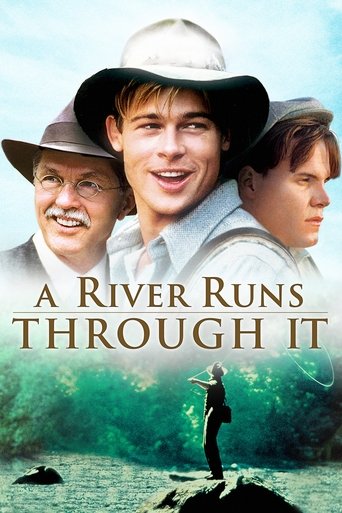
A River Runs Through It
1992 · Film · 123 min
Directed by Robert Redford
The Maclean brothers, Paul and Norman, live a relatively idyllic life in rural Montana, spending much of their time fly fishing. The sons of a minister, the boys eventually part company when Norman moves east to attend college, leaving his rebellious brother to find trouble back home. When Norman finally returns, the siblings resume their fishing outings, and assess where they've been and where they're going.
6 positive5 neutralfrom 11 commenters
Where to watch
No streaming data for this title.
11 comments on Hacker News
They should have some rivers in Montana -- probably most people's primary association of fly fishing is with Norman Maclean's autobiographical novella "A River Runs Through It" and Robert Redford's 1992 film of it.
The introduction to a river runs through it is an interesting read. I never realized how much creative influence Redford had over the production of the movie until I read it a few months ago.
Who Framed Roger Rabbit is arguably a classic, so it would have to be pretty stellar to be as good as at a film level!
People interested in the live action / toon might also want to see the 1992 "Cool World."
It is an early Brad Pitt film, squeezed oddly between Thelma and Louise and A River Runs Through It.
Unrelated but fun item for those interested in Roger Rabbit:
There was a ton of crossover between WFRR and Back to the Future Part Two.
Both films from the top (Amblin Entertainment, Zemeckis, Alan Silvestri) down to some of the production crews IIUC.
So if you listen to the soundtracks of both films they have ringing similarities!
I can't believe I'm not seeing any Guy Ritchie anywhere. Particularly Snatch, but Lock, Stock, and Two Smoking Barrels too.
And almost anything with Brad Pitt. Lots of votes for Fight Club, but what about Legends of the Fall, A River Runs Through It, 12 Monkeys, or Cool World?
And now that I'm thinking about it, Dances With Wolves. Lonesome Dove TV miniseries. Braveheart. The Departed. Lots more, I'm sure.
The Fog of War. It caused me to see geopolitics from both a simpler and more constantly ambiguous perspective.
A River Runs through It. Even more so the book, but the movie gets the job done: the meanings of our experiences only make sense once their dust has settled.
The Leftovers. I'm going to cheat a little and say a TV show here. Better than anything else, it draws a connection between the philosophical immensity of things like 2001/Interstellar and the real drama of everyday human lives.
Before streaming, a movie studio actually had to convince an audience to leave their houses and buy a ticket to make money from a movie. This meant the studio had to pour a lot of money into marketing for each movie. The cost to market a movie could be up $30M to $50M range for a blockbuster movie. For a mid-budget drama like Meet Joe Black or A River Runs Through It, you could be looking at a marketing budget that matches the production budget ($30M production + $30M marketing). These big marketing costs for every movie meant that the quality of those movies needed to be pretty high to justify the marketing costs. Streamers don’t have to convince people to go out and buy a ticket for every movie they release. They just have to keep the existing subscribers paying and get more people signing up. So the marketing cost per title goes way down. This takes some pressure off to make quality content because the risk per title is lower. Also quality movies on streamers don’t necessarily get the marketing and fanfare they would have before streaming.
Try somewhat off-beat American novels:
1. Lonesome Dove, by Larry McMurty
2. The Heart is a Lonely Hunter, by Carson McCullers
3. A Confederacy of Dunces, by John Kennedy Toole
They are great novels, and sadly, are less known than they should be. If you are into movies, there are great ones like "Paris, Texas" by the German director Wim Wenders, or "A River Runs Through It" by Robert Redford.
A River Runs Through It
I loved the multi-threaded story--a love affair with fishing, a coming-of-age story, and an ode to the beauty of Montana in a simpler time. The movie was better than the book. My son has lived the first of those threads on rivers like the Nooksack in Washington. For me the movie articulated the transience of human existence and the receding beauty of the natural world as time passes--a fading that grows within us as we age.
Edit: added last sentence
I've always liked the scene in the movie version of "A River Runs Through it" where the father is teaching his son to write, and has him write an essay, then says "half as long", several times.
That has actually been one of the best reminders for me regarding my efforts at writing. Write and compress until the essential points remain.
This is a bit ridiculous. Moving the summary to the beginning is no better. Simply write more concisely and elegantly.
My favorite illustration of this was in the movie "A River Runs Through It"—a young Norman brought his essays to his father, who would say always "Good. Now make it half as long." This was repeated a few times, then it was good enough. Would that more writers could follow this mantra.
Here's my take:
Art starts where (prior) science/utility/craft/trade stops giving you answers.
Take an abstract painting. The only functional requirements are that it covers a canvas which you can hang on a wall, and that it will interest viewers. Beyond those things there are really no 'answers' or 'directions,' so the 'artistic territory' begins immediately. If you've ever tried to make an abstract painting, you'll know that even when you don't know what the hell you're painting, you still know there are bits you like and bits you don't. The art is in exploring this uncharted territory to create a whole work that somehow pleases, albeit due to little understood principles ('why is this splotch of green more appealing than that blob of red?').
Take another piece of visual art, say a portrait - it's supposed to capture the likeness of the person, as well as fit on a canvas etc., so there's a bit further to travel before you're in pure artistic territory. If it's a piece of graphic design, an architectural sketch, most of the journey is just applying techniques to capture the functional requirements.
In a discipline like maths or engineering, most people, most of the time, are working well within the established techniques, to solve problems that have been solved countless times before. You need to go a long way to reach the cutting edge, where mathematics can become an art.[1]
Programming, however, sits somewhere in between. While it's nothing like abstract art, as we do have vast sums of established knowledge, plus best practices, standard techniques, etc., I'd wager that most programming projects have a very large quotient of 'the unknown' (as evidenced by the failure and lateness rate of IT projects). Therefore programming is in large part an art - there are often no well trodden routes to success, but the great programmers always seem to get there. They tame the unknown, but not in a way that can easily be transmitted to other workers/programmers.
When you see a piece of embroidery, it's artistic in the sense that we don't know exactly why it is appealing, but the person who 'crafted' it was probably not exercising any great artistic expression, just repeating an old design. Just because something's functional requirement is to be aesthtically pleasing, doesn't mean it's a 'craft' which is intrinsically different from disciplines which lack that particular functional requirement. We need to rethink what we mean by art and non-art. In paintings or music, the jump-off point is almost immediate: you have few functional requirements, and few relatively rules to guarantee results. From there onwards it's down to insight/ability on a fleeting, individual basis. With other disciplines, you have many functional requirements and many rules/procedures that let you meet those requirements if followed diligently. Sometimes aesthetic appeal is one of the requirements, sometimes not. But there comes a point once again where only individual insight/ability can bring further progress. Our only choice is to rely on talented people.
Have you ever seen the film, 'A River Runs Through It?' It's about two estranged brothers who are reunited in adulthood, and they think back to years before when their father would take them fishing. Their father said the most important thing for a man to have was 'art.' He didn't mean owning pictures, or painting them, he meant whatever vocatoin/profession/trade you choose, you need to make an 'art' of it. The narrator/protagonist's brother (played by Brad Pitt) was a failed person in some respects, but he had developed an incredible technique/knack for fishing that nobody else understood. Thus, he 'had art.'
So anyway, programming does not usually involve aesthetic appeal as a functional requirement, but it is sometimes an 'art.' I would conclude therefore that we need to listen to the advice of our greatest artists... but you can never replace the art with a formula.
[1] of course, we very often operate on the edge of our own abilities, but until we've reached a frontier where no one else has gone, our 'art' wont deserve any audience