 Hacker Cinema
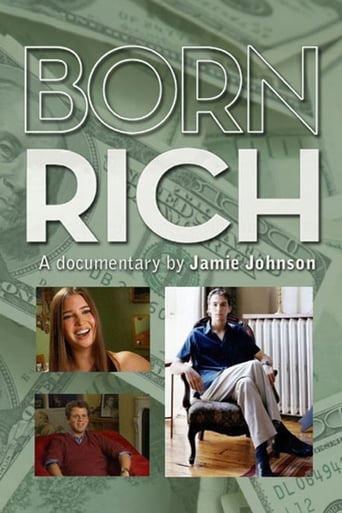
Born Rich
2003 · Film · documentary · 75 min
Directed by Jamie Johnson
A documentary on children of the insanely rich. Directed by one of their own, Johnson & Johnson heir, Jamie Johnson.
13 positive12 neutralfrom 25 commenters
Where to watch
No streaming data for this title.





37 comments on Hacker News
Pointing out somebody who was born into wealth who's good at a thing doesn't disprove his thesis.
I'd counter your example with another: the documentary Born Rich pretty well captures the article's point. There are lots of young people who were born into very wealthy families who clearly don't understand how anything works even at a basic level and at some points of the movie the more self-aware ones are anxious about and reflect on this fact.
For instance one admits that she doesn't understand how her credit card bill ends up with so much money on it every month, how people could possibly live on a fraction of what she spends, or how money is made or how expenses are paid. This fills with anxiety because she understands that she is utterly dependent on the largess of her family.
These are my all-time favorites. Sorry if not fitting your "watched in 2022" criteria.
Brother Can You Spare a Dime (1975) https://www.imdb.com/title/tt0072742/
Thank You For Not Breeding (10+ years ago) https://www.youtube.com/watch?v=abDpktpk7Is
The Atomic Cafe (1982) https://www.imdb.com/title/tt0083590/
Born Rich (2003) https://www.imdb.com/title/tt0342143/
Bonus documentaries (reality projections):
Idiocracy (2006) https://www.imdb.com/title/tt0387808/
Koyaanisqatsi(1982) https://www.imdb.com/title/tt0085809/
Brazil (1985) https://www.imdb.com/title/tt0088846/
> The wealthy have always enjoyed expensive lifestyles and hobbies.
Sorry to jump in.
There is a 2003 documentary by the name "Born Rich".
This is about the children from the wealthy people and how they are coping with the boredom of being able (afford) to do anything.
Many are naturally isolated and invent obscure hobbies and life-styles not fitting their "wealthy statuses".
Not sure how it is changing in more responsible adulthood, when it is becoming their turn to manage the estate. I guess this is then mostly about turf-wars among relatives.
(edit: formatting)
People don't feel velocity, only acceleration, starting from a point of wealth the children might get bored or just party all the time (see "Born Rich" documentary). I think its a great question: how to raise children from money, but not spoil them?
>Women, on the other hand, haven't been given the same advertising on the American dream that men have
There is a documentary, "Born Rich" [0]. It's interviews with the children of very rich people, done by one of their peers. I noticed that in the film there is stark difference between the girls and the boys: the girls were all well adjusted, enjoying their wealth, happy, satisfied, seemingly well-aware of their good fortune; but for ALL the boys wealth meant having a full-blown existential crisis.
This is oblique support for your claim: the classic American dream for women results in being taken care of by a wealthy man in a nice house, maybe with kids, where even house duties become negligible if he's really rich. But men and boys are supposed to work, first at learning then finding something you like then getting good at it. Your work defines you in a very profound way - a profundity that is reflected in our last names. If you're a rich boy, it's like you've been denied an identity. (I recall one of the young men who, to save his sanity, disavowed his inheritance to take a job as an oil field worker. And he seemed the best adjusted of the boys.).
0 - https://en.wikipedia.org/wiki/Born_Rich_(2003_film)
I have a quote that I put in my office in a prominent place. It says "Work done in the spirit of service is the highest form of worship." I really believe that and try to make my work a force of good. I feel too much work is a bad thing, but too little unfulfilling work is also not good.
Some people feel that if they were sufficiently rich, they will never work. I think one source of this view are the health effects of the sedentary lifestyle associated with tech, and I respect people who say that. It's all to common for people to be overworked in tech, so I understand people who want to exit for that reason too.
Still others, don't really enjoy work at all and would exit the workforce if given the opportunity. I respect that view too but it's not for me.
Because even if I had unlimited financial; resources I NEED to still work. I believe work, especially the kind that you feel is helping people and results in deep concentration called flow is beneficial for my mental health.
If I stopped working and entered a perma-vacation, I would go out of my mind. There are only so many golf courses, and so many days you can wake up late, before I would be bored out of my mind. When I go on vacation, I enjoy it and need it. But after about a week, I start to get bored and to miss work. I need a challenge.
There is a nice documentary called Born Rich by Jamie Johnson (one of the heirs to the Johnson & Johnson empire's wealth) in which he films the sons and daughters of billionaires (it's on YouTube). What I found fascinating is the happiest ones seemed to be those that applied themselves by working or in one case applying themselves in academia all the way to a PhD.
Even if I stopped my current start-up, I think I would find myself spending a few months catching up on technologies I didn't have the chance to catch up on, and imagine I would just start a new start-up after that.
They also form dynasties of generations of extremely wealthy children, grand-children, and grand-grand-children, etc.
It's arguable whether the people who originally accumulated all this wealth "earned" it (when many of them in large part merely took the wealth their employees made), but their descendants who just inherit their money certainly have in no way earned it. So should they get to keep it?
For an insightful look in to the world of inherited wealth, see the documentary Born Rich[1], made by the heir to the Johnson & Johnson fortune, where he interviews all his other friends, who, like him, were born in to enormously wealthy families.
[1] - https://www.youtube.com/watch?v=1sD3pG74Wv8
One interesting tell that I might have heard in Jamie Johnson's documentary "Born Rich" was talk of holidays.
If you talk about holidaying with one's family in some exotic locale or of having a summer home in the Hamptons, the person you're speaking with can surmise that you're not poor.
The rich kids in that documentary also regularly go out to bars and think nothing of spending hundreds or even thousands of dollars on champagne.
It's definitely not just about how one talks that signals to others that one is part of the upper class.. but once one is established as in the upper class, then things such as one's manner of speech might distinguish you.
To anyone interested in this, I'd highly recommend Born Rich.[1]
It's a documentary made by the heir to the Johnson & Johnson fortune, in which the film maker interviewed all his friends, who were also born in to incredibly wealthy families.
The director later filmed another documentary on the subject, The One Percent, but I didn't find it to be nearly as good.
[1] - https://www.youtube.com/watch?v=1sD3pG74Wv8
Wealth gets you access to the levers of power. A mere phone call from the likes of Gates, Buffett, or Zuckerberg will open more doors than most of us can dream of, and they don't have to spend a penny to do it.
The rich and powerful also tend to associate mostly with their own kind, which will skew their world view and priorities.[1]
The unspent money can also be used as collateral or leverage to earn more money.
Finally, the unspent money can be passed on to heirs to create an aristocratic class who inherit their status -- something the US founders were explicitly trying to avoid when founding the country. Unfortunately, the wealthy have found ways of subverting their intent.
[1] - For an example, see the excellent Born Rich documentary, made by one of the heirs to the Johnson and Johnson fortune, where he interviews all his friends, who were also born in to extremely wealthy families.
You could also give most of it away to a favorite charity, keeping however much you feel comfortable in owning.
There's a really interesting documentary called "Born Rich", which was made by one of the heirs to the Johnson & Johnson fortune, where he interviewed a lot of his friends who were all also born in to very wealthy families. They all had different ways of dealing with their circumstances, and I remember one of them did reject his family's fortune and tried to live an "ordinary" life.
There's a fascinating documentary called Born Rich[1], which was made by the heir to the Johnson & Johnson fortune, where he interviewed his friends who were also born in to incredibly wealthy families. It was interesting to see how differently they all reacted to it, some embracing their wealth and partying like mad, others rejecting it and trying to live a normal life. Highly recommended.
The documentary's director and some of the participants in this film and its sequel, The One Percent[2] (which was not nearly as good), got in a lot of trouble for talking about their family's wealth, presumably because the ultra-rich families really don't want a lot of attention. The blowback included lawsuits, and, if I'm remembering correctly, an adopted daughter of Warren Buffett's got disowned by him after her own participation in The One Percent, where she talked about him and what it was like for her to be part of his family.
[1] - https://dvd.netflix.com/Movie/Born-Rich/70008257
[2] - https://dvd.netflix.com/Movie/The-One-Percent/70092779
The top earners are the heirs who collect dividends, interest and rent - the rentiers in documentaries like Born Rich. They are unwilling to work, as the real hourly wage has sank in the US since the early 1970s, they have reaped all the benefit.
Far below them is a work force which is split in different skill levels. Only a handful of top school STEM majors graduate every year, then there are the rest.
Since in your universe larger social analysis is excluded, the answer comes down to each individual - their motivation and such.
Another interesting documentary about this topic is "Born Rich" by Jamie Johnson, one of the heirs to the Johnson & Johnson fortune. He interviews several of his peers. The film was nominated for two Emmys. It's available on YouTube at https://www.youtube.com/watch?v=km_JmxnzTvc.
There is a class if people who do not work, whose parents did not work, who themselves have parents who do not work. The type seen in the documentary "Born Rich". They get into the best universities as legacies.
You never hear talk of this idle class ensconced in inherited privilege and luxury. However, a few decades after Americans were lynching those of African descent, blowing up their little girls while they're going to church, executing them for voter registration drives etc. - a few decades after that if an attempt is made to push blacks at Stuyvesant above the 1 in 45 mark, in a city where 1 in 4 are black - then, only then do we hear about the need for meritocracy and so on. From the mouth of a man who got a "small loan of a million dollars" from his father, with his son-in-law who, according to Daniel Golden, bought his way into Harvard.
When am I going to see the articles about legacy admissions to the top colleges? I won't hold my breath.
Luxury for the idle class at the top, the rat race (with some national oppression of Africans, Lakota etc. thrown in) for everyone else. No thanks, I'll keep my sickle sharpened for a higher target.
> Heredity can be measured via twin studies - if twins are adopted into two different families or cultures: what commonalities can we still find, beyond random variability.
And how often does this happen? It is about as common as a sighting of the Higgs boson - and you need a large sample group. Of "identical" twins separated at birth (identical twins are not genetically identical) and sent to two culturally/class-based different families, with little contact.
The Pioneer Fund (you can read about them https://en.wikipedia.org/wiki/Pioneer_Fund ) funded studies like the Minnesota Twin Family Study, but it was found to have many deficiencies, such as what I noted. Often twins in the cohort were only raised apart for a few years and so forth.
On occasion I watch television, and see wealthy heirs like the Hilton heiresses or Kardashian heiresses, or watch documentaries like Born Rich with various heirs and heiresses, and it's quite obvious why such a class spends its money on endeavors that says nature rules over nurture. Like the heir Wickliffe Draper did with the Pioneer Fund. That they are born superior without having to work or do anything. For the past ten millennia they said the gods favored them, like Socrates noble lie ( https://en.wikipedia.org/wiki/Noble_lie#Plato's_Republic ). The popes crowned them king. In our post-enlightened age this does not work so now they say their superiority comes from chains of amino acids. Of course, history tends to depose of them any how, the God-ordained superior genetics of the Romanovs were not as well adapted as the Bolshevik soldiers who rid the earth of them (tangential note - their inbreeding caused hemophilia which brought in Rasputin and hastened their downfall). It's an argument for laziness and parasitism - to not look at people by their work, but by the genetic superiority which they were supposedly born with. It's pathetic and parasitic.
If money was distributed in the USA for something that is actually competitive, like athletics, then people of African descent would rule the country, as they seem to dominate this arena, even in venues like golf.
If you look at the wealthiest people in the US, they are people like the Koch brothers, who inherited their wealth, or the Walton heirs, who inherited their wealth, or the Mars children, who inherited their wealth, and so on.
You could also look at others. Bill Gates was born with a million dollar trust fund - his great-grandfather ran National City Bank, his mother was on United Way’s executive committee with the CEO of IBM, his father ran a law firm, he went to Lakeside high school (current annual fee: $33,000) which had teletypes and access to a GE mainframe in the late 1960s. Warren Buffett is also "self-made". His grandfather owned a chain of grocery stores, his father was a congressman, he went to UPenn and Columbia. Mark Zuckerberg's parents are professionals, he went to high school at Phillips Exeter (current tuition $36,000, more if boarding there).
The first group did absolutely nothing. They're not really being "rewarded" as the article says. They can just jet from Aspen to Monte Carlo their whole lives, expropriating surplus labor time from those of us who work and create wealth. You can watch the documentary "Born Rich" which was made by one of these people (it's sometimes on Youtube) and is about these people. The second group - 1%ers who made it into the 0.1%, I suppose transitioned from one class to another, and had a hand in codifying how a large number of people worked. Even doing some of the initial stuff themselves - porting BASIC to yet another platform, selling a CPM ripoff to mom's friend on United Way's board, starting yet another social network (and being sued for stealing it), beating the S&P 500 year after year.
This is all helped by a massive mechanism of basically all of society tilted to let this class of what I consider parasites to expropriate the surplus labor time of those of us who work. It's a social relationship - workers work and create wealth, and heirs expropriate our surplus labor time and the wealth we create during it. And use it as a cudgel against us not just in the world of business, and not just in the governments they created and maintained, and the schools those governments run, or the media they created and maintain and to a large extent monopolize, but also other social organizations as well like churches. Through the corporate owned news I learn Trump, an heir and businessman now running the government, this week signed a document which would allow churches to be more involved in selecting who is and is not in government. All goes into each other - you organize the wretched of the earth at the bottom of society to believe in some superstitious fantasies in order to select certain leaders who will be even more vehemently against their economic interests. One part of society flows into another, but it all flows back to the center, which is what we all wake up and do most days - work and production, and the relationship between the worker and those who are parasites on worker's labors and who have the upper hand at the moment.
Of course, several centuries ago it was the royal families who had the upper hand on the poor and the workers and the merchants, so these things seem to shift around as history marches on.
I highly recommend a documentary called Born Rich[1] to anyone interested in this sort of thing. It was made by one of the heirs of the Johnson and Johnson fortune, who interviews and follows the lives of many of his friends who were also, as the title says, born in to ultra wealthy families.
It's pretty interesting to see how differently they react to their privileged position, some of them embracing and others rejecting it. It was also interesting to see how the parents of these kids reacted to the documentary itself. Many of them were strongly against revealing anything to the public about themselves or their wealth.
The director of this movie also went on to make a follow-up documentary called The One Percent[2], which was not nearly as good.
[1] - https://dvd.netflix.com/Movie/Born-Rich/70008257
[2] - https://dvd.netflix.com/Movie/The-One-Percent/70092779
A good documentary on the subject: https://www.youtube.com/watch?v=8o46HH-TfNY
It's called Born Rich, and it's by Jamie Johnson, one of the heirs of the Johnson & Johnson empire. Ironically, he chose to do this endeavor despite not needing to work.
"Of course, other things equal, you are better off with more money."
This is not always true.
Posessions like money often bring with them envy and jealousy from others, who may try to deceive or hurt you to get what you have.
I recommend watching the documentary "Born Rich" for some relatively benign examples of the social isolation kids born in to rich families suffer, how some of them can't be sure if others genuinely like them or are just after their money, etc. It's also interesting to see how some of them reject their inheritances and try to live "normal" lives, without help from their families.
Then there are the less benign examples in the news all the time, of people getting conned, robbed, killed or kidnapped for their money.
The possession of money can also ruin families and relationships just as surely as the lack of money.
It's not that Zuckerberg went to Harvard.
It's that he went to Phillips Exeter Academy.
A high school that costs over $36,000 a year (tack on more than $10k more if you're boarding there).
Zuckerberg is rare among these creatures in that he likes programming and wanted to build something. Most of them are the kind of parasites you can see in a documentary like "Born Rich" (it's on Youtube), who will live luxurious lives off the profit they expropriate off of those of us who do work and create wealth.
They are not people like you, spending months of drudge work going over BSD code back in the mid-1990s to find rfork holes and such, who two decades down the line might see a little payoff due to the efforts of their labor.
This reminds me a bit of Born Rich, the documentary by Johnson & Johnson heir Jamie Johnson:
https://www.youtube.com/watch?v=8o46HH-TfNY
> Anti-immigration people
Like the author? He wants a tranche of immigration slots to open and for that tranche, indirectly if not directly, to block immigrants from Mexico, Honduras, Nigeria, and so forth. These slots are effectively only open to Indians, Chinese, and a trickle from other countries.
So this H1-B proposal is anti-immigrant. It means immigration only from mostly two countries. Of a certain class of person. In order to cut the wages of US programmers and force them to work more non-FLSA hours.
> Exceptional programmers
This is risible. I worked with a Chinese H1-B hire who told me he had never touched a computer until he got to the US. While that may have been anomalous, research on the H1-B immigration program ( http://web.cs.ucdavis.edu/~matloff/h1b.html ) shows that it is not the best and brightest immigrating. The millionaire and billionaire angels and VC's want to flood the US with indentured servants chained to their H1-B visa. Look at the top H1-B sponsors - they are for Tata's indentured servants, not for people doing bleeding edge compiler/AI/whatever work.
> you can train people to be competent, you can't train them to be exceptional
Perhaps not, but I've met plenty of people with the capability to be exceptional programmers, but during non-flush times companies want programmers to have a BSCS, and with public colleges become more selective and raising their rates, they never get a chance to do so. The millionaires and billionaires get tax cuts on their capital gains, so the training they require for this work becomes more costly to the worker, and in fact more workers can't afford it, so a shortage develops. So then the parasite millionaires want to suck off of India's free IIT program instead of restoring US education to the level it used to be.
> how many more he'd hire
Yes, times are flush now. How many was he hiring in 2008-2009? How many in 2001-2002? When the economy goes into the toilet again, there will be millions of indentured servants still here on H1-B visas. How many 40 or 50 year old programmers is he willing to hire? Or are we supposed to pay and take out big loans for our college, work 60 hour weeks in our 20s and 30s with the carrot of options while paying San Francisco rents, suffering through the post-dotcom and bank failure recessions, only to be cast aside at 40?
We hear about supply and demand from the oracles of economics all the time, but somehow this NEVER applies to salaries going up. I mean I am open to hiring programmers right now as well - seriously. You'll be paid minimum wage and the output will have to be spectacular. As soon as the economy dips you'll be gone.
We the programmers work. We are the creators of wealth. I have been studying biology recently, including species which have become parasites. As one species becomes more parasitic on another, it changes form completely. It usually gains hooks and suckers to latch on to the working species it is a parasite off of, and the parasite devotes its body to eating and sexual reproduction. In our modern times, the angels, the accelerators, the VC's are the parasites. These "job creators" expropriate the surplus labor time of we the programmers, the network/system/database admins etc. who do all the work and create all the wealth. The LP's of the big VC firms are the type of polo-playing Phillips Andover heirs you can see in the documentary "Born Rich". Something I know the 20-something unkempt dorks who go to Python conferences know nothing about, although they are the ones ultimately being given their marching orders and who are getting profits sucked off their labor. These heirs have set up additional financial hurdles to getting a BSCS at a public college over the years, and the parasites now want to parasitically suck of of India's free IIT universities and turn their graduates into H1-B coolies over here.
> we should train
When the hell was the last time a tech company really trained its employees? Aside from the odd week-long class here or there? What a farce. Companies haven't trained for decades, and the parasites who use companies to parasitically suck off the labor of those of us who actually work have reworked public US colleges to be more financially impossible to get through than they used to - then they whine they can't find more "exceptional" US programmers. What a farce.
Where does the wealth in those dividend checks sent off quarterly to the type of idle class heirs you can watch in documentaries like "Born Rich" come from? It comes from the wealth created by Labor. Workers work and create wealth, and get to keep the first few hours worth of wealth they create. The last few hours of the day, they are made to work for free, with the dividend checks and profits sent off to these heirs and such.
Why should labor cooperate with these parasite heirs who suck off of their wealth-creating ability? Labor hasn't historically, and doubtless will in the future. Capitalism is the fourth major economic system the world has seen, and a rather unstable one. Marx said crises like 2008's $700 billion TARP bailout were harbingers of an eventual total economic collapse, and I for one believe that - one day the economy will go into the ditch and no bailout, New Deal or libertarian type solution will get it going again.
I know nothing of your family, deduce nothing about them and have nothing to say about them.
However younger people often have little or no idea what happened before them. Perhaps among the aunts and uncles of a family, an older brother or sister sacrificed for years working at a dead-end job in order to put a younger brother through college. Then as things work, the younger brother moves across the country has some success, and the older brother is working in a dead-end job. This was the story in "It's A Wonderful Life" 60 years ago and the story wasn't new then.
Then they have kids - the better-off ones go to a private prep school, the ones of the guy who sacrificed go to public schools. The children don't even know everything about how one brother sacrificed his potentiality and even to some extent his children's potentiality for the other brother. Some kids go to Ivy League schools, have great financial success, and develop a conceited attitude. The sacrificer's kids might not even be able to go to college.
If you look at the Forbes 400 richest list with tech CEO's, we see Bill Gates, who was born with a million dollar trust fund, Larry Page, whose father was a professor, Mark Zuckerberg, who went to Phillips Exeter Academy etc. These are are all white, male people born on third base, or at least second base. You look at Silicon Valley CEO's and you see people whose success was shaped to a large extent before they were born. Why have they succeeded whereas some black kid, whose family moved from Mississippi to Oakland in 1947, did not? Or maybe some Ohlone's whose families "owned" large tracts of lands in the Bay Area before whites came and stole it?
It's a self-serving narrative that people succeed solely due to initiative, hard work, flexibility etc. Are white males from upper middle class families the only people who possess these traits? Of course for the self-serving narrative to be tautological, there will always be murmurs among those people that that is so. Of course once in a while a white woman from an upper class familiy will slip through, or someone from a wealthy Brahmin immigrant family, but that should go without saying.
If one brother sacrifices in a family so that another can have success, the successful person will often have a wife and kids with a vain attitude that they're better than the sacrificer and his family. The repayment for the sacrifice is contempt that they're now better than the sacrificer, and that the poorer family has some innate flaws, are uncouth and so forth. If they feel some resentment toward that, they go on HN and whine how their family resents them driving around in a flashy sports car. The only real excuse the golden child has is he has no knowledge of what went on in the years before he was born.
I know a few (computer-interested) people who went to expensive private prep schools as their families are rich. They really live in a complete bubble. In the documentary "Born Rich", one of the rich kids talks about how much of a bubble his parents live in when he introduced his normal, middle class friend to them and they ask him "where did you summer last year?" This is certainly the case, these people have no idea how the average American worker lives. It's kind of like Mitt Romney, whose father was a CEO and who went to the exclusive Cranbrook prep school blathering on how 47% of Americans are dependents who see themselves as victims. Americans were smart enough to throw him to the curb. These people who are born to the manor, and who live off the wealth they expropriate from the workers who create that wealth, are ever increasingly disconnected from the real world and reality. Why shouldn't they hold themselves in ever high regard? Louis XVI and Marie Antoinette did in the years before they wer
Absolutely. It starts off talking about Downey, who has been working as an actor since the age of five, studying, honing his craft, and then working for months on a project to make a 142 minute film of which he is on screen much of the time, a project that made $1.5 billion. He then does the bait-and-switch of comparing someone who works to idle class rentier parasite heirs who have never done a day of work in their lives, the kind of people you see in the documentary "Born Rich".
> Technology makes wealth inequality worse by giving people leverage and compounding differences in ability and amount of work. It also often replaces human jobs with machines. A long time ago, differences in ability and work ethic had a linear effect on wealth; now its exponential.
This is a factor, but not much of one.
Let's see who is wealthy. The top ten of the Forbes 400 wealthiest Americans.
#1 Gates - grandfather ran a bank, and had a million dollar trust fund for him. #2 Buffett - father a Congressman, grandparents owned a chain of stores #3 Ellison - grew up middle class, self-made #4 Koch - inherited oil company #5 Koch - inherited oil company #6 Walton - inherited Walmart #7 Walton - inherited Walmart #8 Walton - inherited Walmart #9 Walton - inherited Walmart #10 Bloomberg - grew up middle class, self-made
The incubi hovering over Silicon Valley are the limited partners whom VCs raise money from. Like the Forbes 400 list, or like the Federal Reserve Survey of Consumer Finances, most of the wealth is inherited.
I've sat next to too many Chinese and Indian guys, running the whole show for some Fortune 500 company in terms of their databases, storage, or some programming group, who were on H1-B visas and making a pittance and living in a small apartment in some crappy neighborhood to think that "work ethic" and "ability" is what is making all the money. These people not only have a work ethic (like many in society), they also have the technical ability. They have the ability and they're using the ability. And making nothing.
Those who get wealthy expropriating the surplus labor time profits of we workers who work and create wealth - they are the ones who are benefiting, not the "hard working" or "able". Watch the documentary "Born Rich" by one of their tribe. How many of the people interviewed their have the ability to know which data structure is proper for a certain project? Or how to set up BGP connections on a Cisco router? And so forth. They are benefiting due to the new technology, but it is they who benefit, the hard working able people building and implementing these things are getting scraps from the table.
While GDP per capita has risen over the past decades, inflation-adjusted wages per hour have fallen. Things have gotten better for those who do not work, and worse for those who do work and create wealth.
The only answer from those who parasitically expropriate profits from the surplus time of those of us who work and create wealth is this - "spend more of your time studying math. Go into debt to pay for college and spend four years paying for your own job training. Then you might live as well as your parents did, who did not have to do these things (or who would live better than you ever will by doing these things."
Ultimately an economic system built on this has too many self-contradictions. Once you drain all the spare money from the average worker, no one has any money to buy the things these companies make. They can go into debt, but that just kicks the can down the road and makes the ultimate crash work.
In fact Sam Altman's business, Green Dot, is predicated on this new reality. Poor people don't have the credit to get credit cards, so they go to Green Dot and get charged exorbinant amounts of money. His business is one of the heaviest into the transfer of wealth from the poor to the rich.
Born Rich
The film was described as "a documentary on children of the insanely rich, directed by one of their own, Johnson & Johnson Inc. heir Jamie Johnson." It consists primarily of Johnson interviewing his friends and peers about the experience of living life free of financial constraints. These interviews are offset by Johnson's exploration of his own experience and family. By the end of the film, Luke Weil became unhappy with his portrayal and sued unsuccessfully.
http://www.hulu.com/watch/174635
"This trend is one of the main causes of the increase in economic inequality in the US since the mid twentieth century. The person who would in 1950 have been the general manager of the x division of Megacorp is now the founder of the x company, and owns significant equity in it."
Boy, is this a load of bollocks. I guess the 20th century war against socialism ("the means of production in the hands of those who work it") and worker's organizations and parties doesn't come much into play into these analyses. Up to the bickering a few months ago in Wisconsin with Walker - although we're so far down the road, that example isn't very useful as a specific case.
Yes, the entrepreneurial middle manager starting his own business, this is the source of income inequality! Meanwhile, half the Forbes 400 inherited their way onto the list. Where's the plucky entrepreneur in that equation? Even "self-made" people like Warren Buffett had a congressman father and a grandfather with a chain of stores. Not exactly a guy pulling himself up by his bootstraps.
I mean, the fact that this speech was made to investors is a signal. Not the tone, but the fact that it's investors who are the ones who sit and hear these things. The programmer in the trenches, working 50-60 hours a week creating wealth is not a part of these decisions on production.
There's a good documentary called "Born Rich" that is on Youtube right now. I would recommend people watch it. This is who the money goes to, not the plucky, hard-working entrepreneur. Blogs are filled with stories of angels and VCs backstabbing founders. As is HN. And the founders usually get the best deal in the company, far better than schlub programmers. Even hackers of the caliber of Jamie Zawinski have attested to this.
This idea of income inequality happening because some hard-working founder gets all of the money is a complete farce. Propaganda even.
If we want to really get into a discussion of this - just who are the "limited partners" the VCs are raising money from, and where did they get their money? We always see a fresh-faced Mark Zuckerberg or Drew Houston, or a Paul Graham or even a Ron Conway, or John Doerr or Michael Moritz. But who are the limited partners they're raising money from? Who is calling the shots on how money gets spent?
The OP was judging a person by his job, and implying that the person in question couldn't be a genius because he worked at a menial job.
I simply provided some counterexamples.
Furthermore, white collar or not, I doubt that many would contend that Kafka or Einstein were some sorts of models of "success" if judged by their jobs, and few would judge them "geniuses" solely by looking at what they did for a living.
The fact that Wittgenstein gave away his inheritance is completely irrelevant. We were talking about jobs as marks of genius, not about inherited wealth.
However, I will grant that being born in to a wealthy family, being given a first-rate education, and being surrounded by highly accomplished individuals (as Wittgenstein was) does usually give the beneficiary a tremendous head start over most people.
I would certainly have bet on someone born in to Wittgenstein's highly privileged position making something of himself than on someone born in to poverty.
That said, plenty of people born in to tremendous wealth squander it and their lives. A couple of interesting, relatively recent documentaries on the subject are "Born Rich"[1] and "The One Percent"[2].
[1] - http://www.imdb.com/title/tt0342143/
[2] - http://www.imdb.com/title/tt0819791/
I remember this one part of the documentary Born Rich where one of the recently-turned-18 kids said that when you're born stupidly rich in the US, getting sued over something -- anything -- is basically a right a passage. He basically said it's not a matter of if you'll get sued, just when you'll get sued.
Given how litigious the US is, if I were super rich I could not imagine keeping a significant portion of my assets in the country. If you have a lot of money it makes a lot of sense to not only diversify your investments but your jurisdictional exposure as well.
If you know the lawsuits are going to take forever (time) and cost a bunch (money), not having many assets in the US makes it easy to accept a default judgement, declare bankruptcy and write off the loss entirely without ever paying any lawyers a cent.
In this case, the people being sued seem like they totally deserve a lawsuit, but that doesn't change the fact that it is naive to not diversify jurisdictionally.
"particularly disgusting set of sycophants"
Yes but it's typical.
sycophant seems to be the norm for the comments at avc.com On this particular post I wouldn't call them particularly disgusting though. I've seen much worse. And in general any disagreement with his thoughts are very nicely said. You rarely see anything snarky or mean spirited.
People are hoping to get some of the pixie dust. I don't think this is really different than the halo that surrounds any successful person.
In the movie "Born Rich" by Jamie Johnson, Ivana Trump was interviewed (it took place 2003). She was surprised by all the people that wanted to be friends with her and treated her nicely. She said something like "I mean I don't have any money my parents do". That's the halo.
"Paradise Lost: The Child Murders at Robin Hood Hills"
http://www.imdb.com/title/tt0117293/
A group of young men are accused of murder because, basically, they look like goths and have the misfortune of living in a conservative Christian community.
---
The "Seven Up" series:
http://www.imdb.com/title/tt0058578/
A group of British kids from various socio-economic backgrounds are interviewed starting when they are 7 years old, and interviewed again every 7 years.
---
"Manufacturing Consent"
http://www.imdb.com/title/tt0104810/
Based on Noam Chomsky's book about the influence the mass media and other institutions have on Americans.
---
"Crumb"
http://www.imdb.com/title/tt0109508/
The life of Robert Crumb, a hugely influential underground cartoonist.
---
"Born Rich"
http://www.imdb.com/title/tt0342143/
About kids who are born in to insanely wealthy families.
Is this really "the first time" the super rich have spoken candidly about their lives? The film Born Rich is a counterexample.
Actually, the article contradicts itself: the byline says "the first time" and paragraph 2 says the studies have gone on since 1970.
Remember that documentary from about 5+ years ago about spoilt rich teenagers? I think it was called Born Rich. Anyway one of the things that one boy said really stuck with me (not sure what his name was but he was generally unhappy, and I think he later sued the publishers):
'People think because I'm rich I must be happy. But they don't realize that my happiness is connected to so many material things, if just one of them goes wrong it can ruin my day.'
Or something to that effect. More material comforts = more dependency for happiness = greater likelyhood of misery (or at least, 'peevement' or angst). He was talking about all the expensive toys that had to be maintained properly, special meals he liked to have, elaborate plans for essentially simple social occassions, and so on.
An interesting documentary around this question was made by an heir to the Johnson and Johnson fortune called "Born Rich"
http://www.youtube.com/watch?v=uKKb7_7qBrk
Keeping a taboo when the underlying reason for it has gone away tends to be detrimental for society. I saw a wonderful documentary recently called "Born rich" (I highly recommend it, amongst other things from it I finally learned why there are a number of US personalities whose educational background seems so at odds with their outward demeanour. It's that the privileged simply can't get chucked out of a University, no matter how poorly they perform.) in which one of the interviewees was worrying about whether it was OK to have taken a group of her Jewish friends to lunch at her club, and speculating that it certainly would have been frowned upon had they been black.
I've no idea whether this taboo she transgressed is real or not. I'd certainly suggest it shouldn't be, it's the kind of prejudice you giggle at when you read it in the popular literature of the 30s and 40s. However, if it isn't real, the mere concern over it in the mind of the members keeps them from expanding their cultural horizons. It has become a permanently inhibiting fear, without any real referent.
In short, if you suspect a taboo is no longer culturally relevant you should probably consider yourself to have a duty to break it to get it out of the way as quickly as possible.