 Hacker Cinema
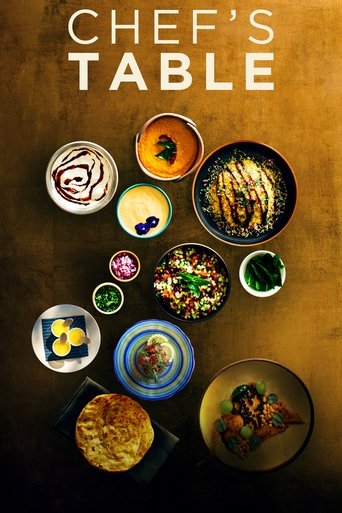
Chef's Table
2015 · TV series · documentary · 7 seasons
Created by David Gelb
Meet culinary stars around the world who are redefining gourmet food with innovative dishes and tantalizing desserts.
14 positive1 mixed2 neutralfrom 17 commenters
Where to watch
No streaming data for this title.

17 comments on Hacker News
Ancient/authentic wheat varieties taste amazing !!! I like millet, einkorn, wheat berry, rye berry, kamut, etc. I get them at the farmer's market. Totally worth it
This was a revelation in taste and health in my 40's :) I realized that all the no carb / low carb fads of the past few years could be replaced with eating what people were eating thousands of years ago, before economic optimization turned wheat into nutrient-free, calorie dense commodity.
(Similar things happened with rice and corn -- the heirloom varieties are amazing; the commodity stuff is highly processed and has fewer nutrients)
---
Remember there was that trend of people eating a McDonald's hamburger without the bun? Do people still do that?
They were onto something (processed wheat makes you sick), but the sad thing is that the real solution isn't available because of economics. You could eat it with real bread from heirloom wheat, and it wouldn't cause the health problems.
But you don't have that option. (Although obviously the meat leaves something to be desired too)
---
Another random anecdote: the first episode of Chef's Table: Pizza on Netflix now tells the story of an Italian guy from NYC who discovered amazing wheat in Arizona and makes acclaimed pizza there :)
I like it, but Chef's Table uses "that one simple trick" 5x an episode where 18th century orchestral music is overlaid in a montage using all the available camera and editing tricks, showing someone literally is just making a cookie.
His Chef's Table episode covers his loss of taste, that is one of my favorite episodes in the series.
You need to watch Netflix's Chef's Table, specifically the episode about Bo Songvisava and her restaurant Bo.lan. It's really interesting. She said that before she started Bo.lan, no Thai people who went out for dinner ate at Thai restaurants because there weren't really any high-quality Thai restaurants. Thai food was considered cheap street food or stuff you made at home. If you go out for dinner, you go to a nice classy western restaurant or something like that. So apparently, she was working at a western restaurant and wanted to learn how to make Thai food, but nobody could teach her because everyone had forgotten how to make it. All the pastes and whatnot were made in factories at the time. She actually had to travel all the way to the UK to learn how to make Thai food in a high-class Thai restaurant (David Thompson's Nahm). Then she eventually made her way back to Thailand and opened up Bo.lan, making everything the traditional way from scratch with natural fresh ingredients.
When you see the episode, it's really astonishing. I never would have considered the idea that a professional chef would not be able to find anyone knowledgable about one's own ethnic cuisine in one own's country and would have to travel around the world to learn about one's own ethnic cuisine. REALLY interesting.
> There is a lesson here: no matter what it is that you are building marketing is going to be important. Sometimes more important than the actual product.
Not if you're this guy [1], he went out of his way to ensure he got the worst reviews on Yelp from his clientele in order to defy the monopoly Yelp has over the Industry and its exploitative shakedowns.
The GM at my last restaurant hated having to pay and play by Yelp's reviews but since we were doing upwards of 20k+ days even during non-peak season on a consistent basis it was a marginal cost at the end of the day and 'a cost of doing business.'
Having been in-out of the Culinary Industry, jumping from tech and automotive in between, restaurants rarely have Marketing down and often relies on word-to-mouth practices.
Unless you're on something like Chef's table, or one of Bourdain's old shows, or get a Michelin star (or to a much lesser degree James Beard award) there is very little exposure outside of local magazines and who even bothers with food critics--if they're even around any more--outside of someone being a person with way too much time on their hands.
One of my colleagues/cooks went to NY on all expenses paid trip to see Blue Hill Farm, and got to be with Barber all weekend long. He said that Chef's Table was a life-line that pretty much put him on the map, because prior to that no one really paid attention outside of his local NY clientele.
One of my more loftier post-retirement goals was to see if I could make a few pilot episodes highlighting the local food scene within certain Tech hubs and eventually Digital Nomad cities all over the World and have dinner with a select few startups to see what they were about.
Having a hand in both Industries I thought I could capture things well, and I even drew up a list of cities I'd visit, starting with my own and a few in CA. COVID has put a damper on it all, but may be worth exploring now that there is a dire need to help and people seem more receptive to help out people in the Restaurant Industry as things are slowly starting to open up. Hopefully with a few EPs and a refined approach I could pitch to Netflix, Hulu, AppleTV et al... Honestly, I just want to be able to aspire to make something worth Zero Point Zero Prodcution's attention as they do brilliant cinematographic work.
1: https://thehustle.co/botto-bistro-1-star-yelp/
They saw the Francis Mallmann episode from Chef's Table on Netflix?
Mad Men didn't even have an audience when it aired (<2 million viewers most episodes), and airs on a network that likely won't exist in 5-6 years (or at least won't be producing new content), so it's not super clear to me what your point is about those shows as evidence of how a network grows. The way a network grows is by producing content people want to watch, whether that's disposable content made to last a minute or content made to last the test of time. HBO isn't growing because people are subscribing to watch Sopranos re-runs.
Past reporting suggests churn in most subscription content services is very low, so your Netflix cancellation may be unusual. I'd also add that exclusive content is one part of the story, but there's also a lot of licensed content that's very good on Netflix as on other services.
But for what it is worth, I would rank the following Netflix originals to be "top tier" within their genre -- some of these genres lend themselves more to rewatching than others, and some are closer to my taste than others, some held up in quality through their run more than others, so in a sense I am ranking shows based on their peak quality --
Orange is the New Black; Bloodline; Stranger Things; The Crown; Gilmore Girls AYITL; The OA; A Series of Unfortunate Events; Mindhunter; The Haunting of Hill House; Unbreakable Kimmy Schmidt; Master of None; Love; Lady Dynamite; Santa Clarita Diet; GLOW; American Vandal; Maniac; Bojack Horseman; F is for Family; Disenchantment; Hilda; Dark; The Rain; Elite; Chef's Table; Making a Murderer; Shot in the Dark; Wormwood; Wild Wild Country; Salt Fat Acid Heat; Queer Eye; The Curious Creations of Christine McConnell; My Next Guest Needs No Introduction; Lilyhammer; Terrace House; Alias Grace; The End of the Fucking World; Collateral; Wanderlust; Longmire; Black Mirror; Comedians in Cars Getting Coffee.
In addition to these, the following shows are Netflix originals in my region, indicating that although someone else initially funded them, Netflix bought them for exclusive distribution here, and also meet the above requirements:
Babylon Berlin; Bodyguard; Casé; Crashing; Cuckoo; Derry Girls; The Great British Baking Show; Happy!; Happy Valley; The Investigator; Peaky Blinders; River.
I have pretty broad taste in TV and watch a lot of TV while I am programming or running data analysis, so maybe the breadth of stuff I include here is surprising to most. But to the extent your post is a useful anecdote about how Netflix has no great shows, I'm responding to your challenge to "Name one show" that would meet that criteria.
(These are TV shows only, not films. I haven't really liked many Netflix original films although there are a few I would say are great, like Okja and Roma)
Someone recently commented elsewhere that they were tired of paying for streaming access to a bunch of shows nobody wants to watch, and they wanted access to the most popular movies/network shows/whatever.
I didn't comment then, but FWIW: some of the best shows available are now streaming originals from Netflix, Prime, etc. If you haven't checked out specifically any of the Netflix originals, you're missing out. It's a complete replacement for the non-sports watcher.
As posted in response elsewhere below, here's a list of Netflix's best work:
- Stranger Things - Narcos - The OA - The Haunting of Hill House - Marvel series. All of them! - GLOW - Ozark - Altered Carbon - American Vandal - 13 Reasons Why
Also good:
- Atypical - Love - Flaked - Maniac - Master of None - Chef's Table - Making a Murderer
This is by no means a complete list, you can find that here: https://en.wikipedia.org/wiki/List_of_original_programs_distributed_by_Netflix
I tried to skim through it and provide my own short list of what I really liked, so this is just one person's opinion.
I suggest following up with Chef's Table on Netflix, which is a documentary series in a very similar vein from David Gelb, the creator of Jiro.
There is an episode of Chef's Table on Netflix dealing with the same effect on Russia's cuisine, and how this chef was trying to resurrect all sorts of traditional Russian dishes which had in effect been lost for 80 years because they were seen as too bourgeoisie. It incidentally also went into how the Western sanctions against Russia had only strengthened his project, because it led to an ersatz locavore movement and forced him to use Russian-available ingredients. For example, he tries to use only honey instead of sugar, because the latter wasn't really present historically in Russia.
So, you look at a bunch of book covers you don't like and call it "crap content".
I can't even count the number of Netflix shows/movies that the description didn't look all that appealing and the show absolutely was wonderful. Chef's Table was probably the biggest example. It looks like a cooking show. In reality is a beautiful documentary series about how world-renown chef's made their way.
Don't judge a book by its cover.
I can't speak to Sherlock Holmes, but Season 3 of Black Mirror is extraordinary. Nosedive could have been edited down substantially, but so could White Christmas or Fifteen Million Merits from the seasons before. I don't agree at all that there was any Netflix degradation.
Abstract is triple-A. A Chef's Table is triple-A. Stranger Things is triple-A.
We all have a sort of cynical habit of presuming that things once were good, and now they aren't. But Netflix has always been a mix of good and bad original content, especially when viewed from the subjective eye that what some of us think is great others think is terrible. They're trying to serve all markets.
I think such discipline is exceptionally rare in software, and it's never sexy. How about NASA? Haven't they only had like 4 software bugs in their control software ever (or some equally absurd figure)?
In design, Apple's core hardware design team is over the top psychotic about the quality of their work. It's a true obsession for them. Many font foundries have similar neuroticism driving their work.
I think Chef's Table (great show!) does us all a disservice by kind of skipping over how unbelievably grueling such an undertaking is. It truly is inhuman. It's unfathomably difficult to create merely a successful restaurant... it takes a perfect storm — in both the positive and negative sense — for someone to create something like a Michelin starred restaurant.
So yes, probably. Is it sexy? Certainly not. It looks insane more than anything outside of the lens of a beautifully crafted documentary.
It's a shame that so many people fall for the trope of the anti-science hippie when it comes to criticism of modern farming.
Believe it or not, most of us who criticize industrialized farming techniques are not tinfoil-hat antivaxers, and understand very well what you describe. Thing is, there's no reason why modern techniques can't be used to produce foods that are more varied, nutritious and flavourful.
Instead we're getting bland produce, all the same two or three varieties, and increasingly devoid of any nutritional value because our backwards practices are destroying the very soil we use (http://www.scientificamerican.com/article/soil-depletion-and-nutrition-loss/).
It's like in terms of food, we're moving towards an "everybody wears a silver onesie" future... scientific progress doesn't have to mean monotony.
In fact it's not progress. It's laziness on an industrial scale, and it's costing us our health (and one of life's greatest pleasures: food with real friggen flavour). So many of us have never tasted a real vegetable or piece of meat. (Ironically, in poorer, less industrialized countries like in South America, the meat is absolutely delicious -- visited last year with some friends; it was like they had never tasted meat before. Then I realised... they really hadn't!)
For a glimpse into what is possible using modern techniques, while still embracing flavour and variety, I highly recommend the Chef's Table episode on Stone Barns Center for Food & Agriculture.
I believe it's the second episode of the first season (available on NetFlix right now... the whole series is worth watching really).
If you are interested in finding out more about Massimo or other Chefs, 'Chef's Table' on Netflix is quite a good watch. He is the focus of episode 1.
I recently watched the documentary Chef's Table on Netflix [1] and in the first episode, there was another interesting story about saving Parmesan cheese.
The earthquake damaged a lot of Parmesan wheels, leaving them vulnerable to spoilage. This would mean a huge loss of investment and possibly bankruptcy for a lot of the parmesan producers.
A chef from Modena then created a recipe called Risotto cacio e pepe that was both easy to make and required Parmesan. He used the to simultaneously raise awareness about the consequences of the earthquake and promote sales of the damaged Parmesan [2]. He ended up selling 360.000 wheels of Parmigiano, possibly saving a lot of cheese makers from going out of business.
[1] http://www.netflix.com/browse?jbv=80007945&jbp=0&jbr=1 [2] http://www.parmigianoreggiano.com/en/press_area/2013_1/massimo_bottura_podium_best_chefs_world.aspx
Actually, Netflix in the US is largely like that for me as well. I never get on expecting to find a specific movie I want to watch. However, I believe Netflix's original content (House of Cards, Daredevil, Chef's Table, Orange is the New Black, and Print the Legend to name a few) are high quality content, meaning that when Netflix has to get its hand dirty, it shoots for quality unlike many cable television providers. I think this may be what the parent comment is referring to.