 Hacker Cinema
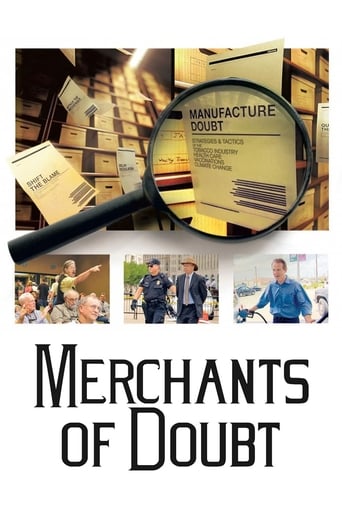
Merchants of Doubt
2014 · Film · documentary · 96 min
Directed by Robert Kenner
Spin doctors spread misinformation and confusion among American citizens to delay progress on such important issues as global climate change.
14 positive3 neutralfrom 17 commenters
Where to watch
No streaming data for this title.




18 comments on Hacker News
funny how this new "new stuff" follows the "Smoking-is-fine" of the past.. in a "Merchants of Doubt" [0] style
[0] https://en.wikipedia.org/wiki/Merchants_of_Doubt_(film)
Indeed, an eye opening book. For those interested, the book[1] tells the story of how a loose-knit group of high-level scientists and scientific advisers, with deep connections in politics and industry, ran effective campaigns to mislead the public and deny well-established scientific knowledge over four decades. These groups denied the truth of studies linking smoking to lung cancer, coal smoke to acid rain, and CFCs to the ozone hole. The book was made into a movie, Merchants of Doubt[2], released in 2014.
1. https://en.wikipedia.org/wiki/Merchants_of_Doubt
2. https://en.wikipedia.org/wiki/Merchants_of_Doubt_(film)
Further:
The CO2 Coalition was established by William Happer, a senior director with the White House National Security Council under Trump. The coalition received donations of over $100,000 from the Sarah Scaife Foundation and the Mercer Family Foundation of Robert Mercer and Rebekah Mercer, as well as $50,000 each from the Searle Freedom Trust, the Thomas W. Smith Foundation, the Lynde & Harry Bradley Foundation, and the Achelis and Bodman Foundation.
For insight on people like Clauser and Happer, I recommend reading Merchants of Doubt, the book by Naomi Oreskes and Erik Conway or the 2014 film.
News to some but this has been going in many industries with ghosts of denial called scientists for hire shifting the blame onto someone else
https://en.wikipedia.org/wiki/Merchants_of_Doubt_(film) https://www.sonyclassics.com/merchantsofdoubt/ https://www.merchantsofdoubt.org/
I believe its budgetted for under Marketing
Thank you for the book recommendation. I try to read and listen to as much content as I can about climate change.
> IPCC was dramatically underestimating the thinning of ice
Much of the IPCC reports summarizes work of scientist, who downplay their own results out of fear that their results will be interpreted as alarmist or biased towards an agenda. This was shown in the documentary Merchants of Doubt. The specific mechanisms employed to carry this out is outlined in this drilled podcast episode https://podcasts.apple.com/us/podcast/drilled/id1439735906?i=1000465248169 it talks about the media, but it uses human psychology and applies to all people.
Because this argues against what I see as the consensus position, I had a quick look for a review from the “other side.” Here’s one: https://insideclimatenews.org/news/04052021/dissecting-unsettled-a-skeptical-physicists-book-about-climate-science/
I haven’t looked closely at the claims made by either yet, but in my quick search I did note that this book is mostly being discussed by political pundits.
It’s important to reflect on the way that presentations of scientific expertise and (lack of) consensus can be manipulated in the public conversation... but in this case I would argue that the bulk of the misrepresentation of the science for political ends has been by “climate skeptics,” and the title of this book seems to continue that tradition. I found Naomi Oreskes’ and Erik M. Conway’s book “Merchants of Doubt” to be a good, approachable but scholarly history of this type of FUD. There is also a documentary based on the book, with the same title.
According to the documentary "Merchants of Doubt," there were modifications that could be made to cigarette design to reduce the likelihood of causing a fire, but the companies resisted changing their products.
I'm not suggesting you presented it with that intent, but that the blog writer did. They said as much in the commentary along with incendiary emotive claims of "falsified", "fake", "fraudulent". No mention of mistake. No evidence of fraud.
You yourself come across as someone with a genuine curiosity, which is why I've persisted. Yet seem sceptical mainly of government, but not so much of an entirely anonymous and unaccountable blog post. I find that surprising. Particularly when so many of the USA's "independent" voices and are shown to be industry backed.
> The system doesn't always self correct and outsiders have different incentives to government-funded scientists.
That's not in dispute, and applies to all fields. That does not imply fraud. Fraud requires additional evidence than finding an error or ten. That does not imply government funded is the least ethical or least accurate of all. How long were the major security flaws in OpenSSH? How often do we read of a zero day that turns out to have been there for ages, merely unnoticed?
Unqualified political lobbyists have different incentives too - the think tanks, PR agencies and free market institutes who shouldn't be permitted to express opinion, or spin fake alternatives, on active scientific research at all. If you want an outsider who has a vested interest to pollute our quest for knowledge, for the sake of an election or quick buck, they are it. Quite often they are committing deliberate intentional fraud.
https://www.theguardian.com/environment/2019/oct/10/vested-interests-public-against-climate-science-fossil-fuel-lobby
I'm going to once again recommend a read or watch of Merchants of Doubt, even if you remain totally unconvinced by then end of it.
Incentives generally apply more in industry where profit encourages the suppression of an inconvenient study, or to engage in fraud to pass emissions tests. The history here is also very well worn, in many industries that adopted the tobacco model, so there's no point replaying it.
I step back here. We both claim to want the same thing: More accurate science and better identification and correction of flaws. There will always be flaws and retractions - that's part of the process. Neither can we introduce rigour into hundred year old measurements if we find some issue much later. Nor can we guarantee that any endeavour involving humans remains free of intentional fraud.
Focusing on government science as constant bugbear weakens your message markedly as in my experience they also have fewer incentives to falsify than industry and politics. Particularly when it is in government interest to downplay the climate crisis as they have done for the last 40 years. Institutes and lobbyists have no incentive or even legal requirement to be truthful. Doesn't mean I find government, any government, entirely trustworthy. Even so the things they fund can be surprisingly successful, and can aim for best practice. I am sceptical of all sources, I am dismissive of political sources, and most sceptical of industry sources. You are never likely to persuade a European to adopt an ingrained US hatred and distrust of government funding in and of itself, that exceeds all other funding sources. All I can say is thankfully our continents must have had very different experiences. Yet I remain sceptical of all sources.
The old HadCrut datasets 1-4 are still available for download. Changes and corrections are documented and explained.
https://www.metoffice.gov.uk/hadobs/crutem3/jan_2010_update.html
What are that random blog's incentives? Entirely opaque - merely an about page that could be entirely fiction. No proof. No accountability. No corroboration anywhere. I see poor practice in presentation, poor practice in analysis, and I see attempt to take down pretty much the entire field from a skim through the pages - that's not healthy scepticism and correcting error, or advancing knowledge, that's a campaign. An agenda. Even if they do find genuine fault in some areas. From the example given there appears to be a real case to investigate on that particular region. Yet the presentations in the entirety lead me to expect to find cherry picking or sleight of hand, and I just haven't spotted it yet. Wouldn't surprise me in the least to discover "the author" is actually a dozen people inside CATO or Exxon.
I know how _I_ would make a case again some of the results if I felt I had found errors, and it would focus on the specific rather than keep widening to the general at every opportunity. If I were to conclude it widened to generality I would have presented compelling and extraordinary evidence covering the whole generality. I would not just presume it so and yell "fraud". I would encapsulate it to correlate with each set of historic corrections and attempt to show their validity or not. That would also aim to include no judgemental language. I would present it in the best way I could to encourage NOAA or whoever to respond, or investigate my finding to permit correction. Perhaps to discover a year or two later that my investigation prompted some improvement.
Even the takedown of Dr Andrew Wakefield, with his bullshit and actually fraudulent MMR study didn't have others immediately yelling "fraud" on an anonymous unaccountable blog. Others sought to replicate and see if the study stood scrutiny. Still others sought to find fault in his methods. Talk of fraud only came much later as preparation and case was made for him to be struck off. Interesting he is still free to promote and pollute the US with his lies and false medical claims, and earn high on the back of them.
Throwing in emotive words like "fake", "fraudulent" and all the others that imply deliberate intent with no proof of fraud whatsoever, are trying to sway the reader into political opposition. To take their "side". There is no "side". Present the errors, explain the errors, try and get them corrected and better practice in future. We're shooting for accuracy and improving the corpus of knowledge, not standing for election are we not?
Ah, there's the issue. I am now, on balance, convinced that site is not trying to correct careless mistakes, improve accuracy or advance knowledge. It's emotively trying to persuade - truth being secondary, or at best incidental. Even then, they may have found actual issues with some of the readings.
I really can say no more.
I have no intention of replaying Climategate via HN. There were enough enquiries to consider that settled, with few recommendations. I read _all_ the "smoking gun" emails at the time, and in context they were typical office work emails, and smoking nothing. Like everyone's office conversations a few silly comments probably should not have become public. But hey, I am not the arbiter, so I will defer to whether those multiple inquiries considered them a smoking gun. They did not.
To roll back to your parent: "let me say that I'm not a climate skeptic ... yet"
I suspect it's unlikely, or that you would be convinced, but I make just one recommendation. If you haven't read or watched the movie of "Merchants of Doubt", you should as it's both a very revealing and very depressing read. The book has more depth, but the movie is more insightful as you get body language. Via interviews with the notable criminals, and TV clips. Like the fellow with a bloody big grin telling that he couldn't touch Hansen on the science, so took to discrediting him personally and had a good laugh about it. Or Heartland or CATO Institute's, I forget which, entirely scam inverse IPCC report - identical match on look and feel even to number of pages. Except says the opposite. With nary a science degree between the lot of them. Send it to every US representative, claim it's truth.
It's tobacco 2.0, and not limited to climate. Every method, every technique, every claim. From the same PR agencies and bullshit institutes, the same people who claimed there's no link between smoking and health now on TV claiming there's no warming. Then again that there is warming and it's a great thing, we should have more of it! etc. You might even understand why, on balance, I am more leery of industry than academia.
Check it out. Thankfully Europe is not nearly so scary yet. Even in the US leaning UK.
So, specifics:
Moving is probably the lesser cases for data adjustment of what springs to mind. There'll be transcription errors, calibration errors affecting a particular station or sensor, methodology and more general systemic errors, such as sea temperature readings as we discover the ship might have an effect on some methods, or that US Navy logs truncated some historic readings, IIRC rounding down to whole degrees only. I tried to find a link to the Navy story, but that seems thoroughly buried by denial results.
I come back to the very tedious simple question. What is in it for the Met Office to fraudulently and inaccurately rig their dataset? Their entire reputation, and the majority of income, depends on accurate weather and climate forecasts. What matters for their future is that they match with reality, otherwise they lose contracts to those who can match reality. They've made a few famous mistakes over their decades of forecasting too. So no, not perfect.
Then the multiple leaked internal oil company reports, not for public consumption. They have been accurately, surprisingly accurately, predicting effects since the 1950s. Even they have overshot some of the predictions - yet whilst they are claiming rising temperatures, I don't hear claims Exxon and BP are in the pocket of the great global climate conspiracy.
> One of the pillars of science is providing your raw data
Absolutely. Providing raw data set so others can audit and replicate, or find faults. Not presenting as the definitive raw graph to show a gullible public it's not happening at all.
Some things don't need adjusting, others require everything be. Weather recording will be somewhere in between. My only work exposure to sensors via software was liquid pressure sensors many decades ago, and entirely unrelated to climate. Every single reading bar none needed adjusting to fit the unique calibration of that particular sensor. Re-calibration was needed regularly. It was a pain in the ass, as that was a manual "send out an engineer" recalibration.
The blog overlays raw results to show there is no climate effect. Are you seriously claiming they have adequately invalidated every adjustment? Why isn't there a paper to read about in Nature? Presuming they haven't invalidated every last one, that's misleading in the extreme.
I'm perfectly comfortable that someone may find reason to suspect or exclude some data, and some adjustments. In fact I would expect it in every sizeable dataset. All? That better have some compelling basis. There's none. Just claims of fabrication.
So reading from your start point: There looks like reason for suspicion of one localised set of results. Except immediately after he's talking of disproving the hockey stick. Time to stop reading. No point digging for context, or looking to original source.
This is astonishingly well worn ground, and Muller, the instigator of that particular conspiracy theory, famously 100% recanted and has since set up https://en.wikipedia.org/wiki/Berkeley_Earth
https://en.wikipedia.org/wiki/Hockey_stick_controversy
I'm out.
The documentary "Merchants of Doubt" covers a few of these cases, all comparing them ultimately to climate change from CO2 pollution, and the oil industry's fervorous cover ups.
There is a large domestic disinformation machine in the US. The disinformation media has for decades used identity politics to get Americans to vote for policies that benefit the 0.01%. Nowhere is this clearer than with climate change.
In my experience, many of those in the disinformation bubble have no idea that climate change denial benefits oil and gas companies and is heavily funded by them.
If you’re interested in disinformation and how it affects climate change policy, the book and movie Merchants of Doubt is really great- it explains some of the strategies used.
All documentaries by: Scott Noble (available free at his site http://metanoia-films.org/), Patricio Guzman, Werner Herzog, Adam Curtis, The Yes Men.
Other great documentaries: Man with a Movie Camera, Sherman's March, Burden of Dreams, Bus 174, My Winnipeg, How to Start a Revolution, Merchants of Doubt, Silenced (2014), the Corporation (2003), Man on Wire, The Parking Lot Movie, Land of Look Behind, Intangible Asset No. 82, Brasileirinho, Jodorowsky's Dune, Revolution OS, Facebookistan, The King of Kong, Kumaré, McLibel, Harlan County USA
Why? Because they're amazing, important, will change your life etc. Sorry I don't have hours to go into detail. Enjoy!
ps I found a lot of these by googling best documentaries lists, IMDb lists etc. I judge whether to watch movies/docos by reading 2 or 3 pages of user reviews on IMDb, occasionally Ebert or Urban Cinefile etc also.
Just yesterday I finished Merchants of Doubt (the book; I didn't know there was also a documentary). It's a really good book, and very informative. Side effects include uncontrollable anger and hate towards certain industries.
See also "Merchants of Doubt"
https://en.wikipedia.org/wiki/Merchants_of_Doubt_(film)
Yup. Merchants of Doubt (2014) is another great documentary to peel back the veil of PR propaganda consultants whom peddle sentiment influence (ie MSM, social media, etc.) to the highest bidder.
coca cola is simply funding the merchants of doubt in this case the Global Energy Balance Network
great book: https://en.wikipedia.org/wiki/Merchants_of_Doubt ok doc: http://www.imdb.com/title/tt3675568/
Well documented in the film "Merchants of Doubt." Many cut their teeth in the tobacco industry and went on to ply their trade in environmental denialism.
The documentary Merchants of Doubt (2014) provides a great look into paid shills on US media. They aim for confusion and they've been doing this kind of work for a long time.