 Hacker Cinema
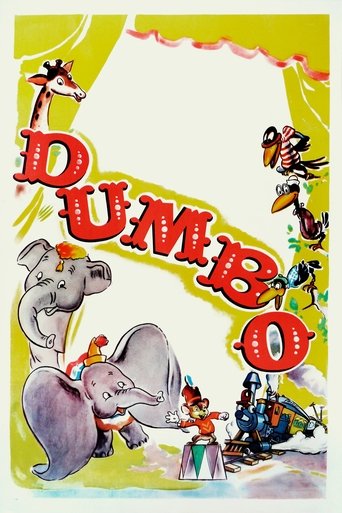
Dumbo
1941 · Film · 64 min
Directed by Ben Sharpsteen, Bill Roberts, Samuel Armstrong, Wilfred Jackson, Jack Kinney, Norman Ferguson
Dumbo is a baby elephant born with over-sized ears and a supreme lack of confidence. But thanks to his even more diminutive buddy Timothy the Mouse, the pint-sized pachyderm learns to surmount all obstacles.
4 negative13 neutralfrom 17 commenters
Where to watch
No streaming data for this title.

17 comments on Hacker News
Didn't Dumbo get drunk on the eponymous movie?
You don't get more pop than that.
Walt Disney died in 1966. There were less but still many notable traditionally animated films (or films which blended some modern technology with hand drawn cels) since then.
The Jungle Book - 1967
Little Mermaid - 1989
Beauty and the Beast - 1991
Aladdin - 1992
Lion King - 1994
It's likely more a question of what you grew up with. When I was a kid I remember heavily disliking many of the earliest Disney animated movies like Pinocchio/Dumbo/Bambi but I absolutely adored the animated Robin Hood, Sword in the Stone, etc.
> If this was the intended meaning
Directors will leave these sort of against-the-grain intepretations open for film buffs. One can similarly watch Dumbo, Encanto and Coraline as involving, past an early part of the movie, a character in the process of dying.
> usurped by a greedy business man (Ray Kroc) from its original founders
It's a weird aside, but maybe worth noting that Ray Croc was probably not just greedy. Ray Kroc was probably also racist against the Irish. A tell-tale sign is using a clown as the company mascot. The US strain of clowns were heavily influenced by "pale white face" racism jokes about Irish immigrants [0] from some of the same minstrel shows notorious for "black face" and "yellow face" and "red face". Ray Kroc was from a generation that would have easily been aware of that and would have been "entertained" by it. Ray Kroc's behavior to the actual McDonald's founders is rather easier to explain assuming it included quite a bit of Old Fashioned Racism than assuming just pure greed. Sometimes it is useful to remind ourselves that past isn't as clean as corporate memos want to paper over it.
[0] Notably, among other things: red hair, big feet, freckles, red drunken noses, loutish drunken behavior. Even the "clown car joke" is the exact same "joke" as "Mexican pickup truck" transposed across a couple of decades and about a different working class immigrant population. (Racists seem pretty lazy in how they reuse old material.) So yeah, if you ever wondered why clowns don't seem all that funny in the modern era, congratulations you probably aren't a racist. Also, now that this past horror is in your head I'm sorry for ruining Disney's Dumbo which uses all the worst of clown stereotypes and "jokes" all in the same place and eats up a lot of runtime with it, if you weren't already concerned about the "black face" crows in the movie or thought you could dismiss them as not central characters or contributing that much to the runtime.
For a good introduction to the problematic social and political content of many Disney films - Dumbo definitely included - I highly recommend Lindsay Ellis' video "Woke Disney" - https://www.youtube.com/watch?v=xU1ffHa47YY
As much hate as the Xerography process gets, this really wasn't true. The character designs for 101 Dalmatians were incredibly expensive, and they blamed the spots on the dogs. Part of the reason Bluth left was that cost control controls were put into place because of how expensive Dalmatians was.
The real problem is that Disney movies boom or bust. The insane successes (Snow White, Dumbo) were offset by busts (Cinderella, Bambi). Ironically, even though we remember these are huge successes now, Bambi was released in the middle of WW2 when the international market was cut off, and Cinderella was a box office bomb.
Disney still has this problem, which is why the death spiral of a Disney CEO is always when they start greenlighting sequel after sequel.
Very few of Disney's were "smaller and less astute."
Disney bought the rights to Peter Pan from Paramount Pictures in 1938. At the time, Disney was a small fraction of the size of Paramount Pictures.
The original author of Bambi sold the motion picture rights to his film in 1936 for $1000 USD to a film producer...Disney was not the purchaser. Disney bought those rights from the producer for an undisclosed amount.
Disney bought the rights to Dumbo for $1000 plus royalties on the book sales. (At the time Dumbo was a very simple, very short story intended as promotional content for a new type of book called a "roll-a-book". It sold very few copies, and would have been a historical footnote if not for the unexpected success of the film.)
Disney bought the rights to Winnie the Pooh and paid royalties to the Milne family for decades, before shelling out $350 million to buy the entire rights in 2001. (Disney originally paid $1000 for the merchandising rights to the merchandising rights holder, it's not clear how much they paid for the film rights but given that the Pooh books were a huge commercial success, estimates are somewhere between $100k and $1million in 195x dollars.)
I think as adults we downplay how difficult first experiences can be, and so I don't think we get that the stories of loss and struggle in kids movies are speaking to them about real problems they either already have or will soon.
Miyazaki has for some people become an alternative to Disney, but his work is full of Dumbo and Bambi moments. The difference is that in his work, the girl (and it is almost always a girl protagonist) is often substantially responsible for saving themselves, by reasonable means. They are not rescued by a boy or by deux ex machina.
Even in My Neighbor Totoro, which is almost but not quite an exception to this rule, the youngest (who is a main character, but not the main character) is saved by a magic bus. However, the main character initiates this rescue by digging deep and calling on resources she might not have thought to exploit. She asks for help from the most powerful person she knows and she gets it. She has to ask, and the terms of the rescue are very defined. Nobody white-knights her, nobody swoops in and reads her mind.
But the main struggle in that story is not a lost child. It is Death. And this resolves itself rather than being resolved by the characters, not through a miracle, but by discovering that the children don't know the situation and have invented a story that is much scarier than reality. In the end most of their fears are unfounded, and while life won't be everything they hoped, it's going to be much better than their internal catastrophizing.
The climactic wisdom in Kung Fu Panda is a trope from Dumbo [movie about elephant, 1941].
An object believed to be magic, giving abilities to the possessor, turns out to be just a prop. It's all in you, you just have to believe in yourself.
Back then, their feature films weren’t money makers, as they didn’t make them.
Their first feature film was very profitable, but it was from about 15 years later (https://en.wikipedia.org/wiki/Snow_White_and_the_Seven_Dwarfs_(1937_film)).
However, their next two movies (Pinocchio, Fantasia) cost them money because they were released during World War Two, when they couldn’t show them in large parts of the world.
They needed Dumbo to make up for that (https://en.wikipedia.org/wiki/Dumbo#Box_office), then Bambi wasn’t a huge success, either (https://en.wikipedia.org/wiki/Bambi#Box_office)
So, I guess it wasn’t till after World War Two that their feature films became profitable. They survived, so chances are the shorts brought in money.
"Disney+ has removed several movies, including “Dumbo,” “Peter Pan,” “The Aristocats” and “Swiss Family Robinson” from children’s profiles on its service over negative depictions and stereotypes."
Edit: further reading of the article gives details for each film. For Dumbo, it is the scene with the crows doing a minstrel show (with the leader's name being "Jim Crow"). Peter Pan has simplified/stereotypical (inaccurate) portrayal of Native people. The Siamese Cat is the issue in The Aristocats.
So they made the decision to not edit the films, but have the warning screen and remove the shows from the 7 & under profiles.
Society goes back and forth on what is considered 'right' and 'wrong'. You only need to look at older movies to see how things change.
What was once considered neutral or even progressive is now considered racist/sexist/etc. Watch 'Dumbo', 'Animal House', 'Blazing Saddles', etc. None of those would be filmed today. Yet we still have not cured many of the ills that plagued society in both times.
The left must relent and let conservative voices be heard. In the long run, it will be destructive to the left if they do not.
> I don't know what you think a Disney story is, but all of Disney's major works are based on existing folk stories and other works already in the public domain.
False. Here's some of their animated features based on copyrighted works (as best as I can tell):
Dumbo
Bambi
Peter Pan
Lady and the Tramp
One Hundred and One Dalmatians
The Sword in the Stone
The Many Adventures of Winnie the Pooh
The Rescuers
The Fox and the Hound
The Black Cauldron
The Great Mouse Detective
Treasure Planet (partially based on the 1987 TV miniseries Treasure Island in Outer Space)
Meet the Robinsons
The Princess and the Frog
Big Hero 6
(I'm using the list in https://en.wikipedia.org/wiki/List_of_Walt_Disney_Animation_Studios_films, and picking out the “based on” or ”inspired by” credits that look recent enough.)
Disney movies generally makes sense and have some logic rooted in the real world. Yes there are talking animals and magic but the stories ultimately relate to the human experience.
I think the problem with the crap the author finds is that – it is nonsensical. These videos addict kids by triggering their innate desire to seek out novel/scary situations and explore them. This instinct exists so kids learn about the real world around them, as quickly as possible. But when kids watch videos with no sense, no logic, and no relation to the real world, their brains learn and reinforce nonsense. It delays their development while reducing their attention for more wholesome – and more boring – exploration of the real world.
Kids' brains are amazingly plastic, they have amazing memories, and they ruminate sometimes for months on novel/strange concepts. Watching, say, Peppa the Pig eat her own father even once can have a profoundly negative effect on a young child.
Absolutely parents should not let YouTube babysit their children. But a child watching, say, Sesame Street, will tell you about how Oscar helped Elmo do such-and-such, or Grover had a bad day and Big Bird comforted him, and they'll apply that to their own life. A child watching Marvel character heads buried in sand will prattle on about random creatures' heads buried in things, and will fail to apply that lesson to anything in their real-life experience.
EDIT: Not to imply e.g. Disney is flawless – remember Dumbo's pink elephants?
The NPV of Disney selling copies of its early movies is tiny. Ignoring the things like Saludos Amigos, most kids today aren't really that interested in watching Dumbo.
But Disney needs to make sure that if you want to visit Sleeping Beauty's Castle, you need to go to Disneyland.
Copyright is a too-broad tool for this, but trade mark doesn't quite cover it.
Anecdotally, I seem to remember reading that HST loved the movie Dumbo, so he probably was a pretty big Disney fanboy. Regardless, the L/R phonetic collision in CJK languages as portrayed in movies probably wasn't the main reason for building and dropping the bomb.
Probably more to do with the sheer grisly nature of the Solomon Islands and Papau New Guinea campaigns, and a desire not to repeat it.
>I know that Disney stops people from taking Walt's original concepts. But is that a bad thing? What concepts did Disney steal? None: he made his own. Other people can do that too.
This is completely wrong. Nearly every famous early work of Disney's was "stolen" from others. Among the more famous are Snow White (1937), Fantasia (1940), Pinocchio (1940), Dumbo (1941), Bambi (1942), /Song of the South (1946), Cinderella (1950), Alice in Wonderland (1951), /Robin Hood (1952), Peter Pan (1953), Lady and the Tramp (1955), Mulan (1998), Sleeping Beauty (1959), 101 Dalmatians (1961), The Sword in the Stone (1963), and The Jungle Book (1967).
The first iteration of Mickey Mouse, called "Steamboat Willie", was copied directly from Buster Keaton's "Steamboat Bill."
This is an excerpt from one of Lawrence Lessig's speeches about the topic: "It was a parody, a take-off; it was built upon Steamboat Bill. Steamboat Bill was produced in 1928, no [waiting] 14 years--just take it, rip, mix, and burn, as he did [laughter] to produce the Disney empire. This was his character. Walt always parroted feature-length mainstream films to produce the Disney empire, and we see the product of this. This is the Disney Corporation: taking works in the public domain, and not even in the public domain, and turning them into vastly greater, new creativity. They took the works of this guy, these guys, the Brothers Grimm, who you think are probably great authors on their own. They produce these horrible stories, these fairy tales, which anybody should keep their children far from because they're utterly bloody and moralistic stories, and are not the sort of thing that children should see, but they were retold for us by the Disney Corporation. Now the Disney Corporation could do this because that culture lived in a commons, an intellectual commons, a cultural commons, where people could freely take and build. It was a lawyer-free zone."
To address your second point, "the idea of capitalism" does not necessarily require giving anyone permanent, state-enforced monopolies of anything, no matter how well written it is. Any justification for copyright has to stem from a benefit to society. Strong arguments can be made for giving creators temporary monopolies of a limited scope, but permanent monopolies are bad for both innovation and the public.