 Hacker Cinema
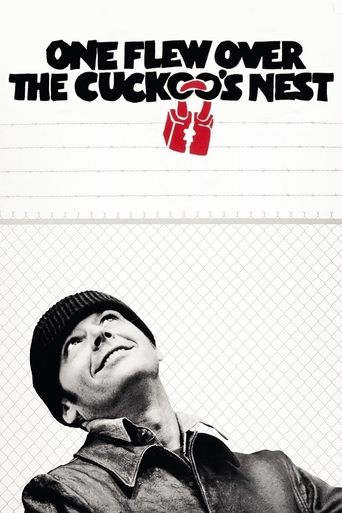
One Flew Over the Cuckoo's Nest
1975 · Film · 135 min
Directed by Miloš Forman
A petty criminal fakes insanity to serve his sentence in a mental ward rather than prison. He soon finds himself as a leader to the other patients—and an enemy to the cruel, domineering nurse who runs the ward.
11 positive2 mixed11 neutralfrom 24 commenters
Where to watch
No streaming data for this title.
24 comments on Hacker News
Yes, a feature of the movie "One Flew Over The Cuckoo's Nest" is a sort of sickly green.
I think hospitals have moved entirely away from green, probably because of its association with industry and asylum use.
Look at all those top non-American films on that list:
1. Once Upon a Time in America
2. One Flew Over the Cuckoo's Nest
3. The Great Dictator
4. Lord of the Rings
5. Chinatown
If there's one thing you can't associate Charlie Chaplin or Jack Nicholson with, it's Hollywood.
Number 9 on your list is famous non-Hollywood filmmaker Alfred Hitchcock.
Electro shock therapy is used for some psychological conditions today. Those who perform it are good at telling everyone else that "one flew over the cuckoo's nest" (book 1962, movie 1975) is nothing like what really happens.
One of the 1st adult films I enjoyed: One Flew over the Cuckoo's Nest. Beautiful pacing, acting, multi-layered.
The Conversation is well worth watching for someone interested in surveillance and paranoia.
Are you reading by opening up to page 1 and reading through to the end? Don't do that. I know, I know, spoilers, but unless you're reading mysteries, it's not a big deal. The best fiction isn't just the ending. Everyone knows Captain Ahab dies at the end of Moby Dick, but that doesn't spoil anything.
So, read the first chapter. Read the beginning and end of the rest of the chapters – a few paragraphs, a page, something. Read the last chapter.
Analyze the story: make a list of characters and their relationships to each other. If there are people related to each other, make a family tree. Consider the locations: map them out, especially if they reference real world locations. Get a feel for how the story moves through the world. Tolkien's books are famous for including the family trees of his characters, timelines, and world maps. Do that.
Try reading a novel that's been made into a good film. Follow along reading and comparing the film adaptation to the novel. Something like C. S. Forester's book The African Queen and the 1951 film directed by John Huston.
Pick a novel that riffs on subjects you're already into. Sylvia Plath's The Bell Jar involves psychology as a major plot element, as do One Flew Over the Cuckoo's Nest and Requiem for a Dream. All three have been adapted into excellent films.
Some movies were political but the politics were far less polarised within the "west" than they are now. Some movies - e.g. "Red Dawn" or "the Hunt for Red October" portrayed a clearly black-and-white division between the "good" west and the "bad" east with the dividing line being formed by the national borders. Outside of academia there was not much support for the "red" side so these movies did not create an internal division, you either liked them or you thought they were mostly over the top but otherwise harmless action flicks. Movies like "The Colour Purple" or "One Flew over the Cuckoo's Nest" were critical of the US but this criticism did not cause division because nearly everyone agreed with it and the movies themselves did not portray the issues as "systemic faults with current society". The few die-hard bigots who might have railed against these movies were ignored as being relics of the past.
How different it is today with movies which are not much more than thinly disguised moral lessons where the audience is lectured on issued of race, gender, "climate", environment, migration and more. The issues - whether real or imagined - are being portrayed as "current", "systemic" and "catastrophic", the "good" vs. "bad" divider goes straight through society where the "good" side is characterised by being "norm-critical" and in opposition to mainstream culture. Those who do not follow are portrayed as "bad" and labelled with a number of -isms and -phobias. Where earlier movies mostly portrayed "the other" - the "reds", the "filthy rich", the "criminals" - as being bad current "political" movies portray "us" as being ignorant, oppressive, wasteful, conservative "white" or "white-adjacent" bumpkins who really need to "be educated".
It was the opposite of a "money grab" and liberals walked hand-in-hand to close mental health facilities, encouraged by the "One Flew Over the Cuckoo's Nest" film.
Didn't think though the consequences however.
It wasn't just Reagan. It was also a reaction against the sometimes very real abuses and problems of the institutionalized mental health industry. A film called One Flew Over the Cuckoo's Nest help publicize the issue and generated a strong reaction against the idea of institutionalization in the US.
Problem is instead of reform they just shut down the entire system. Now we have loads of people on the street who really do need continuous professional help.
That's not really true historically. There's the whole Wild West ethos that still makes its way into pop culture (Star Wars, Breaking Bad, Clint Eastwood, Toy Story 2, Back to the Future Part 2, etc), which glorifies outlaw life and people making it through their wits rather than the support of authorities. There are cities like San Francisco and Las Vegas, basically built on criminals building a local civilization. Prison movies like Shawshank Redemption, the Green Mile, and One Flew Over the Cuckoo's Nest have us rooting for the inmates. We keep electing Kennedy clan members, even though the family fortune is built on Scottish distilleries and securities manipulation. American history includes bomb-throwing anarchists, 3 revolutions, massacres by private security forces, hippie communes, the KKK, police forces bombing their own citizens, and plenty of extrajudicial lynchings.
I think that the time period where this is true is the post-WW2 prosperity. There was a large premium on order and social stability here, along with creating institutions that kept (white, suburban, middle-class, male) Americans safe and gave them a stable upwards trajectory. Much of the support for law & order comes out of the demographic that grew up in this time period, with subsequent generations being much more skeptical of law enforcement and sympathetic to criminals. You don't see 20-somethings flying thin-blue-line flags, but you do see them calling to defund the police.
"One Flew Over the Cuckoo's Nest" is about how forcing someone into a mental hospital just because they don't fit into society is evil and dehumanizing.
There's lots of movies and shows that take place in prisons, but th prison itself is usually just the setting. The film is rarely making a statement about incarceration itself. Also, we have a much more fragmented high volume media culture, so it's not clear that film and TV can effect cultural change like they used to be able to.
Two issues with that. Deinstitutionalisation was not just an American phenomenon, with similar movements in other Western countries. Second, the timeline doesn't line-up. By the 1980s Deinstitutionalisation was well underway, and it wasn't necessarily a federal driver because the states were the ones running the system.
Deinstitutionalisation was a combination of changing attitudes by public (hollywood movies certainly did not help with movies like 'One Flew Over the Cuckoo's Nest'), activism, courts strengthening rights to the point where institutionalization was not possible, and yes, cost cutting by States.
Evil: profoundly immoral and wicked
I follow that with an interesting anecdote!
During the filming of the One Flew Over the Cuckoo's Nest, the actress playing Nurse Ratchett, the principle antagonist in the film, suffered a breakdown resulting from animosity built up amongst the film crew. Her mere portrayal and demonstration of wicked/evil tendencies was sufficient to taint the emotional atmosphere.
Point being:
When one is in an environment, and feels it necessary to try to say "I'm not evil! X, Y, and Z are evil! What I'm doing isn't!", it is generally a sign of cognitive dissonance being brushed up against.
There is an argument to be made, that if what the AdTech industry does is so effective at bringing up feelings of hostility, revulsion, and repugnance once properly understood, it may very well be to an extent "evil" due to a demonstrated capacity to generate widespread feelings of immorality.
It takes time, and effort to elucidate the various ways in which this industry triggers fundamental moral avoidance circuits.
AdTech violates moral principles of "being a good host", "professional discretion", "unimpositive (not imposing on one's guests or making light of imposing on or dominating their attention)", "non-intrusion", "being courteous in the immediate term", and "conservative in taking actions that could have far reaching consequences in the long term".
These are fundamental underpinnings of the fabric of positive societal interaction, and are to differing levels globally recognized.
Taking and violating such fundamental precepts, and in ways difficult to understand and extrapolate by the Common person illustrates a callous disregard for what makes society work, and implicitly sets off those alarm bells you mentioned earlier.
I'm not even being outright inflammatory; just pointing out the essential characteristics of the arrangement. If a barebones explication of what you do violates so many fundamental behavioral assumptions, and generates such animosity when brought out into the light of day, you really need to sit down and give it a long think.
Is delivering a better Ad really worth throwing out the baby with the bathwater?
Is delivering a better Ad worth endangering the framework that got us this far?
If your answer is still yes after giving it intense thought, you need to spend more time amongst your detractors, because you've likely only seen one side of the matter at issue.
> I don't think "one flew over the cuckoo's nest" romanticizes mental illness, for me it is about demonizing institutionalization.
Intent is one thing, effect is another. One Flew Over the Cuckoo's Nest, the book and movie, broke ground upon its release, but one of its secondary effects was to establish the mid-20th-century mental hospital as a gothic setting, akin to the ancient stone manors of old, full of terrible secrets -- not to mention bizarre characters -- that are ripe for literary exploration. Today it's been almost completely tropified, especially since in the current era Great Literature is by definition introspectively psychological. An easy way to establish that your play or movie is "arty" is to set it in such an institution. One of the weirdest instances of this was in The Great Gatsby (2013), which wholly took place in a mental hospital (the plot of the novel being Nick's recollections to his psychiatrist) and implied that Nick admired Gatsby almost to the point of a crush and was so devastated by his death as to need psychiatric attention.
I do recommend you read One Flew Over the Cuckoo's Nest, the novel. It is written from the perspective of Chief Bromden, and his mental illness helps intensify the themes of subtle control, exercised by tyrannical people and institutions, with specific delusions he has that make him sensitive to that control.
I don't think "one flew over the cuckoo's nest" romanticizes mental illness, for me it is about demonizing institutionalization.
It pictures the time when mental illness diagnostic was an easy method to put away anyone annoying or inconvenient (the subject really having a mental illness or not made little difference). It talks about institutional cruelty like torture and lobotomy.
But then I didn't read the book, just watched the movie - perhaps the "romanticization of illness" angle is more pronounced in the book but I'm pretty sure it was not the main theme and the novel did more good than bad for those diagnosed with a mental disorder or developmental disability.
Heinlein is obviously wrong about this, and for all his progressive and libertarian sentiments he seems to have had intensely narrow views on a few topics like drugs.
The one thing I'd say in defense of this quote is that it's from 1967. LSD had only been in major counter-culture circulation for a few years and a lot of the public advocates were people like Huxley and Leary who had produced documentary work on acid, but not major art. To a surprising degree, Heinlein was simply unlucky: acid-derived art got going right as he dismissed it.
Pet Sounds and Revolver were 1966, admittedly, but I'm not sure how well-known their association with LSD was at the time. The really famous and overt psychedelic music like Hendrix, Jefferson Airplane, The Grateful Dead, and the Woodstock scene in general mostly hit its stride in 1968-1970.
Over in non-academic writing, The Electric Kool Aid Acid Test was 1968, the same year the Whole Earth Catalog got started. Fear and Loathing was 1971. P.K. Dick wrote about LSD in Palmer Eldritch in 1965, but didn't actually try it until much later. Zelazny's work has psychedelic overtones and one in-story LSD scene, but he was just getting started in '67. One Flew Over the Cuckoo's Nest is pretty much the only major piece of acid-derived fiction I can think of by 1967.
Obviously, Heinlein was wrong. But I'd be interested whether he ever followed up on this; the acid-droppers started outdistancing the squares almost immediately after he said it.
'One Flew Over the Cuckoo's Nest' is one of those movies I can watch today and enjoy as much (or more) than the first time I saw it.
Yes, it's almost like "One Flew Over The Cuckoo's Nest" divergence level at this point. The movie/show and book(s) are both excellent but tell very different stories.
Great to see the Investigative, Serious Business arm of Buzzfeed get linked here (I don't visit their site often but know of their growing legit digging). A sensitive, yet salacious type of subject that can use a spotlight in my opinion. Simply put, I hope for improvement.
One of the first films I ever watched with my Dad was "One Flew Over The Cuckoo's Nest" partly because it's part of his life history (grew up in Pac Northwest, ran into Ken Kesey a few times) but also because of the amazing life lessons within. The book is even more epic and deep. And, growing up in the US, I know mental health is still not quite up in the priorities as much as, well, look at commercials, there's a glut of dick-pills for sale.
I'm a proponent of using fiction to help re-package heavy, important lessons that journalism brings up. I'd written a short treatment years ago about a serious PhD Psychiatry student discovering most everybody in the "profession" at his Public/Private Treatment Center suffered from their own DSM-diagnosable serious mental illness. From macabre understanding we're all flawed might come enlightenment. Or, you know, just comedy.
If you haven't read the book or seen the movie I'd highly recommend "One Flew Over the Cuckoo's Nest", both are excellent.
I give One Flew Over the Cuckoo's Nest, in movie form, to departing coworkers.
I'm assuming it's both. Kind of. I mean, the supposed purpose is a list of films, but as you read through that list and the way it's been laid out, you see that Lee approached the task by first thinking about a list of filmmakers.
And then you have some other films on the list which are there because they're noteworthy, regardless of the director. So it's sort of a hybrid.
A lot of filmmakers, critics and film buffs, when asked to list the best films of all time, will start from the perspective of their favorite filmmakers and then work backwards from there. (The general public takes the opposite approach.) Similarly, if you ask a music critic or musician to list his favorite songs, he'll often start with favorite albums and then back into songs. Or maybe favorite artists -> albums -> songs. They're used to thinking about an individual work in the broader perspective of its creator's entire catalog.
This can be a useful perspective to consider. Especially since there are some filmmakers (or authors, or artists, or bands) whose career output is highly influential, but whose individual works never really crack the Best of All Time list. Scorsese is a good example. Arguably none of his films, individually considered, ranks as a Best of All Time contender. But when you consider his entire output, you can't deny his influence on the technique of modern storytelling. I'd say the same thing about Milos Forman, for instance, though One Flew Over the Cuckoo's Nest does stand on its own merits on many people's lists. You could also make this argument for Steven Spielberg, controversial though he may be to film snobs. He hasn't made any given work as singularly brilliant as many of the movies listed here, but you can't deny that Spielberg has basically been synonymous with popular American cinema for the better part of an entire era. From the late 70s through the mid 2000s, he basically is the pop movie industry. And like Scorsese, he has had an outsized impact on the way people tell stories through the medium.
One Flew Over the Cuckoo's Nest.
I have no words that could do this movie justice. Should be required watching in high-schools. EVERY YEAR.
> They can? Have you been homeless, or worked with the homeless? What do you think is a sufficient upside to convince someone to be hated by everyone around them, be addicted to all kinds of dangerous chemicals, shit on the streets, and sleep in their own filth?
Heroin. Crack. Severe mental illness. I didn't say even all the resources in the world could help them, just that they were available. Except for the one resource we refuse to offer--involuntary institutionalization. But we don't and we won't. Maybe because of old movies like One Flew Over the Cuckoo's Nest. Maybe because we think they are exercising their civil rights by sleeping in their own filth and shouting at passerby.
> Citation needed on this.
I lived in a building downtown where many of these panhandlers lived. During the day they would hang out on the sidewalk and beg for money. In the evening they would go back to their $3000/mo market-rate apartment and do drugs and prostitution.
I liked the original version. I'd put it up there with One Flew Over The Cuckoo's Nest on the list of best adaptations. But I've seen some god awful remakes, most notably the recent miniseries with Benjamin Bratt.