 Hacker Cinema
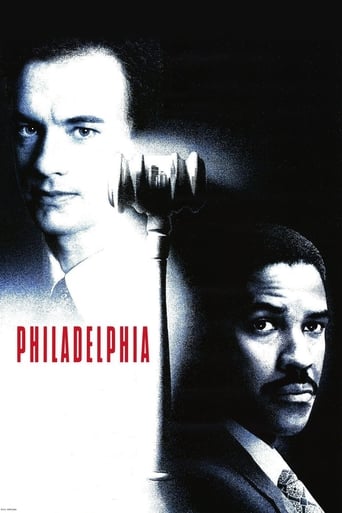
Philadelphia
1993 · Film · 126 min
Directed by Jonathan Demme
Two competing lawyers join forces to sue a prestigious law firm for AIDS discrimination. As their unlikely friendship develops, their courage overcomes the prejudice and corruption of their powerful adversaries.
3 positive2 negative10 neutralfrom 15 commenters
Where to watch
No streaming data for this title.

15 comments on Hacker News
Ouch. This hits incredibly hard.
I’ve been this dad who sits frozen at the TV every evening. I had the affairs with the emotionally unavailable men, and became one myself.
Before you judge the man in this story too harshly — and there’s certainly much to judge, especially given the follow-up post — consider the environment he and I grew up in. Being gay as a young teenager in the early 1990s could feel literally like a death sentence. AIDS panic was everywhere. Gay men in movies were comedy sidekicks or dying wrecks (“Philadelphia”). There was a real threat of violence from other kids. If you could pass as straight, why wouldn’t you give it your best shot? The alternative was to be a laughing stock and die alone in a hospital where nurses don’t dare touch you. (This is literally how I imagined gay life at age 13.)
I still feel like I’m barely getting started on the therapy journey to recover from those decades. Seems like the man in the story never had the chance for professional help (or didn’t seek it). The compartmentalization can be extremely taxing. He disappointed many people, but that doesn’t mean he was a bad person.
> The writing for new shows is predicable and boring.
To YOU because you are probably a middle-aged man who is not supposed to have time to watch everything so that all the tropes are familiar to you. Watch less media, focus on other things.
> Actors are featureless blobs that all look the same.
I think there is more variability than there has even been in the history of media and they have been quite direct about fixing this. What are you even taking about?
> Movies and shows seem to be eye-rollingly preachy and talk down to audiences.
The notion that movies and shows in the 2020s are "preachy" or condescending is not a unique feature of our times. The medium has always been used to shape the society.
For instance, "To Kill a Mockingbird" (1962) engaged with racism, "All in the Family" (1971–1979) tackled subjects like racism and homophobia, and "Philadelphia" (1993) addressed HIV/AIDS and homosexuality.
Many narratives from the past feel less preachy today, not because they were less pointed in their messages, but because society has largely absorbed their perspectives into mainstream thought.
I’m not necessarily disagreeing with your list, even though some of those are mediocre at best, but yeah I did mean per year, and limited to Hollywood (Parasite for instance not counting). And no, ok, I will also straight up disagree with the second Knives out Movie which I thought was absolute trash. A perfect example of poor storytelling and the form over substance of modern cinema.
But just taking say 1992 you have Last of the Mohicans, The Unforgiven, My Cousin Vinny, Malcolm X, Bad Lieutenant, Scent of a Woman, Reservoir Dogs, Dracula, Chaplin.
And then a bunch of fun schlomp like Arizona Dream, Basic Instinct, Sister Act, Army of Darkness, Home Alone 2, Buffy the Vampire Slayer, The Mighty Ducks, Wayne’s World.
These are all undoubtedly great movies.
And then another huge bunch of watchable stuff easily comparable to some of your mentions like Watcher or High Life.
And 1992 is not an outlier.
In 1993 you have Jurrasic Park, Groundhog Day, Whats Eating Gilbert Grape, Scindlers List, Meanace 2 Society, Alive, Dazed and Confused, Falling Down, In The Name of The Father, True Romance, Demolition Man, Carlitos Way, The Secret Garden, Philadelphia, A Perfect Workd, Cool Runnings, Short Cuts.
In 1991 Silence of The Lambs, Ternimator 2, JFK, Point Break, Thelma and Louise, Boyz in the Hood, The Doors, My Own Private Idaho, Barton Fink, The Fisher King, Naked Lunch.
In 1990 Goodfellas, Hunt for Red October, Total Recall, Edward Scissorhands, Home Alone, Godfather 3, Dances with Wolves, Tremors, Back to the Future 3, Awakenings, The Witches, Wild at Heart, Jacobs Ladder, Nikita, Slacker, Millers Crossing.
And the quality difference is massive too, not just somewhat better. Like just Millers Crossing is miles better than anything that has been made in the last 5 years, and I’m picking at random.
In 1994 Shawshank Redemption, Pulp Fiction, Forrest Gump, The Lion King, Speed, Ace Ventura, Dumb and Dumber, Stargate, Natural Born Killers, The Crow, Clercs, Maverick, Ed Wood, In the Mouth of Madness, Interview With The Vampire.
I could go on.
And this is not even talking about how the 80s is a better decade for cinema, or how the 70s is the peak of the power of the author with far more experimental, artistic, and substantial productions.
Has quality declined? Yes. Massively. Humongously. Stupendously.
> When I saw that somewhat ambiguous title, I was hoping it was about that song. Now I have to watch all those videos!
Same here! I thought, "there's no way Talking Heads is near the top of HN".
> Stop Making Sense is one of the all-time great music movies (and I try to watch 'em all).
I still find it hard to wrap my head around the fact that Jonathan Demme, the director of Stop Making Sense, also directed Silence of the Lambs and Philadelphia.
According to Wikipedia [1], comedy TV shows with LGBT characters by decade (which is probably a good proxy). Ellen's "coming out" episode was in 1997.
70s: 12 80s: 11 90s: 28 00s: 45
Willing to wager the trend is similar to movies.
We had (just the ones I can recall off-hand, but had to lookup years):
Paris is Burning ('90) My Own Private Idaho ('91) Fried Green Tomatoes ('91) Philadelphia ('93) To Wong Foo, Thanks for Everything! Julie Newmar ('95) Jeffrey ('95) Birdcage ('96) Bound ('96) In & Out ('97) Boys Don't Cry ('99)
Of course, most of these role were filled by cis people.
[1] https://en.wikipedia.org/wiki/List_of_comedy_television_series_with_LGBT_characters
Yes! The comments on this thread made me think of Philadelphia instantly!
I have Bruce Springsteen’s Streets of Philadelphia (the titular song of that film) playing right in this instant.
If you have time I would recommend two movies that touches deeply upon this topic. They are 'Philadelphia'[1] which garnered a 'Best Actor' Oscar for Tom Hanks and 'And the band played on'[2] starring Mathew Modine.
'Philadelphia' a fictional movie that touches on the social stigma associated with HIV and 'And the band played on' captures the politics of why it was ignored by Reagan and his supporters for so long and the sad politics and scientific infighting in the chase for a cure.
Both are incredible movies.
[1] https://www.imdb.com/title/tt0107818/?ref_=nv_sr_srsg_3
[2] https://www.imdb.com/title/tt0106273/?ref_=fn_al_tt_1
Its really hard to go back and look objectively too. The movie Philadelphia is now really hard to watch because of the aggressive homophobia, and yet that is how most of the US felt about gay people at the time. It almost seems unrealistic in how blatant and evil it was - yet nobody watching it at the time would have felt that way since those sorts of conversations were happening in bars and workplaces everywhere.
Did you include the word "film" in your search? Otherwise there's no reasonable expectation for it to show up. It's like searching for "Philadelphia" and expecting the movie to show up and not the city.
Classical music in film and tv more commonly signals erudition, not simply villainy. When there is a class conflict involved In film, the higher class characters are more commonly the villains, and an appreciation for classical music signals their remoteness.
Philadelphia uses Hanks’ appreciation for opera to signal his class status, not villainy. Silence of the Lambs uses music and food same way.
Making the direct hop to villainy is too simplistic, and pointing fingers at Clockwork Orange is absurd. That film’s synthesized classical music is used to draw a parallel between the commodification of violence and the commodification of culture more broadly.
My recollection is the prejudices around AIDS had diminished dramatically by the time Philadelphia came out. But, the movie is (I think) depicting a past event when things would have been different. Also, movies often blow things a bit out of proportion. In the early-to-mid 80s, though, it would have been spot on.
It is interesting how pages like these are like a time capsule. For instance, I was just watching the movie Philadelphia yesterday and how many of the misconceptions/prejudices around AIDS were prevalent then. And here, in this link, there is news about some advances made there.
I am in complete agreement. I've done a fair amount of teaching, which is to say I was employed to communicate information, such that someone else (from a fairly random selection sample) could and would remember it well enough to actually use the information productively.
I have done this so much that I feel poorly abou tleaving the last paragraph as it is, given that I know there is most certainly a way to find a more parsimonious way to express what I am saying, and I think that is the trust of why mathematical language (and the language in wikis, or APIs, for example) is succinct to the point of absurdity.
Everyone is striving for what's called maximum information density, communicating as much data with as few words as possible, and they do so in the jargon of their respective fields of interest. The problem is, those that are not specialized in that field cannot decipher the language well enough to gain anything of use from their efforts at being succinct. Quite the contrary, the field of potential interest becomes even less appealing for having appeared so mentally taxing to parse.
Reddit has this ELI5 idea, which I think stems from Denzel Washington's character in the movie "Philadelphia" (Mr. Washington plays an attorney defending an AIDS patient who has been unduly fired) saying "Explain it to me like I'm five years old", to get people to reduce their use of jargon and get to the heart of the matter.
Needless to say, the point I am making is that it is one of the great intangibles to be able to communicate one's self effectively, and in my experience is only done well when the communicator understands the level of interest and/or understanding of the communicatee, and can adjust their vocabulary "filter" accordingly.
I think math is particularly tough in this regard because of the amount of time that goes into understanding topics that might be complex for an untrained observer (like an Eigen value, for instance, which are critical for a basic understanding of linear regression).
And yet, have you seen the 4k content out there? Breaking Bad was awesome, but is that really better in 4k than, say BSG or Planet Earth? I bought a 4k TV to use as a monitor several months back and started researching content - Most of it is eyebrow-raising, to say the least. I remember when 720/1080 were first introduced, there was an expected dearth of content, but at least what was out there was worth high-def (flyovers of tourist destinations, PBS nature documentaries, etc). For example - Here's some of Netflix's offerings in 4k:
Series: House of Cards Marco Polo Breaking Bad The Blacklist
Movies and Documentaries Smurfs 2 Philadelphia Jerry Macguire Crouching Tiger, Hidden Dragon Oceans (documentary) Forests (documentary) Flowers (documentary)
Edit:formatting
You seem to be missing a whole slew of games here, and most importantly, you don't seem to understand just how gritty, dark, and realistic Wolfenstein was for its time.
You cherry-pick robo-Hitler in order to paint Wolfenstein as a fun and happy game - but the fact of the matter is that when it was released, it was the most realistic game ever made (give or take), in which you killed nazis. Nothing but nazis. In a first-person perspective, in a dark and gritty environment, in what was seen as very realistic. The policor backlash to the game's realism and grittiness - and the nazi-aspect - was huge. Wolfenstein was far, far more realistic and gritty than Halo has ever been, when put in historical perspective.
Then there's the fact that other realistic console shooters existed long before Halo came out. Take Goldeneye 007 and Perfect Dark for the N64, for instance. Two highly-realistic first person shooters, accompanied by successful multiplayer elements. Or Medal of Honor for the PS1. On the PC, too - take Rise of the Triad, one of the most violent games I can think of. Its multiplayer was simplistic, straightforward, and incredibly violent and gory.
I know it's all the rage to talk down on console gaming and games like Halo in particular, but the fact of the matter is that this kind of gaming didn't start with Halo, and had been around for a long, long time before it. Games like this have always existed alongside deeper and richer games, and that's a good thing - I like more intelligent and rewarding experiences, but after a long day or a stressful week, I just want to get some friends together and shoot zombies in Left 4 Dead 1/2 - just as I don't want every movie I see to be Philadelphia. Sometimes, I just want Armageddon or Die Hard, and there's nothing wrong with that.