 Hacker Cinema
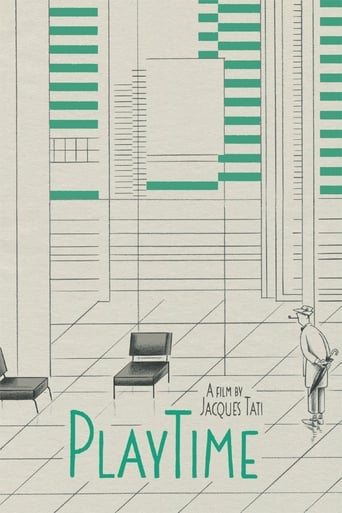
PlayTime
1967 · Film · 115 min
Directed by Jacques Tati
Clumsy Monsieur Hulot finds himself perplexed by the intimidating complexity of a gadget-filled Paris. He attempts to meet with a business contact but soon becomes lost. His roundabout journey parallels that of an American tourist, and as they weave through the inventive urban environment, they intermittently meet, developing an interest in one another. They eventually get together at a chaotic restaurant, along with several other quirky characters.
6 positive7 neutralfrom 13 commenters
Where to watch
No streaming data for this title.
Videos commenters linked
From YouTube links in the comments below. Most are clips and trailers; “Full” means the uploader says so.



13 comments on Hacker News
This reminds me a classic joke:
"Fortran was invented by IBM. That is why you get a compiler error when you write Fortran without wearing a blue necktie".
Also, you might find interesting some movies by a French comedian called Jacques Tati. He made fun of these aseptic "modern" environments in movies like "Playtime" [1] and "My uncle".
[1] https://www.youtube.com/watch?v=zrYB8hgyq4s, https://www.youtube.com/watch?v=l3L7aXoFAIo
What a needlessly mean comment. Maybe you should watch a few of the Tati movies ? Start with playtime, you'll see what gp meant, which is richer than just interior design fashion.
Thanks! Here's the full list: 2001: A Space Odyssey, 8½, Aguirre the Wrath of God, Ali: Fear Eats the Soul, All That Heaven Allows, Apocalypse Now, Ashes and Diamonds, A Woman Under the Influence, Barry Lyndon, Bicycle Thieves, Breathless, Casablanca, Céline and Julie Go Boating, Chinatown, Chinese Roulette, Citizen Kane, City Lights, City of Pirates, Contempt, Daisies, Damnation, Dishonored, Earth, Electra My Love, El Topo, Eraserhead, Eyes Wide Shut, Film Socialisme, Fitzcarraldo, Fuego en Castilla, Hiroshima Mon Amour, Holy Motors, Inauguration of the Pleasure Dome, In a Year with 13 Moons, India Song, Inland Empire, Irma Vep, Koyaanisqatsi, La Dolce Vita, La Jetée, Late Spring, L'Eau de la Seine, Le Voyage dans la Lune, Lolita, Los Olvidados, Lost Highway, Lucifer Rising, Man with a Movie Camera, Metropolis, Mirror, Mulholland Drive, Night Music, Ordet, Orpheus, Persona, Pickpocket, Playtime, Psycho, Rebecca, Rosemary's Baby, Rumble Fish, Scarface, Seven Samurai, Sherlock Jr., Singin' in the Rain, Stalker, Sunset Boulevard, Taste of Cherry, Taxi Driver, Testament of Orpheus, The 400 Blows, The Blood of a Poet, The Cabinet of Dr. Caligari, The Color of Pomegranates, The Green Ray, The Holy Mountain, The Isle, The Lady from Shanghai, The Night of the Hunter, The Passion of Joan of Arc, The Seventh Seal, The Spirit of the Beehive, The Tales of Hoffmann, The Tree of Life, The Turin Horse, Time of the Gypsies, Tokyo Story, Touch of Evil, Trans-Europ-Express, Ugetsu, Un Chien Andalou, Uncle Boonmee Who Can Recall His Past Lives, Vampyr, Videodrome, Wavelength, Werckmeister Harmonies, Wild Strawberries, Moonlight Sonata, Stellar, The Haunted House Biased toward European art cinema, experimental work, and directors who broke conventional narrative rules.
> rooms with glass front walls that had curtains
I immediately thought of the apartments in Yevgeny Zamyatin's novel We, but maybe it's closer to those in Jacques Tati's movie Playtime. It's spooky when something once intended as dystopian parody now has a real life analog.
Where do we draw the line?
Does an anthology approach like Playtime (1967, dir. Jacques Tati) count? It's got kind of an arc to it, but doesn't really have anything like a recognizable struggle with an antagonist. Unless you view brutalism as the antagonist, I guess.
8½ (1963, dir. Federico Fellini) could, likewise, be shoehorned into a discussion of the arc of the film--which it, itself deconstructs in the third scene or so. It's primarily a film about making the film. There's _kind of_ a journey the protagonist goes on, but does it really count as being this same plot?
If you want to watch a film similar to these themes, check out Playtime from 1967 by Jacques Tati. Something I watched recently.
Playtime works wonderfully as a cinematic satire of contemporary society and our roles.
The film's office scenes are particularly striking because they visualize the dehumanizing aspects of modern office design that cubicle farms would later become notorious for - the uniformity, the loss of privacy despite physical separation, and the way architecture can make people behave more like components in a machine than individuals.
The thing about Playtime is the constant onslaught of appropriate explorations on the theme of an increasingly technical life.
By the time the end of Playtime rolls by, what you get is an examination of what it is like to be human and hopefully you feel a sense of joy in being a part of the human race.
It's always nice to see a list which includes movies I haven't watched or heard of. Alas I suspect many are hard to find now, the streaming services don't show much interest in picking up the classics.
My sub-list:
Film I'm pleasantly surprised to see in the top 10: Mulholland Dr.
Film I'm not going to complain about: 2001. It's impact can't be denied even if the last bit drags
Film I'm happy to see recognized: Yi Yi
Films I found underwhelming:
-- Melancholia
-- Tree of Life
Films I'd forgotten about that I now have to watch again:
-- Dr. Strangelove
-- Playtime
-- Yi Yi
-- 8 1/2
Film I would have ranked higher: The Third Man
for a film interpretation of this paper: playtime by jacques tati
All of Tati's films have to be viewed multiple times to be fully appreciated as he pays exquisite attention to details, many of which are small and seemingly insignificant and often missed at first viewing. PlayTime is a visual masterpiece especially for this reason.
In many ways Tati was a silent filmmaker in an era of sound; he neverthelsss embraces sound in a remarkably intuitive way that makes him one of its great film interpreters.
For instance, the buzz of the neon light transformer in PlayTime — an annoying sound we've all experienced. It's a seemingly trivial inclusion in an otherwise complex and 'active' scene. But it's not really trivial, for often when one's experiencing or recalling some real life drama it's often the trivial that one remembers—the main event cannot be recalled without the 'trivial' coming to mind as it's contextually important memory.
Another excellent example is from Mon Oncle, the scene where Monsieur Hulot's 'competence' is being questioned, but one cannot forget the seemingly trivial sound of the secretary's short click-clack high-heel steps† as she briefly enters and leaves the scene—yet her presence is only incidental to the scene's transpiring events. Not only was Tati a master at using sound this way he was also a genius at observing human nature in action.
The other ingredient that makes Tati's films so delightfully memorable is their simple humanity. Decades ago, I first saw Mon Oncle as a kid of about ten—about the same age as Gérard (Hulot's nephew). That was well before I'd learned any French and the version I saw had no English subtitles yet I enjoyed the film enormously and understood what was going on without language—and I still do, I never tire of seeing it. That's part of Tati's genius, he has the remarkable ability to appeal to all ages and new generations.
_
† Edit: this is not the scene I described above (that occurs about 1h 31m in the film) but it's the same secretary walking and sounding the same: https://m.youtube.com/watch?v=YdCSijdyI6E.
Metropolis, though overlong and a bit hammy, pulled me through with the music and the visuals. Even when the effects aren't believable the design is stunning.
In fact, it's pronably not until the 80s with skmething like Blade Runner or Brazil that you get a film so thuroughly designed and detailed from a visual perspective.
Edit: Though Tati's Playtime just came to mind.
A still from Jacques Tati's film "Playtime" (1967): http://1.bp.blogspot.com/_SS76YifzgN0/TBqlmteuTTI/AAAAAAAABYI/eRiMsdUGZKA/s1600/playtime7.jpg
Another old man shouting at the clouds, I guess.
- The web was much smaller back then. Of course it's difficult for your personal blog to gain traction now, there are so many alternative content producers (most of them are better than you), and alternate content medium like video and audio. A lot of people who would have started a blog in 1999 probably have a podcast, video channel, or do live streaming instead. All these things were not really possible in 1999. Or, maybe they blogged because that was their only technological choice, maybe they actually just prefer posting content on social media only for their friends now that the technology exists (LiveJournal and Xanga were basically social media blog platforms, supplanted by the posting capabilities of Facebook and others).
- And, speaking of that, blogging is not at all dead, it's just that the people making a living doing it are much more sophisticated than they used to be, and use their blog as a complement to other methods of reaching their audience. For example, a food blogger will have social media images and videos of their food/recipes, and then host the recipes on their blog/website. But here we've got the other author who is probably mad that they can't get some solid views and ad revenue from putting out a low-effort blog with 20 minutes of spare effort every month.
- The Internet used to be "whoever is wealthy enough to own a $2000 computer and has Internet infrastructure available in their wealthy country" and now it's available to the entire world. So, sorry it isn't your own personal gated community for your rich nerd friends anymore.
- The big corporations on the Internet are only part of the Internet, perhaps even the minority of it. Shaking a fist at Google or Facebook is tired and played out, as is complaining about hamburger menus.
- The article is mad at easily-blockable ads in search engines. How do you expect them to make any money if you aren't willing to pay for it?
- The reason there's white space in websites now is because the Internet is big and important enough to justify hiring graphic designers and UX designers who know a lot more about what they're doing than the author would ever be willing to give them credit for. News flash: UX/UI people work off of real usage data and know what designs customers like better based on actual hard data.
- Web directories sucked hardcore compared to modern search engines. You'd never be able to find specific things that have just escaped your mind. Try searching for "modernist movie comedy office building" in 1999 (this is what I searched when I tried to remember the title of Playtime (1967)).
The Matrix.
I always thought it would be interesting to have a prequel about the first person to escape. Office Space meets X Files, and the order of the complexity slowly becomes more apparent, until the movie turns into Playtime.