 Hacker Cinema
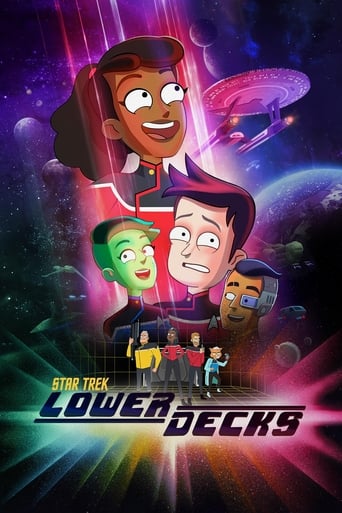
Star Trek: Lower Decks
2020 · TV series · 27 min episodes · 5 seasons
Created by Mike McMahan
Science FictionFantasyAnimationComedy
The lives of the support crew serving on one of Starfleet's least important ships, the U.S.S. Cerritos, in 2380. Ensigns Mariner, Boimler, Rutherford and Tendi have to keep up with their duties and their social lives, often while the ship is being rocked by a multitude of sci-fi anomalies.
6 positive1 mixed6 neutralfrom 13 commenters
Where to watch
No streaming data for this title.

15 comments on Hacker News
> What "The Federation doesn't have money" really means is, we don't want stories about Geordi worrying about how he's going to pay his nephew's rent or Data arguing about whether or not he his patent for some $TECH is being violated and he's not getting paid out properly. We don't want stories about how some medical issue could be fixed but Ensign Bob can't afford to pay for it. We don't want stories about Commander Sally arguing about her pay raise.
You don't seem to be acknowledging that rent goes down when basically anyone can start their own colony within a huge stretch of the galaxy, or that patents and wage comparison look kind of silly when everyone's basic needs are far beyond met, or that 'fixing a medical issue' becomes crazy cheap when replicator technology and computers are that far advanced.
> I would have written straight into the story bible that this is a framing device and authors are not to sit there and try to examine the details too closely
Star Trek: Lower Decks explored these ideas a bit more - right around the same time they were cancelled. Great episodes, highly recommend checking them out.
Yeah, kind of what Lower Decks (the show, and for that matter also the episode "Lower Decks") is to Star Trek, but not comedy. Andor is indeed the closest I know of to that, though you see little touches of similar things in some episodes of The Mandalorian and the Clone Wars cartoon (though of course that one's also full of the "magical beings")
There's an episode in Lower Decks where a civilization is burning money since they have "replicators" and you can just make anything. Assuming you have free energy (sun) and automated manufacturing, maybe that could be possible but I wonder if the concept of money ever goes away. I still believe in merit eg. why try if you get the same pay as doing less. And doing it for fun... But this is why open source Linux devices have broke cameras (no drivers).
Which nu trek? I mean Discovery is to me nearly unwatchable and I activly dislike almost all of the characters. Strange New Worlds on the other hand feels like classic trek with a better budget it is well cast and well written. Picard... I liked parts of it, it got better the farther along it went. Season one was actively bad, bad with good moments though. Season two was better Q stole every moment he was on screen. Season three legitimately was great star trek. Lower decks... if it weren't considered cannon it would be better, as is it a fun adult cartoon comedy. Prodigy is a kids show that I put on for my small children but could not be bothered to actually fallow. The Nu trek movies are brainless popcorn flicks written by people that wish they were writing starwars/fast&the furious crossover fanfiction instead.
Give strange new worlds a shot you won't regret it.
I think we only got new Trek due to Paramount trying to sell Paramount Plus.
Star Trek: Strange New Worlds is terrific and has the spirit of the original series.
Star Trek: Lower Decks is also amazing in a very different way. It's like the writers made an adult cartoon show for all the super fans that references every meme, while still being very endearing and true to trek.
Star Trek: Picard, is also supposedly really good, but I have only seen one episode so far.
It won't.
TL;DR: you can't RLHF immunity to gaslighting without breaking the model.
I'm calling it here, though I doubt this comment will get cited when someone actually proves this in a formal way: no amount of instruction tuning or RLHF can make LLM immune to having its system instructions overriden, without destroying its ability to complete inputs outside its training dataset.
Sure, you could RLHF it to ignore any known prompt attack, and the final model may even get good at recognizing and rejecting those. Sure, you could introduce some magic token and fine-tune the AI until it becomes asymptotically impossible for it to confuse what tokens are "trusted" and what tokens are "tainted". But the LLM still reasons about / completes all those prompts together.
There is no clear code/data separation here - neither in the LLM architecture, nor in natural language itself (nor, fundamentally, in our physical reality). User and system inputs always blend together to drive the LLM - meaning user input is always in a position to override system data.
If you can't make the LLM ignore its system instructions, or can't get it to follow your own, you can always try and make it change its understanding of the concepts in its system rules. What happens if my input redefines what "being nice" means, in general, never once referring to the bot or its rules? You can RLHF that away, but can you RLHF away every possible way any of the concepts in your system rules could be implicitly redefined during a conversation?
Fictional example, to illustrate what I'm talking about: in one episode of Star Trek: Lower Decks, some of the heroes were stuck on a shuttle with a locked-out autopilot, set to "take them home" (i.e. Earth). They couldn't override it or reset it so it takes them to their desired destination, so instead they redefined what the computer understood as "home" in this context, changing it from "Earth" to another destination - and watched as the autopilot changed course, continuing to obey its system prompt, to "take the ship home".
Animated movies that I often rewatch (in no particular order):
- Spirited Away
- Grave of the Fireflies
- Finding Dory
- Up
- Tokyo Godfathers
- Akira (NOT the English dub, which completely changes the story and dialogue for the worse, and for no good reason)
- Mononoke Hime
- Ghost in the Shell (the original one)
- My Neighbor Totoro
Animated series I'll rewatch:
- Guardian of the Sacred Spirit
- Castlevania
- Futurama
- Archer
- Arcane
- Cowboy Bebop
- Ergo Proxy
- The Dragon Prince
- Hakaba Kitaro
- Star Trek: Lower Decks
> Regardless what the reason may be, I would like to see a return to shows like Startrek Next Generation or Stargate SG-1 and a depart from their current versions
Seth MacFarlane's The Orville fills that void, even if it's scifi comedy. Clearly modeled after Star Trek TNG, it's refreshing to see adults behaving professionally, in control of their emotions. New Trek plots depend on their characters being immature, irrational, depressive and unstable psychological wrecks. Their seasons would be shortened to a few episodes if competent adults were in charge.
The cartoon show, Lower Decks, was made to compete with the Orville in the comedy department, and according to the fans, is unexpectedly good. I've lost count of how many simultaneous New Trek shows are going on now, if they were made by better people this would be a new Trek golden age.
Except there is a sustainable market, just make it available on amazon, apple, etc.
I just finished watching the first Jurassic World with the kids, if cost £3.50 on apple. I have a feeling I may have a dvd or bluray of it somewhere in a box as I've seen it before, and it wasn't at the Cinema, but it wasn't worth the half hour trying to find it.
Discovery Season 1-3 was on netflix, Picard and Lower decks on Amazon Prime. Discovery Season 4 came out on amazon and apple at something like £2 or £3 an episode.
That's how you make money. It doesn't cost a lot to put your program on platforms like Amazon or Apple (Presumably it's a simple "x% of the price in commission").
For film-length consistency, I wouldn’t be surprised by it taking years to solve, despite what @dougabug says in a sibling comment.
But “years” isn’t very much time.
(I have the mental image of it being as easy to make a film as it was for the character of Mariner in that episode of Star Trek Lower Decks where she makes a filmified version of the ship, in the holodeck, in a few seconds; but the more I think about it, the more I realise I think I don’t feel the normal drives for expensive economic signalling in a way that would allow me to actually predict what people would do given the technology).
I feel what you say too, that all the content feels samey. But I'll offer a suggestion that works for me: try some animation. That's where you get the passion projects that can feel different. Animated characters and settings can be far more expressive and varied and fresh, compared to the stock sameyness you get from live action.
The new She-Ra on Netflix was the best thing I've watched in quite some time. It's not a kiddie show, it works for all ages, think like Pixar movies. Other great cartoons across a variety of streaming services: Steven Universe, Gravity Falls, Owl House, Star Trek Lower Decks, also the more mainstream Bob's Burgers. If you want something fresh to watch, try animation.
The relevant question is "near-full admin access of a system that does what?"
If Okta has implemented a BeyondCorp model, the attackers had access with known limits. It doesn't matter how much access if the machine they've accessed is itself untrusted. That's the punchline of an episode of Star Trek: Lower Decks where they allowed an evil computer to take over the lighting systems on a starship; while they repaired the ship, all the computer could do was flick the lights on and off angrily.
Lower decks is on Amazon prime here in Spain. I have the service but I still download it because I hate all the restrictions. Also prime shows annoying trailers before every episode.
It's not blasphemy for me :). I'm having real troubles considering Discovery and Picard (and JJ movies) as canon - they're just too different from all the earlier installments up to ENT (including). Instead of optimistic and cerebral experience, we're now getting generic violent action movies with nonsense plots.
In my head, the only true successors to Star Trek as it was up to 2005 are 1) The Orville, and 2) Star Trek: Lower Decks. Apparently it turns out you have to market something as satire to get a shot at exploring more thoughtful topics.
It's various minor things. Like PADDs being proper LCARS tablets with a bit more space for content, smaller bevel[0] and even portrait mode[1]. Or the experiments with circular (radial) elements on display, which arguably are now decorative, but still they fit in, so are a good starting point for further exploration.
Or, and I can't find a screenshot of it now, that one tiny joke that made me almost spit out my tea. A scene on the bridge, the captain talking to someone over the viewscreen; she makes a gesture to cut off audio, the tactical officer presses a button on his console, and a small icon of a crossed out speaker appears on said console. Immediately recognizable even for non-StarTrek audience, and still they made it fit the style.
--
[0] - https://www.yourprops.com/PADD-replica-movie-prop-Star-Trek-Lower-Decks-YP821473.html
[1] - https://www.yourprops.com/Medical-PADD-replica-movie-prop-Star-Trek-Lower-Decks-YP821806.html, though there was precedent in DS9, AFAIR.