 Hacker Cinema
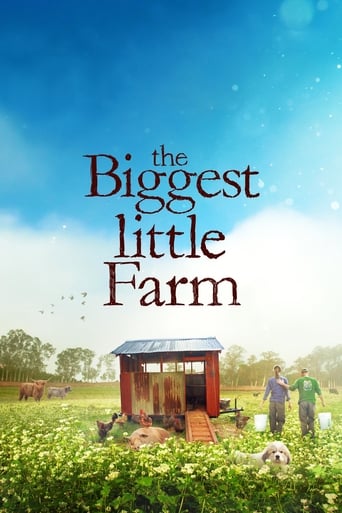
The Biggest Little Farm
2019 · Film · documentary · 91 min
Directed by John Chester
The successes and failures of a couple determined to live in harmony with nature on a farm outside of Los Angeles are lovingly chronicled by filmmaking farmer John Chester, in this inspiring documentary.
14 positive1 neutralfrom 15 commenters
Where to watch
No streaming data for this title.
Videos commenters linked
From YouTube links in the comments below. Most are clips and trailers; “Full” means the uploader says so.




18 comments on Hacker News
I enjoyed this movie:
https://en.wikipedia.org/wiki/The_Biggest_Little_Farm
Similar challenges, but attempts at natural solutions (not easy, so much complexity)
Trailer: https://youtube.com/watch?v=UfDTM4JxHl8
Check out a documentary called "The Biggest Little Farm" for a US based farm that created true bio-diversity/ecosystem, and used it instead of pesticides to grow food.
Have you seen The Biggest Little Farm?
https://www.imdb.com/title/tt8969332/
Maybe biodiversity is the solution.
Most of the habitat destruction is directly manmade, not indirectly through climate change. Way to put words in my mouth I never said, but no :)
Desertification due to unsustainable farming practice, deforestation for industrial farming (for vegetarian meals!), logging, and habitat clearing for homes and cities is the biggest contributor.
They’re literally cutting down or burning the Amazon in Brazil to keep livestock and to farm the land. They do it unsustainably and the soil is robbed of all nutrients. This results in most plants dying and desertification.
Want to see the best way to reverse this? Watch the (most fabulous) movie “the biggest little farm” where they turned a plot of land suffering from full desertification from monoculture farming into a small paradise teeming with life and diversity.
Also, to counter your point, it’s possible to add red seaweed to livestock feed which contains enough bromoform to counter around 80% of methane production. It does this by inhibiting the enzyme that creates the methane as a byproduct.
> upending the economic mainstay of that whole region would be done "easily"
Change the incentives (remove animal subsidies), and the problem will solve itself.
There is a big demand for plant based protein now ... we know how to grow peas, beans, lentils ... however it's not profitable to do so now because we continue to subsidize animal agriculture (one of the most harmful things we can do to the environment) with obscene amount of money. That's the main reason plant-based cheeses cost 3x more than cow-milk-based, although it should be other way around.
> crop that is profitable (without subsidies), suited to the region, and also doesn't require pesticides that affect insects would not be easy
Easy is not the important part. Easy led us to hell (or purgatory), where we currently are.
Those problems you're writing about can be solved with biodiversity. Let's imagine smaller fields, with different crops, interplanted with trees and shrubs to enable a lot of life [0], and you won't have problems with mice or bugs, because diversity will take care or any infestations.
If you're interested how to farm economically without pesticides/herbicides, may I suggest movie The Biggest Little Farm (2018), where the role of biodiversity is nicely illustrated.
[0] https://fotobanka.chrudimskenoviny.cz/sites/default/files/imagecache/big/a3.jpg
[1] https://www.imdb.com/title/tt8969332/
Reminds me of this movie: https://en.wikipedia.org/wiki/The_Biggest_Little_Farm.
> We still need to plow and harvest large fields even if we all go vegan
We would need just 25% of those fields. The rest can be returned to the nature. [0]
> Should we kill a bunch of cows to make way for native species
But we're killing them already, at astonishing quantities. It's enough to not make new ones, the problem will solve itself.
> okay when the feral goats in the Galapagos were machine gunned down
Maybe don't introduce farm animals where they don't belong?
> kill off all the feral cats, or just let them continue killing birds and small mammals
Give the birds & mammals a chance to live and procreate, by giving them enough habitat to live in. In time nature will solve the feral cats problems - when bigger predators appear.
> Is it okay to spray for mosquitos and ticks
No, because you're spraying poisons and killing other species as well, and reducing the human health. That's not practical. But you know, biodiversity is the solution [1].
When you kill predators (owls, foxes, coyottes ...), mice proliferate. More mice, more ticks. Let the mice eating predators return and ticks numbers goes down.
Mosquitos? Don't spray poisons and let number of amphibians/fish go up. The problem solved.
[0] If the world adopted a plant-based diet we would reduce global agricultural land use from 4 to 1 billion hectares - https://ourworldindata.org/land-use-diets
[1] The biggest little farm - https://www.imdb.com/title/tt8969332/ - not a scientific resource, but pretty illustrative
This excites me.
I've been hearing much more lately about how crude our approach to farming/agriculture is and how counterproductive current methods are. No-till, carbon farming, cover crops, etc. which spend more effort in creating a balanced ecosystem where crops are incorporated versus placing product, extracting value, leaving nutrient deficient earth behind.
There's an interesting documentary called Biggest Little Farm where a couple tries to strike that balance although not focused on tech/automation. This article bringing in the resourcefulness and ingenuity of farmers with tech alongside that balanced ecosystem has worldwide impact.
As for economical in the "traditional" sense, maybe not. I don't know how much success they're (still/actually) having but if you want a little glimpse into what should be possible in easily digestible docu-film format, look up "The Biggest Little Farm" (it's on Netflix for example).
One thing I took away from that is that it's maybe not economical in a "have a one crop pigeon poop farm" (i.e. you sell pigeon poop from feeding pigeons), you can have a farm that sells a lot of things that uses a lot of different animals and crops in combination in order to not have to buy in things from the outside that "traditional" farms have to.
I'd also like to throw you some links... https://elpocito.wordpress.com/
Pfaf.org plants for a future
Ic.org intentional communities
Basically "unproductive" land is/should be cheap, being out of the hustle and bustle of city life is great for clearing your mind, travel to a warmer climate (or snug it down) in the winter, consider it'll take you about a decade but your barren land can become a real cornucopia... There's a feel good film out there called "the biggest little farm"https://youtu.be/UfDTM4JxHl8
> They are unnecessary. Humanity lived thousands of years without them.
Totally agree.
Cca 75% of pesticides/herbicides are used for meat & dairy production (we need 75% of agriculture land for it).
> They harm billions of animals.
And they harm people, too. Pesticide bioaccumulation in milk has been linked to Parkinson's disease, for example.
> But not using them would condemn us to a subsistence economy.
I'm not sure that's true.
There is a lot of regenerative agriculture styles not needing pesticides/herbicides. Current agriculture practices are oriented on mass scale and low prices - when you modify that need, you can have much greater yields, but have to change your way of thinking about it.
One example (sorry, have to return to work process). We've all seen the large fields of wheat, so large, you can see the earth curvature. And not a single tree in sight.
If you remove all the nature, tile it, seed large swaths of land with a monoculture, you remove a place for wildlife to live in.
Without predators (foxes, owls) your crop gets all eaten by mice, which overpopulate easily. So you have to use pesticides (which we then eat in our food & drink in our water).
If you have a monoculture, then bugs easily propagate and there is nothing to stop them and you'll have a large loses. But if you stop planting monoculture (maybe alternating rows of crops with rows of trees, and some bushes & flowers between them), bugs will have harder time to infect whole harvest and there is enough natural predators from the bug world to take care of them.
Biodiversity is the key.
[https://www.imdb.com/title/tt8969332/ - The Biggest Little Farm, sustainable farm on 200 acres outside of Los Angeles talks in some lengths about this] [https://www.theguardian.com/environment/2022/may/07/secret-world-beneath-our-feet-mind-blowing-key-to-planets-future] [https://www.agricology.co.uk/field/farmer-profiles/iain-tolhurst-tolly - a single person from previous article]
The Biggest Little Farm[1] is a good documentary on this sort of topic. They started an organic farm and hit a similar pain point when coyotes started eating their chickens. They also had a problem with gophers eating their crops. I don't remember exactly but they were fighting the gophers with something, but it wasn't working that well. The solution was to let the gophers go wild, and the coyotes would take care of them instead of their chickens. They balanced each other out.
Now I don't know how this works with bald eagles, but there might be a similar solution for this.
[1] https://www.imdb.com/title/tt8969332/
Thanks for the recommendation - looks like you meant "The Biggest Little Farm". https://www.imdb.com/title/tt8969332/
I liked the movie The Biggest Little Farm about getting a farm running: https://www.biggestlittlefarmmovie.com/
Realistic? Idealistic? Impractical? I don't know and I'm sure others with more knowledge will comment, but I thought it was interesting and entertaining.
Two documentaries - Kiss the Ground and Biggest Little Farm are probably a good jumping point.
I think it would be great if you could invest in creating biodiversity more so than accelerating mono-culture agriculture with pesticides.
The real problem is that these folks (And all other cash crops) have rows and rows of the same crop and nothing else.
That’s not how nature works. Work WITH nature by creating bio-diversity and pests will be eaten by something else, etc.
If you haven’t seen it, I recommend watching “Biggest Little Farm” https://www.biggestlittlefarmmovie.com/
The modern American way is to announce it on a website, promise to make a movie, and do everything with crowd-founding and hire a bunch of college kids for nothing, plus two Mexicans. Actual knowledge of the business not required. See the current movie "The biggest little farm". https://www.sundance.org/projects/the-biggest-little-farm
The previous famous way was "Farmer John" near Chicago, which was similar, but more of a collective.
I’d like to recommend the documentary The Biggest Little Farm. Among other things it illustrates the contrast between industrial farming and its soil treatment (optimized for cost and short term profit) and alternatives (rebuilding rich soil which captures water etc.)
It’s incredibly inspiring.