 Hacker Cinema
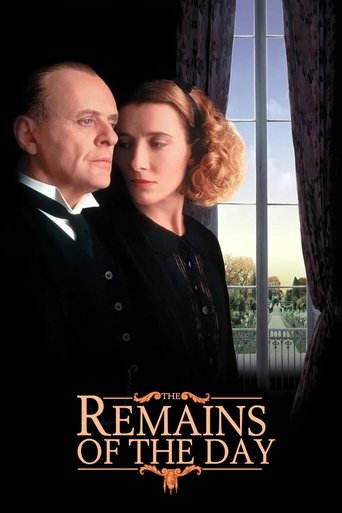
The Remains of the Day
1993 · Film · 134 min
Directed by James Ivory
In interwar Britain, a rule-bound head butler's world of manners and decorum in the household he maintains is tested by the arrival of a new housekeeper. The possibility of romance and his master's cultivation of ties with the Nazi cause challenge his carefully maintained veneer of servitude.
2 positive4 neutralfrom 6 commenters
Where to watch
No streaming data for this title.




6 comments on Hacker News
In 1993, this was a "box office success":
https://en.wikipedia.org/wiki/The_Remains_of_the_Day_(film)
I came up with a fun game that’s along the line of your snarky movie game. I call it Mixed Up Movies, where you have to create a movie title and description that combines two separate movies into one. You write the description and provide the real actors and the other folks have to guess the name of the movie.
For instance:
Hilarity ensues when a mild-mannered suburban family adopts a troubled San Francisco homicide detective.
Clint Eastwood, John Lithgow, and Margaret Langrick star in?
Dirty Harry and The Hendersons
Or:
A retired English butler reminiscences about his time in service to a Lord’s estate while also trying to convince his fellow townsfolk that recently arrived aliens come in peace.
Keanu Reeves and Anthony Hopkins star in?
The Remains of the Day the Earth Stood Still.
Or:
The boss of a Los Angeles crime syndicate enlists the help of a top British Spy to help recover a stolen briefcase by going undercover at an exclusive high-stakes poker game.
Ving Rames, Daniel Craig, and Samuel L Jackson star in?
Casino Royale With Cheese
It's okay to be jaded, but to present that as coming from wisdom that others are missing is both self-congratulatory and lacking in self-awareness.
I think you misrepresent startup founders. Most I've met are generally very smart people and they've read The Remains of the Day too so it's not like they're this nerd-in-the-basement fantasy you get from the movies. The Hollywood fantasy is dead.
I'm only saying this so that young fellows browsing HN from their computers at university aren't immediately discouraged. To them: The world is very exciting here. You can find a team and work happily and passionately on something you care about. You will be fine. It is probable that you will be better for it. Good luck!
For anyone who hasn't seen the movie based on the novel, I would highly recommending watching it[0]. Superb, nuanced performances by Sir Anthony Hopkins and Emma Thompson. The movie would also serve as an introduction to the Merchant-Ivory oeuvre[1].
[0] The Remains of the Day (1993) http://www.imdb.com/title/tt0107943/
[1] Merchant Ivory Productions https://en.wikipedia.org/wiki/Merchant_Ivory_Productions
I slightly disagree with everything you said.
> Pulp Fiction wasn't created at a time where > home movies were so widespread
VHS: 1976
Pulp Fiction: 1994
I'm not sure what you mean, then, by "home movies." If you mean "home theater," well, even middle-class people were spending loads of dough on big-screen TVs and hi-fi surround sound.
By "home movie" do you mean the ultraconvenience of streaming Netflix, Amazon, and Youtube? Then you probably have a point, even though it wasn't that hard to drive down to Blockbuster.
> If a movie is character-driven, > there's not a lot of benefit to seeing it in a cinema these days > as opposed to the comfort of your own home. > Big effects on the other hand, they benefit from the cinema experience.
I think seeing a movie in a theater is more social than technical.
>> The point is that people want interesting, >> well written movies with great stories.
> If they did, then these films would be the blockbusters. > Whereas Adam Sandler's films were routinely panned for being crap, > yet routinely pulled in 8 figures.
I think you two are talking past each other. He's talking about Star Wars and Lord of the Rings, which check all the boxes in Joseph Campbell's The Hero with a Thousand Faces. But you think he means The Remains of the Day or some other literary adaptation that nobody really likes. So as a contrast you pull out low-brow comedies, the cinematic equivalent of going out and getting drunk. But those same audiences also went to see Lord of the Rings.
Not as well as we were already doing within the EU, for a discounted membership fee. A discount that we will now have to concede in a future deal, and that will likely be finalised after a nice recession.
Meanwhile, London will lose its significance as the gateway for passporting to Frankfurt. All the prosperity built up since 2008 has been erased for the sake of what were ostensibly lies.
I implore US citizens: do not be fooled by populism and nonsense just because it runs parallel to your own frustrations with politics and with the established order.
You will regret it, as my country's 52% of Leave voters will regret it when they realise that everything they voted for will not and cannot be delivered as promised.
For the UK to trade with the EU and not become irrelevant to the other nations it seeks to trade with, it must submit to free movement of EU citizens.
Free movement was one of the major reasons why the Leavers voted as they did.
Direct democracy is a farce. Giving executive power to people who do not understand economics and who, a day later, express that they did not know what they were voting for or what the repercussions would be, is frankly absurd.
Of course it's a great failing of the government that, since 2013, they were unable to communicate the benefits of EU membership which have been summed up in single paragraphs and even in tweets since the Brexit result became official. Something that should worry all Britons now is the fact that, since no British government has had to actually negotiate a trade deal for decades, we may struggle to negotiate with post-Brexit EU effectively to get a deal that won't be atrocious for our financial sector.
It was a great failing of David Cameron to disengage from realpolitik and offer the public a voice instead of just honestly telling everybody that our financial stability and indeed prosperity since the financial crisis of 2008 is much thanks to EU membership and 'passporting' through the City of London while the EU paid for the economically weaker, rural regions.
Now we're stuck in limbo. Our Leave campaigners, Boris Johnson and Michael Gove, both used the Leave campaign as a power play. I doubt they expected or wanted to win, they just wanted to force even more EU concessions or at least to increase their own standing in a Conservative party that largely disagreed with their ideologies.
Neither of these men have the balls to push the button, because they know that once Brexit's official, the UK will be in for a rough ride, and they won't be able to appease the public when they have to admit that the money saved is minuscule compared to their fabricated figures, and that immigration cannot be curbed due to EU trade law and should not be curbed due to its positive effect on the UK economy.
Cameron also won't push the button, because only his refusal to make the Brexit official can save his legacy and his country. Only inaction can provide time for someone with courage to emerge — courage enough to tell the British public that they had no right to make such a massive decision based on lies and ignorance regarding how our country's economy works.
I am reminded of a scene in a movie called "The Remains of the Day" — I have the book but have yet to find time to read it. In this movie, an American congressman visits England while representatives from pre-WW2 Europe meet and try to preserve peace through lordly dinners and entertainment. The American congressman makes an unpopular but rational speech about how these "gentlemen" and lords are amateurs, and that the time had come for the politics of the real. Professionals being in charge of making decisions that can plunge nations and economies into wars and depressions.
He was warning against WW2, but the same applies today. Politics cannot be informed by emotional or populist sentiments. Politics must be informed by what makes good economic sense. What actually benefits a country and its subjects. Sovereignty is a question for 1914. It is not a question for 2016. Immigration isn't a viable scapegoat; it is one of many EU-connected reasons why the UK is thriving.
We have many forgotten people in the UK, but their failure to adapt and the failure of Westminster to consider and provide for them properly is not the failing of the EU directly, and certainly not sufficient reason to abandon the EU. Ask any Brexit voter. Ask them to remember 2008. Ask them to remember the fun and joy of recessions. Most of them won't really like that idea. Then explain that all of Vote Leave's promises cannot be delivered. Then regret comes.
Many people actually want the EU to fall apart. EU bureaucracy is cited. Bureaucracy that these "decent, normal people" never, ever encounter in their everyday lives. Bureaucracy that actually assures these "normal" people of their rights as workers, as women, as parents, etc. Bureaucracy that is inevitable in free trade. Bureaucracy that takes years to devise no matter who you trade with.
During these years of negotiating with the EU and with others, our currency will be devalued, our economic standing will drop, our businesses will suffer, our foreign investors will leave and our jobs will dry up. Animosity will continue to grow. Animosity between rich and poor, between educated and uneducated, between young and old, native and migrant, left- and right-wing.
It's just laughable. I've considered a fraction of the situation here. It was the same fraction I considered when I voted remain. I was alarmed to discover that other voters did not even consider this much. Even if you consider what I considered, or more, and arrived at the opposite conclusion, that the UK will fare better alone, that would be better than the reality.
Because in reality, nationalists and misinformed/uninformed voters simply saw an opportunity to mess around with UK politics for the sheer hell of it. In turn throwing the fate of our younger, well-educated and business-minded generation into a state of incredible uncertainty. Sure, these people had a right to feel dejected, but that aggression and agitation should have been directed at the last general election, or at the next.
The Tories should have felt the wrath of the working-class and the pensioners they failed directly, rather than using it to get elected only to cause a shattering blow to our economic competitiveness and to globalisation. Cameron instead used the referendum as a get-into-Downing-Street-for-free card, expecting to essentially wing it with a "guaranteed" majority for remain.
How difficult is it for a senior web developer to move to the US permanently? I'm just curious. There may be nothing for me here in the UK in the coming years.