 Hacker Cinema
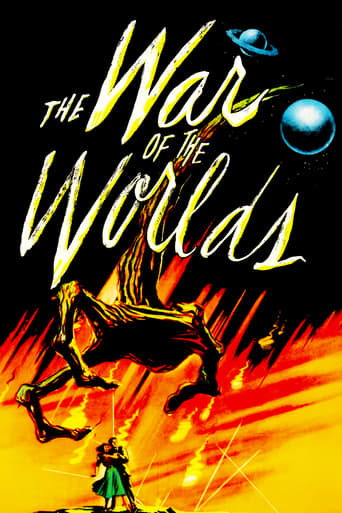
The War of the Worlds
1953 · Film · 85 min
Directed by Byron Haskin
The residents of a small town are excited when a flaming meteor lands in the hills, until they discover it is the first of many transport devices from Mars bringing an army of invaders invincible to any man-made weapon, even the atomic bomb.
2 positive3 neutralfrom 5 commenters
Where to watch
No streaming data for this title.



5 comments on Hacker News
That was normal in the 60s. Scifi was encouraged. They wanted kids to be inspired by space and technology. Star Wars changed things, driving a wedge separating what would eventually be "kids" movies from hard scifi, but that wasnt always so. Movies like 1953's War of the Worlds were very much all-family affairs.
Hands down the best movie experience I've had was this old refurbished theater in my hometown in the 90's and early 00's. Two weekends each month they showed an old movie. Classics from Casablanca, Laurence of Arabia, Fiddler on the Roof, to The Day the Earth Stood Still, Forbidden Planet and War of The Worlds.
Tickets were $4-5, boxes of popcorn and soda's of reasonable size were a $1-2 each, all movies lead with a cartoon and had an intermission.
Best of all the ushers. They would kick you out if you made too much noise and wouldn't let you take your seat if you got up too often.
It's a real shame that movie studios have cut the theaters margin on movies so thin that the theaters can't bring their snack prices down, nor offer a better experience (like kicking people out who can't shut up).
The Black Mirror series is worth watching, although they seem to focus mostly on 'digital consciousness'. The USS Callister episode is not only gripping but very funny too. So many great episodes though - hard to pick a real standout although I would have to say if I had to San Junipero is one of the best things I have ever watched.
Then there's the really cheesy old "so bad it's good" stuff, for example: - When Worlds Collide (1951) - The People That Time Forgot (1977) - Swamp Thing (1982)
Have you seen the original War of the Worlds?
Then there is the Alien franchise, Aliens (Alien 2) being my personal favourite - Bill Paxton is sooo funny in that and of course it's directed by James Cameron. Some other great actors like Michael Biehn too.
Have you watched the series Firefly? Also the (related) movie Serenity.
There is soooo much great stuff out there!
There's a great article on the topic (for USA) by Michael Ventura of Austin Chronicle:
A little clause set between commas in a missive from a reader about a recent column ["Hero vs. Superhero," July 25] -- in that piece I wondered about the effect of today's movie superheroes on little children as opposed to what children saw, say, in John Ford's 1956 The Searchers. The reader was intelligently critical of the piece, but in that clause he doubted that many 7-year-olds ever went to movies like The Searchers. A natural mistake -- he was clearly too young to remember, and how else would he know? But, for me, his error brought back a lost world.
In today's America, where parents chauffeur kids to "play dates," only on the poorest streets do 7-year-olds still roam free ... but they don't go to movies much because tickets are so pricey ... the concession stand is even more expensive ... and you can't just walk into any movie (it might not be rated for kids) ... and you have to know the exact time a film starts ... and shopping-mall movie theatres are rarely within walking distance. Today you're blitzed by TV ad campaigns and product tie-ins in fast-food joints, so you know all about a Hollywood film before it starts ... and today's urban parents panic if their grade-school children disappear, unaccounted for, for hours on end.
Fifty years ago, none of that was so. In the larger cities, two or three movie theatres were in walking distance of most neighborhoods. Each had but one screen. The program began with a newsreel, a few cartoons, and brief "coming attractions" (not today's compilations that tell the whole story). Then the "features" began -- plural, features, for all neighborhood theatres played double, sometimes triple, features, two or three movies for the price of one ticket. Nothing was rated, there were no sex scenes or obscenities; anyone could go to any movie. Admission price for a kid was rarely more than a quarter. Popcorn for a dime, a Coke for a nickel. They weren't supposed to sell kids tickets during school hours, but they did. As for kids roaming about -- "Go play in traffic," our parents would say, and they wouldn't be surprised if we didn't walk in 'til dinnertime, which in our immigrant neighborhood wasn't until after 7. ("Go play in traffic" wasn't so harsh a phrase as it sounds. Where else could we play?)
And you didn't go to a movie, you went to "the movies." You rarely knew the title of the film you were going to see until you saw the marquee -- and even then you might not recognize the title. Big productions were advertised on billboards, but there weren't so many billboards. No ads on the sides of buses, and none in supermarkets (and there weren't that many supermarkets). Second features were never advertised. TV ads for movies? Very rare in the early Fifties, and not so common by the end of the decade. Except for Davy Crockett's "coonskin" hats (and that was for television), massive product tie-ins were decades away. So adults and kids alike went to the movies, to see whatever was playing -- especially during the hot months, because in those days the big pull was to go to "an air-conditioned movie," as the phrase went. Into the early Sixties, movie theatres were among the only air-conditioned public buildings, and nothing was more rare for working-class people (on the East Coast anyway) than an air-conditioned residence. (I didn't live in one until I was 29.)
And there was this, a fact that can't be overestimated: Almost all movies (with Disney the major exception) were made for adults. Kids went to the movies, but few movies were calibrated for kids. Yet no ticket-seller I ever encountered thought it strange for a 7-year-old alone, or a group of three or four, to show up. I went every time I could scrounge the change, and I don't remember ever being turned away.
My birthday is late in October, so I was still 7 in 1953 when I saw my first film without "parental guidance" -- or parental presence. Frankly, it kind of shocks me to write that, for I can't imagine the parents of 7-year-olds today allowing their children to go to the movies alone. In fact, I doubt a lone 7-year-old would be sold a ticket now anywhere in this country. But once upon a time, it was no big deal. (All of which makes urban parents of 50 years ago sound permissive. They weren't. We would never have dreamed of speaking to our parents, or to any adult, as I now hear so many minutely supervised kids speak to theirs. Disrespect was not tolerated. Neither was whining. I know that sounds like an exaggeration. It's not.)
So, at the age of 7, three or four other urchins and I saw Vincent Price in House of Wax -- in 3-D, no less. It was deliciously scary in a harmless sort of way. But that same year I felt true horror at seeing (alone) The Robe; the Jesus I prayed to -- I watched him be crucified, watched the nails entering his hands, and it was among the more shattering experiences of my little life. And then, a different kind of shattering, that same year: The War of the Worlds -- the scene where the crazed mob throws the scientists out of their truck, destroys their work, and so (seemingly) ends all hope that mankind might survive the martian invasion. When later I became an obsessive reader of history, I had occasion to think of that scene many times.
In the spring of the next year, when I was 8, my 6-year-old cousin Tony and I "went to the movies," and what was playing was what I now know to be one of the rarest films by a major director and major star: William Wellman's The High and the Mighty, my first John Wayne film. Tony and I sat through it twice -- that is, we sat through The High and the Mighty, a second feature that I've forgotten, and The High and the Mighty again. For in those days once you bought a ticket you could sit there till the theatre closed. Also, since you just "went," you almost always walked in the middle of whatever picture it was, stayed through the second feature, and watched the first feature until the scene you walked in on. That's the origin of the saying, "This is where I came in" -- people would often leave at that point, with those words on their lips. Not me. I always stayed 'til the end, even if I didn't like the picture. I was (and am) stubborn that way. The High and the Mighty was about a haunted, limping co-pilot (John Wayne) who'd survived the crash that killed his wife and child. He redeems himself by managing to land a (propeller-driven) airliner that otherwise would have been destroyed. Tony and I walked out whistling the haunting theme music. We went back the next day. Which was the first time I ever went to a movie. I can still whistle that theme, but I've never seen that film again -- to my knowledge it has yet to appear on TV, VHS, or DVD. What happened to it? In any case, I kind of fell in love with John Wayne. He was the man my 8-year-old wanted to be.
Other movies I saw solo or with buddy-urchins: The Blackboard Jungle, East of Eden, Rebel Without a Cause when I was 9 ... The Searchers when I was 10 ... age 11, I saw Edge of the City (the complex friendship between John Cassavetes and Sidney Poitier turned my young head around about race). Eleven, too, when I saw A Face in the Crowd and The Three Faces of Eve. Face left me absolutely stunned -- so much so that I couldn't stand to see the film again until I was well into my 40s. I know this will sound incredibly naive to a modern ear, but Face taught me that those smiling faces on TV were laughing at me. Baby, that changed me. I stopped believing a lot of things that year -- and stopped calling myself a Catholic. I didn't trust a priestly smile anymore. As for The Three Faces of Eve -- my mother had been in and out of mental hospitals, so Eve taught me more than I wanted to know, earlier than I could absorb it, and to this day I've not been able to watch it again.
All of which is to say ... there are good arguments for and against a child seeing such things, though I'm glad I did. Good arguments for and against children roaming dangerously, freely. Yes, disasters happened. You had to learn how to handle men who sat next to you and groped (that was rare, but once was plenty); I'd always grab an aisle seat, and I took to the trick of spilling Coke and popcorn on the seat next to me. But, as W.D. Snodgrass said when asked why he didn't write poems about A-bombs: "I've seen more people killed in their living rooms." It isn't much of an exaggeration to say "the movies," as an entity, raised me. It was like listening in to the conversations of the grownups. Which, we now forget, is how children have been raised for eons. So, reader, yes -- 7-year-olds did see The Searchers, in another world, and in a freer, riskier, more exciting, and inviting country.
https://www.austinchronicle.com/columns/2003-08-22/174046/
The lack of vehicles for SF delivery have at times impeded literary acceptance and broader adoption -- take H.P. Lovecraft for instance, https://en.wikipedia.org/wiki/H._P._Lovecraft#Literary
Format adaptations have catapulted some great SF into the pop culture stardom:
The War of the Worlds was published in 1898, and though looked upon favorably, it is rarely mentioned today without also mentioning the 1938 radio broadcast.
The Wizard of Oz (Baum 1900) is more famous for its 1939 film.
In more modern times, Johnny Mnemonic (1995 film from "Burning Chrome", Gibson 1986), Snowpiercer (2013 film from "Le Transperceneige", Lob and Rochette 1982), and The Martian (2015 film from "The Martian", Weir 2011) have all increased SF visibility through film adaptations.
Without format shift, would general SF readers have pursued these works independent from the film? Probably. Would these works have entered pop culture and have been sought by the everyman, even the ones who don't routinely buy books or enjoy reading? Less likely.