 Hacker Cinema
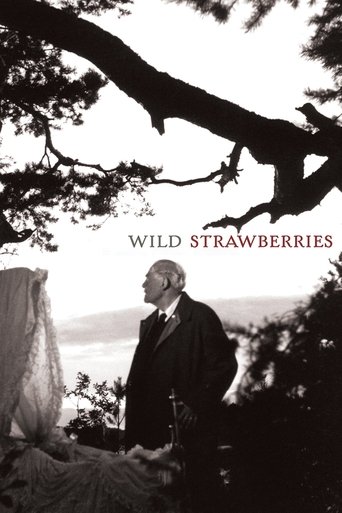
Wild Strawberries
Smultronstället
1957 · Film · 91 min
Directed by Ingmar Bergman
Crotchety retired doctor Isak Borg travels from Stockholm to Lund, Sweden, with his unhappy daughter-in-law, Marianne, in order to receive an honorary degree from his alma mater. Along the way, they encounter a series of hitchhikers, each of whom causes the elderly doctor to muse upon the pleasures and failures of his own life. These include the vivacious young Sara, a dead ringer for the doctor's own first love.
1 positive5 neutralfrom 6 commenters
Where to watch
No streaming data for this title.

6 comments on Hacker News
Thanks! Here's the full list: 2001: A Space Odyssey, 8½, Aguirre the Wrath of God, Ali: Fear Eats the Soul, All That Heaven Allows, Apocalypse Now, Ashes and Diamonds, A Woman Under the Influence, Barry Lyndon, Bicycle Thieves, Breathless, Casablanca, Céline and Julie Go Boating, Chinatown, Chinese Roulette, Citizen Kane, City Lights, City of Pirates, Contempt, Daisies, Damnation, Dishonored, Earth, Electra My Love, El Topo, Eraserhead, Eyes Wide Shut, Film Socialisme, Fitzcarraldo, Fuego en Castilla, Hiroshima Mon Amour, Holy Motors, Inauguration of the Pleasure Dome, In a Year with 13 Moons, India Song, Inland Empire, Irma Vep, Koyaanisqatsi, La Dolce Vita, La Jetée, Late Spring, L'Eau de la Seine, Le Voyage dans la Lune, Lolita, Los Olvidados, Lost Highway, Lucifer Rising, Man with a Movie Camera, Metropolis, Mirror, Mulholland Drive, Night Music, Ordet, Orpheus, Persona, Pickpocket, Playtime, Psycho, Rebecca, Rosemary's Baby, Rumble Fish, Scarface, Seven Samurai, Sherlock Jr., Singin' in the Rain, Stalker, Sunset Boulevard, Taste of Cherry, Taxi Driver, Testament of Orpheus, The 400 Blows, The Blood of a Poet, The Cabinet of Dr. Caligari, The Color of Pomegranates, The Green Ray, The Holy Mountain, The Isle, The Lady from Shanghai, The Night of the Hunter, The Passion of Joan of Arc, The Seventh Seal, The Spirit of the Beehive, The Tales of Hoffmann, The Tree of Life, The Turin Horse, Time of the Gypsies, Tokyo Story, Touch of Evil, Trans-Europ-Express, Ugetsu, Un Chien Andalou, Uncle Boonmee Who Can Recall His Past Lives, Vampyr, Videodrome, Wavelength, Werckmeister Harmonies, Wild Strawberries, Moonlight Sonata, Stellar, The Haunted House Biased toward European art cinema, experimental work, and directors who broke conventional narrative rules.
> Somewhat ironically, HD killed cinematography.
Imagine Wild Strawberries in HD. I think it would seem bleaker. Or Blue Velvet. It would make Blue Velvet creepier. It would also make any Corman film seem classier.
HD didn't ruin cinema. It only ruins beauty.
You are a scholar, sir.
I ran the Google Cinema Club for 10 years, and I held up the flag for films like this. I'd rather show a good movie with lousy attendance than a shit movie that everyone likes.
I'm embarrassed to admit we only showed Wild Strawberries out of all those (many other Kurosawa flicks, though). Ran was just too long for a movie that started at 7:00 pm, while people had a last shuttle to catch.
A few other "greatest" scenes in cinema:
* Isak's vision of his family picnicking at the end of Wild Strawberries (1957), where a man finds peace in his journey through the memories of his life
* Hidetora walking out his burning castle in Ran (1985) amid a battle amid his two eldest sons for supremacy, his plan to divide his kingdom among his three children having come to a disastrous end - a man realizing his children (and humanity in general) are more horrible than his naive dreams of unity could sustain.
* Two scenes in The Cranes Are Flying (1957): a montage of Veronika's beloved dying in battle (he falls as his soul seems to ascend bc the camera angle) while she goes about her life; Veronika finding out Boris is dead for sure at the train station, giving the flowers intended for Boris to the returning men and their families, and then she sees the cranes above Moscow - hope and renewal.
* In I am Cuba (1964): a martyred revolutionary, a student, is carried through Havana as the whole city stops what they're doing to honor him, solemnly, cigar-factory workers and all.
* In Andrei Rublev (1966), there's an extended sequence where a bellmaker's young son agrees to pour a bell for a local lord. You see the entire process of making the mould and pouring the metal. It has a town-fair atmosphere. But at the end, there's tremendous pressure on the young bellmaker to have the bell ring properly and have no cracks. And it does. The protagonist, the lapsed monk Andrei Rublev, regains his faith, seeing the result of the young bellmaker's hope. (I've shared this a few times on this website.)
* At the end of L'Ecclise (1962), the two lovers decide to meet the next day but they don't. Instead, we see thirty shots of the empty city - a devastating way to get to the heart of loneliness and lack of connection in modern life.
I don't think this is anywhere near as obvious as you make out. Film is an odd example, given that the films that lay claim to being great works of art (e.g, Koyaanisqatsi, Wild Strawberries, The Battle of Algiers) are rarely the most popular and highest-grossing films (e.g., Transformers, Avengers, Toy Story). We usually mean something by 'greatness' quite different from 'popular'.
Even if we just focus on popularity (i.e., first-order preference satisfaction), money is a very rough proxy for it:
1. Lots of profitable activities, once you price-in their externalised social costs, are net negative. Given the scale of the climate and ecological crisis, that is very far from a marginal phenomenon. Ecological economists like Herman Daly argue that once ecological costs are included in the national accounts, we are running a GDP loss.
2. Some commodities are instrumentally necessary but intrinsically negative. Many people acknowledge that social media is a net negative, but use it anyway because it helps build their profile and career. Market dynamics often transform intrinsically positive activities into merely instrumentally necessary activities, e.g., the marketisation of academia means researchers spend their whole career optimising for maximum articles and grants, not great work.
3. Market demand reflects the stratified incomes of people around the world. Markets are therefore heavily skewed in favour of the interests of the rich.
4. Market exchanges which are mutually beneficial for the transacting parties often have unintended effects in the aggregate, sometimes negative, e.g., no one wants Facebook to be a monopoly, and no individual makes it so, but it is the aggregate consequence of people joining Facebook.
The Magician, Wild Strawberries, Through a glass darkly, The Virgin Spring and the Seventh Seal. These films are 50 years old! Being in these films alone would be enough to qualify as a cinema legend and he still had nearly 50 years to go! Extraordinary!!!