 Hacker Cinema
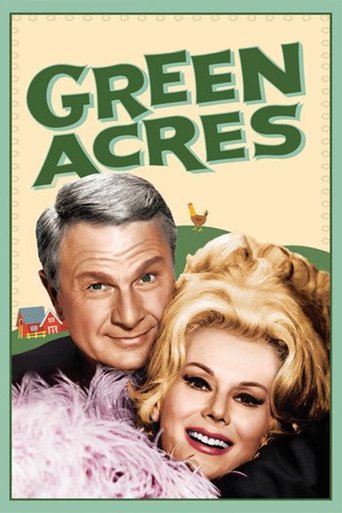
Green Acres
1965 · TV series · 30 min episodes · 6 seasons
Created by Paul Henning, Jay Sommers
Green Acres is an American sitcom starring Eddie Albert and Eva Gabor as a couple who move from New York City to a rural country farm. Produced by Filmways as a sister show to Petticoat Junction, the series was first broadcast on CBS, from September 15, 1965 to April 27, 1971. Receiving solid ratings during its six-year run, Green Acres was cancelled in 1971 as part of the "rural purge" by CBS. The sitcom has been in syndication and is available in DVD and VHS releases. In 1997, the two-part episode "A Star Named Arnold is Born" was ranked #59 on TV Guide's 100 Greatest Episodes of All Time.
2 negative8 neutralfrom 10 commenters
Where to watch
No streaming data for this title.
Videos commenters linked
From YouTube links in the comments below. Most are clips and trailers; “Full” means the uploader says so.



11 comments on Hacker News
My mom read books during the day when my dad was at work. She'd tell my dad how hard she worked all day :-)
I'd look over her shoulder and wonder how she made any sense out of the page full of text, as there were no pictures. I was fascinated by that, and was well motivated to learn to read.
I was not allowed to watch TV beyond Daktari and Saturday morning cartoons. I hated that restriction, but in hindsight my parents made the right call. My dad would watch the news, but it was just gibberish to me.
Later, I was not allowed to watch Green Acres. My parents said it was "rubbish". I did not see an episode of it till I went to college, and eagerly watched to see what I had been missing. I lasted 10 minutes - it was indeed rubbish.
See also: online dating (and the pitfalls thereof) as showcased in a 1967 episode of Green Acres
https://www.imdb.com/title/tt0592766/
"I Love Lucy" (first few seasons), "Frasier", "Seinfeld", "Friends", "How I Met Your Mother" are some of many TV shows taking place in middle-income apartments.
"The Jeffersons" live in a "Deluxe Apartment in the Sky".
Diff'rent Strokes took place in the apartment home of a multi-millionaire.
In "Green Acres" they leave a "penthouse view" apartment to live in a run-down house.
Oh yeah, I have a family member who watches these old TV series, and the increased fidelity of TV broadcasts today makes so many fake props blatantly obvious. For example, at about 24 seconds into the intro to "Green Acres", you can see quite clearly that the background is a painted backdrop: https://www.youtube.com/watch?v=DrbPAt1_vc4 ... If you watch an actual episode of the series they use these painted backdrops with quite some frequency.
The owner would need to have multiple income sources and ba a jack of all trades a la "Mr. Haney" of "Green Acres" TV Show where they own the hospital, but also run several businesses... antique store, an airplane service, an animal rental, a taxi service, a home renovation service, an unemployment agency, several delivery services, and a chicken watching service, just to name a few.
I remember those, and the 'Rural Revolution' that preceded it. Lots of shows in the 1960s like The Real McCoys, The Beverly Hillbillies, Green Acres, Petticoat Junction, Andy Griffith, Gomer Pyle, Lassie, and Hee Haw, until the 'Rural Purge' of the early 1970s.
Then in the mid-late 1970s came those shows and movies you mention, less comedy and more drama, more a sort of glorified frontier days theme. I think some of that might've come out of the 1960s hippie/naturalist trend, although it's a bit different.
I watched them all in the 80s, in syndication on the local channels, and my parents' VHS tapes had a lot (all recorded from TV). But in retrospect there were at least two related but different trends there.
should have spent more time consulting this old-timey documentary about it: https://en.wikipedia.org/wiki/Green_Acres
They were idealized versions of Americana...
Idealized by city folk, maybe. As one who grew up in a rural area, when I watched the shows it was more "let's make fun of the simple country folk and their strange ways". There was no idealization, most of it were television shows that looked to be written by city people that have never been past their city's beltway, who imagine what country life might be like. Poster children include Green Acres and The Beverly Hillbillies.
I do miss Hee Haw, though. R. I. P., Messrs. Owen and Clark.
The good stuff on TV today is far better than the best pre-internet TV.
(My parents wouldn't let me watch Green Acres, telling me it was trash. By the time I was an adult, it wasn't in syndication anymore. Eventually it shows up on Netflix, I watch it to see what I had missed. It's total trash. Didn't make it through a single episode. It's much the same for the rest, like My Favorite Martian, etc.)
> Childrens TV shows were always about selling toys, that was always the bread and butter.
As the article points out this simply isn't true. They weren't always like that. It was the direct result of a change in law during the Reagan presidency. All of your examples come after that.
Look at kid's shows from before the change in law. Say, the 1960s. Underdog, Rocky & Bullwinkle, Gilligan's Island, Flipper, Green Acres, Captain Kangaroo, etc.
The author blames the modern sitcom's remoteness from working and lower-middle class concerns with their creators' immunity from the recent recession. In place of everyday situations, we have shows set in "soundstages and writers’ rooms," the haunts of the out-of-touch in New York and LA. So you wind up with a show with this sort of genesis:
Our creator was once a prominent writer and performer on a comedy sketch show, which aired live every Saturday night from an NBC studio in New York. It ran for 90 minutes. After their time on the show came to an end, our creator decided to pitch a sitcom based on their experiences there. The lead character is the head writer on a comedy show, similarly produced in New York. They must balance their work in the writers' room and their personal life, though this turns out to be difficult. A pilot is made, and our creator plays the lead.
Modern viewers may recognize this as 30 Rock, but it is in fact The Dick Van Dyke Show. It is based not on SNL but on a direct ancestor, Your Show of Shows. Carl Reiner's performance in the pilot may have dissuaded executives from casting him in the commissioned series (hence Dick Van Dyke), while Tina Fey remained the lead in her own version. But otherwise the parallel rings a sight near perfect.
The author stumbles over himself insisting, however, that while The Dick Van Dyke Show did not give vent to working and lower-middle class concerns, it did at least feature characters who "had careers" and were definitely of a class. As if the same were not true of shows like 30 Rock (which is at times obsessed with class difference), or of Parks and Recreation and The Office. These do not depict realistic workspaces, but why place that demand on a sitcom? And why not place the same demand on, yes, The Honeymooners, Taxi, The Mary Tyler Moore Show, I Love Lucy, The Beverly Hillbillies, Green Acres, The Andy Griffith Show, and on and on. In all cases the demands of the form—and in almost all cases the demands of overly long tenures—stretched the premises and the rare attempts at realism very thin.
I think you can make an argument that the most popular comedies available right now—whether on TV or at the movie theaters—are unflinchingly escapist. (Though, as the article notes in its discussion of an episode each of Horace and Pete and Girls, this has not gone unnoticed or unremarked by all of the shows' writers. Still, these two are not the most popular things around by any stretch.) Similarly, Fred Astaire and Ginger Rogers were seen to traipse across exclusive resorts, high-class stages, ballroom floors, and Venice, in elaborate dresses and a "top hat, white tie, and tails"—all during the Great Depression. Sometimes hard circumstances produce a public clamoring for comment; sometimes the public just wants a reprieve.