 Hacker Cinema
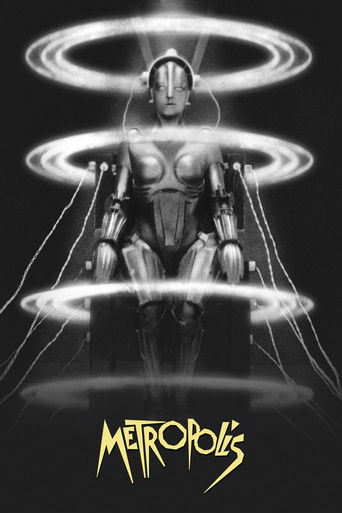
Metropolis
1927 · Film · 148 min
Directed by Fritz Lang
In a futuristic city sharply divided between the rich and the poor, the son of the city's mastermind meets a prophet who predicts the coming of a savior to mediate their differences.
34 positive8 negative3 mixed53 neutralfrom 98 commenters
Where to watch
No streaming data for this title.
Videos commenters linked
From YouTube links in the comments below. Most are clips and trailers; “Full” means the uploader says so.


117 comments on Hacker News
Domingo Gonsales is flown to the moon by tying himself to wild swans, and meets Lunar Christians - The Man in the Moone by Francis Godwin (1601)
Manned mission to the Moon by giant gun - Jules Verne (1865 ish).
Manned trip around Saturn by comet - Jules Verne (1877).
Time traveller sets off to the future - H.G. Wells (1894)
Martian invasion of Earth - War of the Worlds by H.G. Wells (1905)
Global telephone network reaches as many connections as a human brain and wakes up - Dial 'F' for Frankenstein, Arthur C Clarke (December 1, 1975)
Birth of Dr Susan Calvin, founding of US Robotics & Mechanical Men, development of 'Positronic Brain' - Asimov's robot stories (1982 and after)
British space station under construction - The Outward Urge by John Wyndham (1994)
Portal to parallel universes - Sliders (1994)
Doctor Samuel Beckett steps into the Quantum Leap Accelerator and vanishes - Quantum Leap (1995)
Skynet becomes self-aware - Terminator 2 Judgement Day (August 29, 1997. at 02:14 am Eastern Time)
HAL 9000 AI computer operational (1997), first human voyage to Jupiter system (2001), first landing on Europa and alien life discovered (2010) - Arthur C. Clarke's 2001 A Space Odyssey
Moon leaves Earth Orbit after nuclear waste explosion, taking human-occupied Lunar colony with it - Space:1999 (13 September 1999)
Efficient international flight, using Zeppelins and blimps - Rudyard Kipling (2000)
Global climate disaster - The Day After Tomorrow (2004)
Replicants - Bladerunner (2016)
Keanu Reeves smuggles digital information in his brain - Johnny Mnemonic (2021)
Arnold Schwarzenegger kills to survive in a typical American TV show - The Running Man (2025)
Woman relifed into robot, rich people discover workers' rights - Fritz Lang's Metropolis (2026)
First colony mission to Mars, 100 colonists on the largest spaceship ever built - Kim Stanley Robinson's Red Mars (2026)
Tibetan monks finish listing all the names of God, stars start going out - The Nine Billion Names of God, Arthur C. Clarke (when computers were rentable and could print 1000 names per second)
and many more: https://scifi.fandom.com/wiki/Timeline_of_fictional_future_events
Those shows are just shorthand for 'utopian future with no need for money', 'distopian future where corporations have control', 'distopian future where machines have control', 'distopian future where the government have control' etc
Plainly, the precise future we get will be as unlike the films as our current situation is like Metropolis (robot girlfriends, skyscrapers, drones/flying transport) but the specifics are very much different.
We certainly do live in interesting times. Would be nice for them to get a bit less interesting IMO.
> could be bladerunner, could be star trek, could be 1984. Could be terminator.
It's a profound moment for sure, but let's ask ourselves: could the creative works of early last century have predicted our world? Would people in the 1930s say "2030, it could be like Metropolis, could be like 20,000 Leagues Under the Sea, could be like Flash Gordon"? No.
The real future might be nothing like any of the sci-fi movies we're so used to representing potential AI-based futures.
One thing I've been trying to remind myself about is that humans have explored only a very narrow slice of possibilities within the known universe. AI's ability to crawl the search space is going to uncover way more slices, (which yes, could lead to various outcomes like the movies listed), but more likely to be some hybrid/blend of outcomes (or entirely new outcomes) that we haven't imagined yet at all.
"May you live in interesting times" and all that
The movie Metropolis has a base-10 clock in the background. It's in the scenes with the business owner.
Thanks! Here's the full list: 2001: A Space Odyssey, 8½, Aguirre the Wrath of God, Ali: Fear Eats the Soul, All That Heaven Allows, Apocalypse Now, Ashes and Diamonds, A Woman Under the Influence, Barry Lyndon, Bicycle Thieves, Breathless, Casablanca, Céline and Julie Go Boating, Chinatown, Chinese Roulette, Citizen Kane, City Lights, City of Pirates, Contempt, Daisies, Damnation, Dishonored, Earth, Electra My Love, El Topo, Eraserhead, Eyes Wide Shut, Film Socialisme, Fitzcarraldo, Fuego en Castilla, Hiroshima Mon Amour, Holy Motors, Inauguration of the Pleasure Dome, In a Year with 13 Moons, India Song, Inland Empire, Irma Vep, Koyaanisqatsi, La Dolce Vita, La Jetée, Late Spring, L'Eau de la Seine, Le Voyage dans la Lune, Lolita, Los Olvidados, Lost Highway, Lucifer Rising, Man with a Movie Camera, Metropolis, Mirror, Mulholland Drive, Night Music, Ordet, Orpheus, Persona, Pickpocket, Playtime, Psycho, Rebecca, Rosemary's Baby, Rumble Fish, Scarface, Seven Samurai, Sherlock Jr., Singin' in the Rain, Stalker, Sunset Boulevard, Taste of Cherry, Taxi Driver, Testament of Orpheus, The 400 Blows, The Blood of a Poet, The Cabinet of Dr. Caligari, The Color of Pomegranates, The Green Ray, The Holy Mountain, The Isle, The Lady from Shanghai, The Night of the Hunter, The Passion of Joan of Arc, The Seventh Seal, The Spirit of the Beehive, The Tales of Hoffmann, The Tree of Life, The Turin Horse, Time of the Gypsies, Tokyo Story, Touch of Evil, Trans-Europ-Express, Ugetsu, Un Chien Andalou, Uncle Boonmee Who Can Recall His Past Lives, Vampyr, Videodrome, Wavelength, Werckmeister Harmonies, Wild Strawberries, Moonlight Sonata, Stellar, The Haunted House Biased toward European art cinema, experimental work, and directors who broke conventional narrative rules.
- Electric motors were invented in 1827 and one of the first things the inventor did was a toy electric car in 1827. The first proper electric car was 1890, and they were popular as golf carts and milk floats through the 1900s. What they were lacking was good enough batteries. - https://en.wikipedia.org/wiki/Electric_vehicle#History
- Reusable rockets have been a thing since the Space Shuttle in 1981, building on a 1969 plan for reusable space vehicles. - https://en.wikipedia.org/wiki/Space_Shuttle
- Autonomous cars: human chauffeurs and taxis (and trains) so we can be moved around without doing the driving, go back to the first cars. We haven't had the technology to build them (and arguably don't and won't have until we get near AGI).
- Data centers in space ... ???? Bueller? Bueller?
- Humanoid robots were seen in Fritz Lang's Metropolis film in 1927, they've always made sense. What doesn't make sense is lying about having built humanoid robots and then having to admit they were being remote controlled, cough Tesla.
[1] https://en.wikipedia.org/wiki/Metropolis_(1927_film)
This is the rare case when Europe is even worse. Metropolis, the 1927 Fritz Lang film, is out of copyright in the United States but will still be in copyright in Germany until 2047: 120 fucking years.
It’s preposterous, and offensive to anyone’s intelligence to claim that this is about incentivizing production; does anyone seriously believe there is a potential artist out there who would avoid making their magnum opus if it could only be under copyright for 119 years?
Metropolis becoming public domain in 2026 couldn't be more perfect, since the film is set in 2026.
It is eerily similar to our times, too, unfortunately.
> If Planet Money Movies wanted to release their own version of Metropolis, how would they do it? Can you just go to Amazon, buy the Blu Ray, and somehow release your own?
Yes.
For example, wikipedia has a copy of Metrpolis and that's basically what happened
https://en.wikipedia.org/wiki/File:Metropolis_(1927).webm
I've always been curious about what it means for a movie to enter the public domain. A few years ago I sent a mail to Planet Money in what I thought would be an interesting hook but never got a response:
"Hi Planet Money, today is public domain day. I see that Fritz Lang's classic Metropolis is now in the "public domain." I was curious what that meant at a practical level for a German language silent film.
If Planet Money Movies wanted to release their own version of Metropolis, how would they do it? Can you just go to Amazon, buy the Blu Ray, and somehow release your own? What about the anti-piracy measures on the Blu Ray? What about the work that Transit Film did in restoring the film from the original negative? Does that count as some sort of newly original work? It's a silent film and a foreign film. How does the soundtrack and translation work?
If you have to make a new copy from the original reels, what if someone is hoarding them? Does that mean you could buy all the copies and prevent someone from releasing a public domain version?"
Per the Wikipedia article:
>The word clanker has been previously used in science fiction literature, first appearing in a 1958 article by William Tenn in which he uses it to describe robots from science fiction films like Metropolis.[2] The Star Wars franchise began using the term "clanker" as a slur against droids in the 2005 video game Star Wars: Republic Commando before being prominently used in the animated series Star Wars: The Clone Wars, which follows a galaxy-wide war between the Galactic Republic's clone troopers and the Confederacy of Independent Systems' battle droids.
The first thing that sprang to mind was the movie Metropolis.
If data integrity is assured, and thus there is no change in the data to store/transfer, then that's the opposite of computationally transforming the data?
How do we see robot and AI and helping interactions in film and tv and games?
A curated list of films for consideration:
Mary Shelley's "Frankenstein" or "The Modern Prometheus" (1818), Metropolis (1927), I\, Robot (1940-1950; Three Laws of Robotics, robopsychology), Macy Conferences (1941-1960; Cybernetics), Tobor the Great (1954), Here Comes Tobor (1956), Jetsons' maid's name: Rosie (1962), Lost in Space (1965), 2001: A Space Odyssey (1968), THX 1138 (1971), Star Wars (1977), Terminator (1984), Driving Miss Daisy (1989), Edward Scissorhands (1990), Flubber (1997, 1961), Futurama (TV, 1999-), Star Wars: Phantom Menace (1999), The Iron Giant (1999), Bicentennial Man (1999), A.I. Artificial Intelligence (2001), Minority Report (2003), I\, Robot (2004), Team America: World Police (2004), Wall-E (2008), Iron Man (2008), Eagle Eye (2008), Moon (2009), Surrogates (2009), Tron: Legacy (2010), Hugo (2011), Django Unchained (2012), Her (2013), Transcendence (2014), Chappie (2015), Tomorrowland (2015), The Wild Robot (2016, 2024), Ghost in the Shell (2017),
Giant f robots: Gundam (1979), Transformers (TV: 1984-1987, 2007-), Voltron (1984-1985), MechWarrior (1989), Matrix II: Revolutions (2003), Avatar (2009, 2022, 2025), Pacific Rim (2013-), RoboCop (1987, 2014), Edge of Tomorrow (2014),
~AI vehicle: Herbie, The Love Bug (1968-), Knight Rider (TV, 1982-1986), Thunder in Paradise (TV, 1993-95), Heat Vision and Jack (1999), Transformers (2007), Bumblebee (2018)
Games: Portal (2007), LEGO Bricktales (2022), While True: learn() (2018), "NPC" Non-Player Character
Category:Films_about_artificial_intelligence : https://en.wikipedia.org/wiki/Category:Films_about_artificial_intelligence
List of artificial intelligence films: https://en.wikipedia.org/wiki/List_of_artificial_intelligence_films
Category:Films_about_robots: https://en.wikipedia.org/wiki/Category:Films_about_robots
Category:American_robot_films: https://en.wikipedia.org/wiki/Category:American_robot_films
The flip side of that is that every time a new AI approach becomes popular even more people proclaim "this is what thinking is", believing that the new technology reflects the underlying process of human intelligence. This phenomenon goes back further than AI as a formal discipline, to early computers, and even during the age of mechanical computers. There are parallels with robotics, where for centuries anything that could seemingly move like a human was perceived to be imbued with human-like qualities.[1] The human instinct to anthropomorphize is deep-seated and powerful.
I keep returning to this insight by a researcher of the Antikythera Mechanism, which in the context of ML seems even more apropos today than in 1986:
> I would like to conclude by telling a cautionary tale. Let us try and place the Antikythera Mechanism within the global context of ancient Greek thought. Firstly came the astronomers observing the motions of the heavenly bodies and collecting data. Secondly came the mathematicians inventing mathematical notation to describe the motions and fit the data. Thirdly came the technicians making mechanical models to simulate those mathematical constructions, like the Antikythera Mechanism. Fourthly came generations of students who learned their astronomy from these machines. Fifthly came scientists whose imagination had been so blinkered by generations of such learning that they actually believed that this was how the heavens worked. Sixthly came the authorities who insisted upon the received dogma. And so the human race was fooled into accepting the Ptolemaic system for a thousand years.
> Today we are in danger of making the same mistake over computers. Our present generation is able to view them with an appropriate skepticism when necessary. But our children's children may be brought up within a society dominated by computers, that they may actually believe this is how our brains work. We do not want the human race to be fooled again for another thousand years.
-- E.C. Zeeman, Gears from the Greeks, January 1986, http://zakuski.utsa.edu/~gokhman/ecz/gears_from_the_greeks.pdf
I also regularly return to Richard Stallman's admonition regarding the use of the term, intellectual property. He deeply disliked that term and argued it was designed to obfuscate, through self-serving[2] equivocations, the legal principles behind the laws of copyright, patent, trademark, trade secret, etc.
Contemporary machine learning may rightly be called artificial intelligence, but to conflate it with human intelligence is folly. It's clearly not human intelligence. It's something else. The same way dolphin intelligence isn't human intelligence, or a calculator isn't human intelligence. These things may be able to tell us something about the contours and limits of human intelligence, especially in contrast, but equivocations or even simple direct comparisons only serve to obfuscate and constrain how we think of intelligence.
[1] See, e.g., the 1927 film Metropolis, which played off prevailing beliefs and fears about the progress and direction of actuated machines.
[2] Serving the interests of those who profit the most from expanding the scope and duration of these legal regimes by obfuscating the original intent and design behind each regime, replacing them with concepts and processes that favored expansion.
Another form of this observation is what initiated the flood of private equity into music back catalogs - people will go back and listen to music many many more times than they will a lot of other content. And the longevity of it is much longer, especially when you consider remixes, covers, and samples.
Every so often I’ll throw on some old jazz standards I’ve never heard of. Some classical music. Some early soul and R&B.
Old movies though? Only the iconic ones through a sense of obligation (eg, school/study) or someone convincing me I absolutely have to. Metropolis, Citizen Kane, interesting movies for their time and contribution. I just don’t feel the need to go back to this stuff the same way I actually enjoy going back to old music or other art.
I try to watch silent films, but I just don't like:
1. reading dialog cards, especially since I can lip read a bit and that's not what the characters are saying
2. the truly awful "period" music added
3. the grainy black and white
I've seen some work on the 1929 film "Wings" that was done in high def, sound effects were added, and some small colorization of scenes.
I'd like to take that further:
1. remove graininess and fuzziness with AI, and of course all scratches, etc.
2. add foley sound effects
3. replace dialog cards with dubbed dialog, lip read if possible
4. add a decent music sound track (Like what was done with "Metropolis")
5. colorize it!
These are all very doable today, as I've seen each done in a small way.
Why should we suffer all the limitations of silent movies? I just want to enjoy it, not suffer.
The fact that the President was granted that immunity in the first place by a so-called "conservative" Supreme Court should make it abundantly clear that the "conservative" movement fully intends to take it as far in the wrong direction as they feel they need to. The goal? to secure absolute power and therefore a future in which the ultra-wealthy rule America with an iron fist, and dissent can be crushed easily. The techniques are all fascist, but the film Metropolis is the end game, not another Holocaust -- but if a good old genocide helps rally the voter base, then so be it.
Strong agree: Upstream Color is poetry
Stanley Kubrick did something similar in `2001: A Space Odyssey`. In a scene where staff were being transported in a taxi... on the moon... 100% of the dialog is meaningless. They're discussing the merits of this or that sandwich, not how wonderful the Earth looks from space, or overcoming technical challenges.
It's so refreshing to be living in an environment vs being spoon fed.
Even better is very old or even silent movies ("M" is fantastic: modern-ish thriller from 1931 where sound is a character; Metropolis)
Also dialog-less movies: `Koyaanisqatsi` is incredibly beautiful and has a specific plot, even if there's no understandable dialog nor words.
In theaters _right now_ is `Flow`. No dialog, and no _human_ characters! It's all animated cats and dogs and other animals. It's startling how directly the characters transmit their goals and agenda and emotions.
Nobody's mentioned Lon Chaney yet! Of his movies, definitely watch "The Unknown" (1927), "The Phantom of the Opera" (1925), and "The Hunchback of Notre Dame" (1923). I recommend watching in that order, for reasons that are my own. :) I also remember "West of Zanzibar" (1928) as being good: Wikipedia tells me it's not strictly a "silent" film because it has a synchronized sound track... but if we're counting "Shaun the Sheep", then we can count "West of Zanzibar" too. Finally, "He Who Gets Slapped" (1924) is a real trip.
I'll also recommend "Nosferatu" (1922). And "Metropolis" (1927) — but note that "Metropolis" is, or has been, kind of a "semi-lost" film: they're still turning up bits and pieces of it from time to time. I saw what-was-then-called "Metropolis" in the 2000s, and then again in 2024, and I felt that it had radically changed for the better and more-comprehensible. After checking Wikipedia: presumably the first version I saw was the 2001 release (124 minutes) and the second was the 2010 release (148 minutes). But also note that I was 15 or 20 years older, which might have helped.
If (and, presumably, only if) you have read Dante's Inferno, then you might enjoy the film adaptation "L'Inferno" (1911). Wikipedia calls it "the first full-length Italian feature film." The full 62-minute film is available on Wikipedia [1]. Unlike all of the above films, I do not recommend "L'Inferno" as a popcorn movie, but I found it really impressive as a sort of "living tableau" shot-for-shot reenactment of Gustave Doré's famous illustrations.
[1] - https://en.wikipedia.org/wiki/File:Dante%27s_Inferno_(1911).webm
I'm not a big silent movie guy, but I'll add to the chorus of people recommending Metropolis. It's pretty interesting.
https://en.wikipedia.org/wiki/Metropolis_(1927_film)
M by Fritz Lang, 1931. It does have a soundtrack but very minimal. Music is an essential part of this movie. Metropolis.
1 o’clock in the morning with Charlie Chaplin. Also his: the Gold Rush, the Kid, the Great Dictator.
Oh yes, Coppola has been accused of all manner of experimentation orthagonal to the zeigeist. I remember Tucker being panned for being kitcsh, then being complimented later for the same reasons. I mean look at his filmography its all over the place, and he had to literally kill Michael Corleone so the studios would stop harassing him for sequels.
I understand looking at a film 'in situ' by itself of course but it's more fun to see a coppola or a scorsese or even a james cameron.
It's a whole arc for him, and anyone who can't see Metropolis through that lens... is missing out on a cool and dramatic history of filmmaking.
Premature optimization is the root of all evil. - Donald Knuth
Head and hands need a mediator. The mediator between head and hands must be the heart! - movie "Metropolis"
Chaplin and Keaton (among others, like Lloyd) are still hilarious and their films technically impressive and full of movie-magic spectacle. I’ve watched a fair amount (certainly a ton more than most people) of silent film and IMO the comics are by far the most-accessible of the bunch to a modern audience, requiring minimal “education” on how to understand, appreciate, enjoy, or “read” them. They’re the only ones I’d unreservedly recommend to just about anyone who likes movies.
Very few dramatic silents are even close to as accessible—I’d say the ones that age second-best are those that lean art-film, but those are hindered by that entire genre being obscure and difficult to enjoy for most people, so while they may not be much more challenging to enjoy than a talkie art film and might deliver just as much quality as most of those can, that’s a fairly different bar to clear than enjoying a comedy or ordinary drama.
The comedies do seem to be surviving better, too, even if not as well as they deserve. The dramas survive in the public consciousness as a very-small number of well-known scenes or images (the rocket-in-the-moon’s-eye, the android from Metropolis) but reference most anything else from even those films, let alone other very-well-regarded but barely-watched-today movies, and nobody but a few film nerds will notice.
Paprika is good, but I wouldn't elevate it to greatness. Whereas, for me, Perfect Blue makes the cut. The odd thing is, they both essentially explore aspects of the same theme: subjective reality and what happens when those of different individuals' collide. But they do that in very different ways...
And thank you for bringing up Metropolis, that film tends to be underrated.
Cowboy Bebop: The Movie
Your Name
Violet Evergarden
Perfect Blue
Paprika
Metropolis
There's a bunch of great animated movies.
If you're referring to series then among the best Seinen classics are shows like:
Berzerk (1997)
Monster (2004) [My personal favorite]
Cowboy Bebop
Steins:Gate
Vinland Saga (newer)
Frieren (newer)
There's a lot of Shounen classics as well, my favorite probably being
Full Metal Alchemist: Brotherhood
granted there's several tropes in it that aren't going to be as enjoyable to watch on repeat for older folks. But the storytelling and plot is practically like Breaking Bad but in anime form.
A lot of that subconciously assumes the doomsday outcome - machines and automation will sweep people aside, and then the reasoning becomes circular.
> At a certain point we're automating new tasks faster than humans can learn them.
That assumes the pace of automation is increasing, but similar concerns have been around for a long time, going back to the industrial revolution. Read Dickens or HG Wells (though a specific cite doesn't come to mind), or look at the 1927 silent film, Metropolis.
But right now businesses can't find enough employees.
> Say it takes 1 year to train a human in something, and 1 year for a robot/AI. well it might take 1 year for the first AI, but copying software is easy. Training the next person takes another year. Even if it's parallelized and you save some time, the cost of training the marginal additional person is was larger.
That's how automation works. Then the people go on to the higher skilled jobs that the machines can't do, including designing, manufacturing, operating, and servicing the machines. Cars made the entire horse industry redundant; calculators and computers put lots of human calculators out of work.
Yet today, with a much larger population, employers can't find enough workers.
If things like that didn't happen, then productivity wouldn't increase and we would be able to afford more shelter, food, healthcare, education, etc.
Before people cheer too much, surprisingly works can retroactively be snatched back from the public domain and go back into copyrighted state.
The prime example is the movie Metropolis. It became public domain in 1953 but copyright was restored in 1996 only to re-enter the public domain a year ago today.
That story of mission driven burnout happens a whole lot in human history. During the race to the moon in the 60s I recall reading about the epidemic of broken marriages and families around the space program due to overwork and burnout.
A troubling question I often ask is: is it possible to do big things in a healthy balanced way? Or is greatness intrinsically a “Moloch” that demands human sacrifice? (That imagery was inspired by the 20s film Metropolis that touches on this question a little.)
If the latter is true then I don’t think this bodes well for the future of our species. It means we either die in the fire of our own striving or we die quietly in mediocrity, but either way we die. There’s never a lasting positive outcome.
BTW Elon Musk himself looks an awful lot like a victim of his own burnout culture. I suppose you can give him credit for taking his own medicine.
> Saying that purists want people to suffer is quite misleading
Not at all. I've watched enough movies where the director clearly wanted the viewer to suffer, based on the idea that only through suffering can the viewer be enlightened. The suffering is in the form of making a bad movie.
Solaris comes to mind. I've tried to watch it multiple times, but the director (and the director's fans) clearly revel in the notion that one must suffer through the movie, and that's the point of it. The movie is boring on every level - bad dialog, bad plot, bad cinematography, bad pacing, bad acting, everything is bad about it. And it's (small) number of fervent fans love it for its wretchedness. They can keep it :-)
I saw a colorized version of Metropolis a few decades ago. The technology to do it right wasn't there, but it was enjoyable in a way the original was not. I've since watched the full version when the missing footage was found, and there's an ideal film that would benefit from the application of modern technology. I bet Fritz Lang would love it.
TCM also ran a version of the silent "Wings". They added some color in a few spots, and some airplane engine sounds. Even just that little bit made the picture much more watchable.
I'd like to see the FM Busby musicals fixed up.
Some movies I wouldn't touch would be Top Hat. It's perfect as it is :-)
The film Metropolis is the first thing this brings to mind
https://www.youtube.com/watch?v=q030WNZvXrA
Metropolis is proof that big, unsubtle Special Effects Pictures go back to the silent era.
The movie's Big Philosophical Statement is people should be nice to each other, but the visual effects were unmatched at the time and hold up well even now, assuming you find a good restoration. It's truly a marvel of its era, in every possible sense.
Metropolis is actually about the fear of the mass industrialization and the class struggle. Fritz Lang was Austrian, but the movie was produced in Germany in a period were things were quite grim there.
The protagonist of Metropolis is in the title: Metropolis, the city, from the greek μητρόπολις, meter = mother, polis = city (or state).
Strongly recommend watching ‘Metropolis (1927)’ if you’re into film history. It’s one of the oldest science fiction movies ever, and is still a good watch. It’s about a humanoid robot and an authoritarian government.
I saw it this week and was baffled by the insight and the scale of it.
I am telling you that Metropolis for always being cited as one of the greatest films of all time is not actually that good, although very very influential.
'Fritz Lang's Metropolis'
Metropolis (1927 film) : https://en.wikipedia.org/wiki/Metropolis_(1927_film)
Fritz Lang's Films - IMDb : https://www.imdb.com/list/ls006049088/
Fritz Lang Filmography : https://en.wikipedia.org/wiki/Fritz_Lang_filmography
> the very best outcomes flow from great leadership that combines the head and the heart
Metropolis is a terrific film [1].
[1] https://en.wikipedia.org/wiki/Metropolis_(1927_film)
> I suspect most of the silent movies of the time would seem quite trivial compared with much amateur YouTube content today
I can't say what constituted "most film" in 1926 (are we going by what sold the most tickets? big blockbusters versus daily newsreels & cartoons?) but if you look at the era of 1925-1927 it includes Phantom of the Opera, Battleship Potemkin, The Vanishing American, The Bat, Metropolis, and Wings. Many of this list is iconic to this day to where they continue to be referenced & emulated in pop culture that many people recognize even if they haven't seen the originals before.
Granted this discussion will be hamstrung by how much film has been "lost" with so much of that content no longer in living memory at all (to say if it was masterpieces or crappy filler).
It's not that the glacial pace is a feature of old films. It's a feature of Tarkovsky's movies and even today some directors use similar techniques.
Fritz Lang's Metropolis has a much faster pace and it's a scifi movie from 1927.
Metropolis is a remarkable film whether it's a frontrunner or not. And I agree with the general consensus that the film is of great historical importance.
Rather than dwell on that I think it important that we consider the future of early silent movies and how we can revitalize them for modern audiences who have become accustomed to—even jaded by—the visual 'pyrotechnics' of modern high definition video technology. By comparison, silent movies are deficient on multiple fronts, they're not only missing sound but also their visuals are in B&W and generally of low quality (low resolution).
These technological limitations present a high barrier for modern audiences to jump over, so they're often dismissed (many of today's audience have never seen classics from the silent era). How we should go about overcoming the barrier is an important and huge topic and cannot be covered in depth here but I'll mention a few ideas that I think are relevant.
1. Much of the footage that's currently in circulation from the silent era is of terrible quality, it consists of copies that are multiple generations away from the original camera stock. So often what we see today is footage with crushed blacks and washed out highlights to the extent that most of the detail in those areas of the image is lost.
This is unfortunate as the quality of the original camera negatives/masters are often surprising good—much, much better than one would expect. So why aren't modern copies made from the original negatives? Is it because they no longer exist, or if they do then they've deteriorated, or is it that for some reason the originals remain inaccessible?
I've limited knowledge of the reasons but all three are implicated—depending on the film of course. This came to my attention several decades ago when the actor James Mason presented a multi-part TV series on Chaplin's films wherein he compared some original film stock with the more widely circulated poor copies and the difference in quality was dramatic—the original stock being quite excellent.
2. Mason pointed out that accessibility was often a problem as Chaplin usually immediately destroyed footage he wasn't happy with, and second, he kept extremely tight control over master footage. Even though Chaplin died in 1977, the current copyright holders are keeping to this tradition by stressing that any Chaplin footage from 1918 onward is still in copyright (as I mentioned in my earlier post, it's likely Chaplin's works won't come out of copyright until 2067). Clearly, this is a disincentive for those wishing to gain access to the films with the view of reconstructing them. Moreover, it also seems the current copyright holders aren't doing much to either make these films readily accessible or doing much by way of reconstructing them. In essence, ridiculously long copyright law is standing in the way.
3. Even after copyright expires, it doesn't necessarily mean that owners of the physical masters/negatives/media will make them available. We've seen this nasty ploy used by many art galleries whose artworks are long out of copyright but who have refused third partly access to them for copying (high quality copies are thus restricted from entering the public domain). Copyright laws ought to be amended to remedy this anachronistic anomaly.
That said, some copyright holders have made reasonably good copies available on DVD such as Buster Keaton's The General. (the Kino release). Unfortunstely, whilst this release is certainly much better than the low quality versions that once circulated on TV decades ago, it's not a proper high quality digital reconstruction of same as dust, scratches and other artifacts are still visible. It's better than nothing but still not good enough.
4. As mentioned, unfortunately modern audiences aren't accustomed to viewing old B&W silent movies. Unlike when I was a kid, TV stations no longer broadcast these movies, so kids no longer grow up appreciating them for what they are. It's similar to when 78 sound recordings became passé when vinyl became available. Retraining audiences is possible but I've little idea how one would go about it. (Incidentally, I've worked in radio and TV broadcasting and I'm experienced with modern digital recording techniques but I have no difficulty in viewing old films or listening to 78 recordings. (Listening to, say, the great Caruso on a 100-year old recording still brings me pleasure because I've learned to mentally tune out surface noise and distortions, but I'm realistic enough to realize that this will never become a widespread practice.)
5. Thus, the only practical option left is to upgrade these films using the best technology available. It's clear that in the near future that both AI and other techniques such as cleaver Fourier analysis and reconstruction will be able to improve these films out of sight—much better than any version currently available. It would happen all the sooner if copyright holders were more cooperative and or if archaic and unreasonable copyright laws were dragged screaming into the Twenty-first Century.
Metropolis is a front-runner for most-influential-movie-ever (assuredly not at the top, but—it's a contender), and it's largely the visual design that does it. It is, indeed, captivating throughout, carrying one through the film's... less-endearing qualities. Blade Runner is absolutely one of the most important films to owe it a huge debt, and it's no accident that Blade Runner went on, itself, to influence the visuals of so many later films. It's (Metropolis) the kind of film "visionary" ought to be reserved for. There are a few very-famous bits that even people who've not seen it might know about, but the whole movie's full of that kind of thing.
Metropolis, though overlong and a bit hammy, pulled me through with the music and the visuals. Even when the effects aren't believable the design is stunning.
In fact, it's pronably not until the 80s with skmething like Blade Runner or Brazil that you get a film so thuroughly designed and detailed from a visual perspective.
Edit: Though Tati's Playtime just came to mind.
Yeah. For anyone who appreciates really, really good cinema and hasn't seen Passion—I dunno, drop everything and go watch it, I guess. It's one of a handful of silent films that truly, today, "historical importance" entirely put aside, stands with the rest of the greats—and might even shoulder past more than a few of them.
Sunrise is great and important—sure, yes, it's good, even, kinda. Metropolis looms large—yeah, true, and I enjoyed it, but it's clunky as hell, if we're being honest. A dozen other greats—yes, they're good, but I can name a hundred ways they could have been better. A bunch of others are more-or-less flawless but are also weird and niche. Passion? No notes. Perfect movie.
Anyone looking to get into silent film, I'd strongly recommend comedies (including, and perhaps especially, Chaplin and Keaton) as a good starting point. I've gotten to the point that I can truly enjoy a lot of silent dramas, but IMO the comedies are far more approachable for a modern audience. Good gateway drug.
Just off the more famous films (The Great Dictator and Modern Times and maybe City Lights for Chaplin, or The General for Keaton, say) I'd recommend The Kid for Chaplin, and Sherlock, Jr. for Keaton. And of course both made numerous short films, in addition to their features. Though the very-famous ones are all great, too—I especially love City Lights, personally.
Been meaning to check out Harold Lloyd (responsible for one of the most enduring and imitated images in Hollowood, the guy hanging on the clock on the side of a building, featured in Safety Last) but haven't made it to him yet. I bet he "reads" pretty well to a modern viewer, too.
[EDIT] Some beginner drama recommendations, for those who feel ready:
Metropolis (duh... though it's a bit on the long side, maybe skip if you can't tolerate longer movies, and it's maybe a bit belabored for modern sensibilities)
The Passion of Joan of Arc (just... damn. This is a perfect movie.)
L'Âge D'or (The Golden Age—but, uh, maybe just if you appreciate things a bit more art house)
Le Voyage dans la Lune (A Trip to the Moon—it's short, and, if one plays with various accompanying soundtrack options, including some more modern ones, one may find it transcendently good)
M (yes Fritz Lang made this very short list twice, because fuck you this movie is amazing, this is maybe the most modern-feeling of this whole bunch)
It makes me think of the early days of cinema. It took a while for things to fall into place. Even things that are considered masterpieces like "Metropolis" are a bit weird in contemporary terms; set pieces go on way too long, serious moments sometimes come off as comical, actors stare into the camera, etc. It's not hard to imagine that the non-masterpiece run of the mill stuff was nigh unwatchable in today's terms.
So "Nothing Forever" isn't funny now but I'd be surprised if something like it is more than 5 years away from watchable.
Speaking of Ol' Man River, it is instructive to compare the lyrics Robeson sung in the (New York?) 1936 movie version[0] with those he sang in the Moscow 1949 recital version[1].
[0] https://youtu.be/yyJtGNk9iEU?t=90
[1] https://youtu.be/8iGFYezNBdY?t=106
Speaking of Metropolis, I once saw a version with electroswing background on YT that I can no longer find: anyone else remember this interpretation? know of useful keywords to try?
Brazil, The man from Earth, Moon, The fountain, Ad Astra, Donnie Darko, Ender's Game, Edge of tomorrow, Solaris (the old one), Westworld (70s), Metropolis (the japanese anime), Dark Star (trippy, 70s, great end), Firefly series and Serenity movie, Attack the block, Fifth Element, planet of the apes (the old one), ex machina, children of men
>Metropolis is so influential that I'd call it a must-watch for... well, basically any fan of popular media of any kind. Film, literature, graphic arts, video games, music(!). Its influence is everywhere.
And notice that it managed to be extremely influential WITHOUT being in public domain.
>Not only can you legally download it, you can burn it to disk and sell copies if you wanted to.
What about a derivative work? Like if somebody recreated the film Metropolis into a 3D version, scene by scene. Ultimately the same film but using Blender or whatever so every scene is perfect as a 3D movie. Is that new film copyrighted to the person who did this work now?
Getting to see 'Metropolis' in a restored movie palace with a live organist playing the entire time was quite the nice experience. Not sure I want to watch it at home and taint that experience. Still nice for others to have the option and for free.
A lot of people feel the same way about Casablanca.
My advice is: you don’t have to like it.
If you are lucky you’ll stumble across an article or YouTube video that goes into details about how metropolis inspired movies _you_ love and on the back of that you can rewatch it as a sort of “behind the scenes” experience.
Silent-era sensibilities are very different from even WWII-era talkies. The field developed whole bunch, very fast. A lot of those films are difficult to appreciate without active effort to acclimatize oneself to them, much the same way lots of people bounce off classical music or jazz (or hip-hop, or heavy metal, or most musical genres, really) until they've had a bit more exposure and learned how to enjoy them. Plus, a lot of them were leaning really hard into one movement or another, and Metropolis is one of those (many) cases, so what it's aiming to do well isn't necessarily the same set of things most modern films would aim to do well (and indeed, off the beaten path you can find plenty of modern films that similarly target some particular effect or art movement, which can also take a bit of adjustment to one's expectations to enjoy)
Acting in particular has gone through some serious changes as fashions come and go, and most any style one encounters aside from what's now in-vogue tends to come off as corny. Even Casablanca, which is ahead of its time in many ways (for an American movie, anyway—the US lagged in some film technique developments at the time, compared with other markets) features acting that's less-naturalistic than what's popular now. Also, changes in editing have really made a difference in how performances come across, which is part of why watching a scene being filmed from a behind-the-scenes camera can make the acting seem off or bad—because it's not being filtered through modern shot-framing and editing.
IMO the comedies suffer the least and remain fairly accessible (no matter when you were born, if you can't laugh at Chaplin and Keaton, there's something wrong with you) but, for most people, approaching the rest of the silent era is more a project than something you can just dip into here and there and expect to have a good time. The field was immature, the whole "silent" part of it takes some getting used to, and there was a whole lot of art-movement-influenced experimentation going on.
There is, however, a lot of variety in styles in the silent film era, especially in foreign film. If you don't like 20s German expressionist films, try films of the 30s (IMO the silent era got a lot better toward the end), try American films, try French, try Spanish, Russian, stuff like that. Weird absurdist Spanish films that evoke the atmosphere of Monty Python, shocking short films, heart-rending dramas, cheap action schlock, about-the-town documentary or semi-fictional films, heavy-handed allegory—lots of stuff to explore. Plus the comedies, of which many are excellent and most are fairly accessible to a modern audience.
[EDIT] If you want something a bit easier to chew on, from the same director as Metropolis, M, which I mentioned in my first post, is much closer to a modern film, in terms of its storytelling and its plot structure.
I disliked Metropolis quite a lot. Maybe it was influential and was probably a gamechanger at a time. But is it good in any way from today's point of view? I'm not talking about effects or scenography which could not technically be better at that era. I'm talking about acting and script which look abysmal to me. I would probably not have this kind of opinion but it's often on some kind of top list and my expectations were high. Maybe I'm missing something? Or is it just touted for historical significance?
It's not that I have a problem with old movies. Casablanca came out only 15 years after Metropolis and is perfect in every way I care about.
Excuse my ignorance: does this mean that anybody can "legally" (for example) torrent-download Metropolis? Or that can be a "free" Netflix-alternative created today with movies that are part of the public domain?
Yes. But they are black-and-white and silent, which severely limits the audience these days.
Some of these movies have circulated with more recent soundtracks, and those are off limits. In particular there’s a somewhat infamous 1984 version of “Metropolis” with music produced by Giorgio Moroder and Freddie Mercury. That won’t be in the public domain until 2079…
> Jan 1, 2023 will also be a fine day for film in the public domain, with Metropolis, The Jazz Singer, and Laurel and Hardy's Battle of the Century entering the commons. Also notable: Wings, winner of the first-ever best picture Academy Award; The Lodger, Hitchcock's first thriller; and FW "Nosferatu" Mirnau's Sunrise.
Metropolis is so influential that I'd call it a must-watch for... well, basically any fan of popular media of any kind. Film, literature, graphic arts, video games, music(!). Its influence is everywhere.
Sunrise is one hell of a roller-coaster of a movie. As with anything in the silent era (especially the non-comedy films) it's a bit of an acquired taste but it's among the earliest films that I didn't just find interesting or funny, but that really got me on the edge of my seat, several times. It's got some real "yell at the screen" moments :-) I enjoyed it way more than the director's more-iconic Nosferatu. Though, for my money, it's no M or The Passion of Joan of Arc, as silent film dramas go. Still, really good, and I think a lot of critics hold it in far higher regard than I do.
Haven't seen the rest.
> On the literary front, we have Virginia Woolf's To The Lighthouse, AA Milne's Now We Are Six, Hemingway's Men Without Women, Faulkner's Mosquitoes, Christie's The Big Four, Wharton's Twilight Sleep, Hesse's Steppenwolf (in German), Kafka's Amerika (in German), and Proust's Le Temps retrouvé (in French).
Damn, what a powerhouse year in literature. And look at that, my favorite novel (To the Lighthouse) is about to be public domain!
The Holmes news is awesome, too. Bunch of copyright troll dicks have been making doing anything with Holmes risky for years. Great that everyone can more-easily ignore them.
I asked ChatGPT. It gave me bunch. I got some I've never heard of. I think I'll look into them.
<ChatGPT>
list 50 interesting movies that explore AI.
The Matrix
Ex Machina
Blade Runner
The Terminator
I, Robot
The War of the Worlds
A.I. Artificial Intelligence
Transcendence
The Fifth Element
2001: A Space Odyssey
WarGames
Westworld
The Machine
Her
The Iron Giant
Automata
The Truman Show
The Prestige
The Martian
The Fly
The Bicentennial Man
Surrogates
The Day the Earth Stood Still
Limitless
Robocop
Electric Dreams
The Island
The Time Machine
The Circle
The Arrival
The Host
The Stepford Wives
The Brain that Wouldn't Die
Frankenstein
The Invisible Man
Metropolis
The Thing
Jurassic Park
Independence Day
Gravity
Artificial Intelligence: AI
Avatar
The Hitchhiker's Guide to the Galaxy
The Matrix Reloaded
The Matrix Revolutions
Inception
Interstellar
The Time Traveler's Wife
The Butterfly Effect
The Future.
</ChatGPT>
Counter argument: I disagree with most of what you say here.
I think what impacts all people, regardless of age, is much less about the medium and much more about message. I disagree with the "medium is the message" idea being applied universally. Zelda Breath of the Wild has the same spirit as the Gameboy games, and the NES games. And before that, the same spirit of the games and fantasy books about knights, and forts with secret passageways made out of sticks and renaissance fairs. Super Mario Odyssey is a digital evolutions of the same kind of playgrounds and energy like jungle gyms, or tag, and running around and collecting things like hide and go seek or a scavenger hunt. Splatoon is like a soccer game, or an airsoft game, or any kind of childhood battle/skirmish game. Each of those types of games I think map to styles of play that are really, really old.
I do think there is a message in the medium, though, and that the message is "we think this game/story is important enough to convey properly that we'll invest cutting edge technology to enable the best possible experience". I think each generation actually does in fact experience the same impact when that message is received. They way it is conveyed changes, because the cutting edge changes.
You can tell when media hits that Goldilocks zone; it's not something frozen in any particular time. It moves and evolves. The Peter Jackson Lord of the Rings holds up. The original Star Wars holds up. The first James Bond holds up. The Wizard of Oz holds up. Metropolis holds up. Shakespeare holds up. Etc etc. You can trace stories back eons, and the ones that convey core messages about human experience in a time/era appropriate way are an essential part of how we think of ourselves. People who feel rooted and secure in their cultural context don't find the past contemptible, they are reassured and feel connected to an evolving set of stories.
You can still see that with modern media. It will vary person to person, each cultural niche and personality type has a different Goldilocks zone preference.
I don't think variety and saturation with more different forms of expression than we could dream of is actual sophistication. In a lot of ways it's actually more difficult than I think it's ever been to really convey a compelling story in a cutting edge manner. The army of people and resources needed to make a modern movie is insane, as it is for a cutting edge video game. I think that's leading to less sophistication, because the inevitable bureaucratic behemoths that are needed to create cutting edge story telling tends to kill off a lot of the best storytellers. The best story tellers should be more discoverable than ever, but it's increasingly difficult to plug them into these incredibly expensive projects.
If you go back past the 1950s-1960s TV era to the early 20th century, there's quite a bit of the dark and gritty stuff. The movie "Metropolis" (1927, Fritz Lang) is a fairly dystopian work, for example. A lot of popular writing from that era has a similar flavor. By that measure, the 50s and 60s were an unhealthy aberration, a one-sided positivity culture similar in style to fascist and communist propaganda regimes that never mentioned the negative aspects of those systems.
I personally like William Gibson's take on this, from Gernsback Continuum:
> "But the couple in front of me lived in it, and they frightened me. They were the children of Dialta Downes's '80s-that-wasn't; they were Heirs to the Dream. They were white, blond, and they probably had blue eyes. They were American. Dialta had said that the Future had come to America first, but had finally passed it by. But not here, in the heart of the Dream. Here, we'd gone on and on, in a dream logic that knew nothing of pollution, the finite bounds of fossil fuel, or foreign wars it was possible to lose. They were smug, happy, and utterly content with themselves and their world. And in the Dream, it was their world."
> "Behind me, the illuminated city: Searchlights swept the sky for the sheer joy of it. I imagined them thronging the plazas of white marble, orderly and alert, their bright eyes shining with enthusiasm for their floodlit avenues and silver cars. It had all the sinister fruitiness of Hitler Youth propaganda."
Metropolis is the first superhero movie.
> first true Cyberpunk movie
Tron, Brazil, Videodrome, Metropolis, Terminus, Escape From New York, Blade Runner, etc etc etc
"she inspired a generation of film makers and artists that reality is not one that needs to be reproduced exactly as it is filmed or photographed"
I'm not sure what you mean by that, but there were plenty of films before the 1943 Meshes of the Afternoon which showed reality in fantastic, even dreamlike ways.
From the 1902 A Trip to the Moon to the 1920's The Cabinet of Dr Caligari to 1922's Nosferatu to 1927's Metropolis, and other German Expressionist films, to name just a few.
For me the new thing that Meshes of the Afternoon brought to the cinema was an explicit interest in dream symbolism.. though even that may not be that new, if you count Bunel's 1930 film L'Age d'Or and other films of the surrealist era.
Deren has often been described as being in the surrealist tradition, and I think that's accurate in as much as she was interested in artistic use of dreams and dream symbolism, and the borderline between dream and waking life.
Definitely in modern times. I think though that the original undead AI construct would be the robot Hel/Maria, in the 1925 movie Metropolis. Unless you count Frankenstein, published in 1818 by Mary Shelley, but that seems more a biological body and mind brought back to life, rather than a robotic AI construct.
https://en.wikipedia.org/wiki/Metropolis_(1927_film)#Plot
Not too many years ago all the props of movies and TV shows were simply destroyed when the TV show or movie ended. There was no "collector market". Since the items were worthless to the studios when filming was complete, actors were allowed to take what they wanted. This is why you rarely see items from the early days of movies (1920-1950) for sale, they were rarely saved. The movie posters from the movies in those days were some of the only items preserved, and those can command premium prices, even into the millions for a poster like "Metropolis". It also makes you appreciate the fact that the ruby slippers from "Wizard of Oz" were saved. (Source - the Hollywood ride in Disney Studios)
For modern audiences, I would recommend https://en.m.wikipedia.org/wiki/Metropolis_(novel) over the film adaption. The film is amazing for it’s time. But, is... difficult to appreciate today. The book however, has some of the most intense imagery I’ve ever read. I had to put it down between pages to give my mind a bit of time to process each scene.
An important bit of context for the book is that it was written by a woman who moved from an agrarian village in Germany —where nothing had changed for hundreds of years— to height-of-the-Industrial-Revolution New York. It was quite a shock. And, imagine the book is from her extrapolations.
A fun bit is that it was written long before the invention of computers. So, this vision of a technologically advanced society has no concept of computerization and substitutes mind-numbing, body-crushing proletariat labor as the means of automation.
If you are interested in the evolution of film, including the silent ones, this course on MIT OCW is a good resource:
https://ocw.mit.edu/courses/literature/21l-011-the-film-experience-fall-2013/
I subscribed to the Criterion Channel after watching the lectures, which has a number of the movies referenced in the course. I developed a new appreciation for Buster Keaton and Charlie Chaplin. There is a lecture on German film:
https://ocw.mit.edu/courses/literature/21l-011-the-film-experience-fall-2013/lecture-videos-notes/lecture-6-german-film-murnau/
Prof. Thorburn doesn't seem to like Metropolis either:
> It's much admired by certain film scholars, although not by me.
There are a number of articles and videos discussing and ultimately dismissing the charge that Metropolis was a pro-Nazi film.
"Fritz Lang's Monster: Was Metropolis a Pro-Nazi Film"[1] by Elly Hoffman is one of these, and it echoes the conclusions of the others:
"Thea Von Harbou may very well have attempted to slip her pro-Nazi opinions into Metropolis, but ultimately Metropolis not only does not reflect how Nazi Germany operated in practice -- -- the Nazis' failure to truly uplift the working class -- -but it actively disregards and objects to the pillars of Nazism. The Führerprinzip is rejected in Metropolis' critique of Joh Fredersen, the Volksgemeinschaft is contradicted in its promotion of general equality and its lack of a 'racial enemy', and the Judenkampf is contradicted in the absence of an all-evil Jewish caricature, as well in Metropolis' portrayal of the beauty of technology not lying in its use for exterminating the enemy, the Jew, but instead as being the very goal when building Utopia. The Nazi ideals, the Nazi vision of Utopia, not only does not exist in New Babylon, but Maria and Freder's mission ends up casting such ideals and visions into the gutter."
[1] - https://medium.com/science-technoculture-in-film/fritz-langs-monster-was-metropolis-a-pro-nazi-film-f9cbe0ff5fd5
> I wouldn't put a lot of stock in to proto-Nazi Germany's discounting "sentimentality" in Metropolis.
I think this is being way too harsh on the critics. Sadly, I forgot to add the sources above. The first quote is from a liberal newspaper, the second is from a satirical magazine (Simplicissimus [0], certainly above suspicion when it cames to Nazism) and the last one is from a communist newspaper. H. G. Wells himself notices a "sauce of sentimentality".
> We know where hard-hearted disavowals of sentimentality led.
I don't want to start the discussion whether Metropolis is a pro-Nazi film (it isn't), but we certainly know where a hard-hearted embrace of kitsch sentimentality led.
[0] https://en.wikipedia.org/wiki/Simplicissimus
"If you want to see a great Fritz Lang movie, watch "M" (1931). It's much, much better"
As a huge Fritz Lang fan, I strongly disagree.
M is a darling of mainstream film critics, but in my opinion it's absolutely atrocious, massively overrated, and not worthy of shining Metropolis' boots.
That said, Lang has some other masterpieces I would recommend, like Kremhild's Revenge and the Dr Mabuse series. I'd watch those long before touching M.
Back to those German reviews of Metropolis, I wouldn't put a lot of stock in to proto-Nazi Germany's discounting "sentimentality" in Metropolis. We know where hard-hearted disavowals of sentimentality led.
Watched it a few years ago. The filming and scenery is very impressive, but the story - not so much. Here are some German reviews from 1927:
"Thea von Harbou invents an impossible plot that is crammed with motifs. Nothing but emotional phrases. Dreadful. A serious topic cruelly kitsched up. Effects not because the story demands them, but because the film wants to show its tricks. The end, the tearful reconciliation between employer and employee - awful."
"Take ten tons of horror, pour a tenth of sentimentality over it, cook it up with social sensitivity and spice it up with mysticism as needed, stir it up with marks (seven million) and you get a topnotch colossal film."
"The director apparently had an utopian film in mind that should contain the major contemporary currents. Something for everyone: the "Metropolis" for the bourgeoisie, the assault on the machines for the workers, the collective for the Social Democrats, a good heart and the spirit of the savior for the Christians. Apart from the kitschy content, the film's technical performance is undoubtedly excellent and unmatched to date."
If you want to see a great Fritz Lang movie, watch "M" (1931). It's much, much better [0].
[0] https://www.youtube.com/watch?v=d_I2akJ0k2w
Last year, I had the opportunity to watch Metropolis accompanied by a live orchestra. I have to say, it was quite the experience, somewhere between movie and concert, with the audience applauding after each act. It made me truly appreciate silent films as a lost form of art, I can't recommend it highly enough.
Having said that, yes, the film is not what we would today call "hard sci-fi". But a lot of the things that Wells criticizes as unrealistic are clearly intentional and meant to be symbolic, like the machines not serving any visible purpose. H. G. Wells obviously recognized this, which makes the review read a bit unfair and bitter. I wonder if there's a story behind this.
I recently watched Metropolis for the first time with my kiddo, to learn about silent film and earlier ideas about the future. That it was set 100 years in the future and nearing 2027 made the prospect intriguing.
While some of the themes are obvious—rich living in the sky, poor toiling underground… I had trouble fully understanding the point of the lady robot and "heart mediating between the head and the hand" angle. Wells' helped me come to a better understanding, thanks for that.
I think he gets much right, about art's fear of technology. I found his complaints about car and plane models nitpicky however. (They had already spent too much, I suppose they could have spent more.) I am generally pro-technology/efficiency, however there are negative aspects that often need to be addressed for the good of society, and aren't.
But then he drops square into urban planning and the density/NIMBY debate, which affects many parts of society today:
That vertical city of the future we know now is, to put it mildly, highly improbable. Even in New York and Chicago, where the pressure on the central sites is exceptionally great, it is only the central office and entertainment region that soars and excavates. And the same centripetal pressure that leads to the utmost exploitation of site values at the centre leads also to the driving out of industrialism and labour from the population center to cheaper areas, and of residential life to more open and airy surroundings.
That was all discussed and written about before 1900. Somewhere about 1930 the geniuses of Ufa studios will come up to a book of Anticipations which was written more than a quarter of a century ago. The British census returns of 1901 proved clearly that city populations were becoming centrifugal, and that every increase in horizontal traffic facilities produced a further distribution.
This vertical social stratification is stale old stuff. So far from being 'a hundred years hence,' Metropolis, in its forms and shapes, is already, as a possibility, a third of a century out of date.
He's both right and wrong, and there is definitely a tension between these forces today. Mid-century the movement was outward, these days inward. It took decades, but NIMBYs seem to have finally lost the upper hand, in my city at least. Population is increasing so it is somewhat inevitable in the long run.
Interestingly, Wells also gets bogged down in the details of mechanical efficiency, which have put numbers of folks out of work. But when we watched it, my brain immediately converted the factory to a metaphor of modern work, not the physical production of cheap goods. We see today it is quite possible to fleece the poor and increase homelessness by limiting housing and inflating assets, cheap goods or not. Manipulating the masses has never been easier, as well. In any case, lots to think about.
It's very interesting to see H. G. Wells being so optimistic about the future, merely a decade after WWI and the atrocities therein (does anyone know if he fought in the Great War?):
> And what this film anticipates is not unemployment, but drudge employment, which is precisely what is passing away. Its fabricators have not even realized that the machine ousts the drudge. [...] 'Efficiency' means large-scale productions, machinery as fully developed as possible, and high wages.
Of course, he ended up being wrong and Metropolis (along with Charlie Chaplin's Modern Times) ended up being eerily right. Modern life is a drudge. People don't toil in the fields, but they waste away in office buildings. The internet wasn't the harbinger of a new Enlightenment, but often does the opposite: it proliferates ignorance.
I'm not sure that 1984 isn't just The Republic (an ancient greek's utopia) with minor differences. https://news.ycombinator.com/item?id=24069572
(Properly speaking, it's only truly dystopic for 13% of the population who are self-censoring Outer Party members https://news.ycombinator.com/item?id=23975900 . Proles are free. The Inner Party is meritocratic. Presumably the Outer Party members are those who are both too snobbish to be proles yet insufficiently apt to join the Inner Party, so it is no wonder they —as some do in our present— make up for lack of ability via surplus of ideology. Someday I should try to write a short story in which the recently-promoted Syme is telling his new colleagues amusing anecdotes about this fellow Smith he used to work with: not a bad chap at heart, but frightfully prone to paranoid[1] conspiracy theories.)
As for Brave New World, it's a (utilitarian) utopia, just one that doesn't have any room for English Literature teachers, so of course they'd be against it, wouldn't they?
https://news.ycombinator.com/item?id=24098309
We does seem truly dystopic, a precursor of the Paranoia RPG. Compare https://en.wikipedia.org/wiki/Metropolis_(1927_film) . I don't think it directly influenced Brave New World, however, because BNW can be constructed simply by taking the pillars of the pre-WWI world (church, family, wealth, etc.) and imagining a world where either things are reversed (e.g. doing one's duty doesn't mean putting off the pleasant to do the unpleasant. Doing one's duty is consuming pleasantries.) or, even more heretically, completely irrelevant (families, nuclear or otherwise. No need to straighten out who inherits what when money doesn't seem to be an issue.).
Where BNW does agree with pre-WWI mores is in its class system, which is just handled more efficiently, if no less obviously, in the After-Ford future because people colour- rather than costume-code themselves. https://news.ycombinator.com/item?id=24222905 (or, if costume doesn't suffice, refer to postal code.)
For clear evidence of technical progress between the eighteenth and twenty-first centuries, we can compare https://en.wikipedia.org/wiki/The_Engine with GPT-3.
[1] Blair/Orwell > "I have said that at St Cyprian's we were not allowed to keep our own money. However, it was possible to hold back a shilling or two, and sometimes I used furtively to buy sweets which I kept hidden in the loose ivy on the playing-field wall. One day when I had been sent on an errand I went into a sweet-shop a mile or more from the school and bought some chocolates. As I came out of the shop I saw on the opposite pavement a small sharp-faced man who seemed to be staring very hard at my school cap. Instantly a horrible fear went through me. There could be no doubt as to who the man was. He was a spy placed there by Sambo! I turned away unconcernedly, and then, as though my legs were doing it of their own accord, broke into a clumsy run. But when I got round the next corner I forced myself to walk again, for to run was a sign of guilt, and obviously there would be other spies posted here and there about the town. All that day and the next I waited for the summons to the study, and was surprised when it did not come. It did not seem to me strange that the headmaster of a private school should dispose of an army of informers, and I did not even imagine that would have to pay them. I assumed that any adult, inside the school or outside, would collaborate voluntarily in preventing us from breaking the rules. Sambo was all-powerful; it was natural that his agent should be everywhere. When this episode happened I do not think I can have been less than twelve years old."
Movies with great impact on me:
1. Untouchable - must see
2. Gattaca - are we going there?
3. 1984 - must see
4. Idiocracy - initially looks like joke/stupid movie, but it's more real then we may want to agree
5. Life of others (made in Ge)
6. Amelie Poulain (made in Fr)
7. Turtles can fly (made in Ir)
8. Stalker - the russian original (3 parts) (made in Ru)
9. Metropolis
Other good movies:
Lost Horizon
The Bucket List
The Truman Show
Solaris 1972
Enemy at the Gates
The Hitchhiker’s Guide to the Galaxy
Tips for good movies in general: take countries one by one and search best ever movies from that country.
Let's not forget the "almost '30s" (1927) Metropolis movie poster [0]. One of the most iconic illustrations and my personal favorite.
[0] https://en.wikipedia.org/wiki/Metropolis_(1927_film)#/media/File:Metropolis_(German_three-sheet_poster).jpg
I agree with you that at the individual level, forgetting things is important for sanity and wellbeing.
When it comes to the culture of a country though, I don't think we should only preserve what we currently consider interesting. The purpose of an archive is to preserve things which may become interesting in the future.
Consider a society of philosophers, poets and artists who create amazing pieces of art. Then, consider a change in that society where the populace is more interested in horse races instead. Now all their writings become about horse races, the biographies of those horse racers, etc. They dismiss the old stuff as uninteresting. Should they destroy the books written by those philosophers and instead recycle the paper for printing stories about racing horses onto it? For us in the future, such a destruction would be quite sad. It would be silly to assume that we don't have present biases either. Maybe back then, everyone was familiar with the poets so there was no need to preserve their art as everyone already knew it. And why teach it to children when they are more interested in horse races?
Many archaeologic sites have been visited by pillagers again and again over the centuries (continues until today [1]). What are they taking? The interesting stuff they can sell. Too often, only the "boring" stuff remains to contemporary archaeologists. How happy they are when they find a receipt written into a clay tablet!
For decades, no piece of Bach was performed publicly. Now he's considered as one of the greatest musicians of all times. People could have tossed away his manuscripts as uninteresting yet they didn't. Another example is how many scenes of the Metropolis movie were cut during distribution and the original version only survived thanks to an Argentinian museum.
It gets even worse when political or religious arguments come into play. Greek art was considered heathen lore and only survived thanks to muslims preserving it. Mayan books were burned by missionaries. IS has been bombing many ancient sites it had control over. All these folks consider the stuff they destroy to be harmful and uninteresting. After all, a good muslim is only interested in qran, a good christian only in the bible. Fortunately we at least preserve the writings of the past centuries that we consider politically incorrect today instead of destroying them, but there are stories of british archives even in the present day "misplacing" evidence of crimes committed during colonization.
[1]: https://www.abc.net.au/news/2018-10-21/egypts-3-billion-dollar-smuggling-problem/10388394
Like I said, the original goal was to have something to stream old movies. There is no service I could reliably find things pre-1970, especially the cardboard era of special effects. I'm a huge fan of the hammer horror films and every now and again I'll want to watch Mothra or Metropolis. Good luck finding anywhere to stream them outside of the "watch x online" sites which generally have poor quality or are mislabeled.
The torrenting features were tacked on later, and honestly I don't think it was much work at all. Setting up a proxy credit card just to sign up for another subscription service is more annoying to me than playing with server gear for a weekend.
> Now we are trying to keep every one of those insignificant things, for what purpose?
What seems unimportant and insignificant to us now might become very interesting in the future. People in the future might consider the arrival of the internet as the beginning of a new age. Furthermore, some things may seem obvious to a person born in our times, but might not be obvious to people born in the future.
So many works, including even movies from the 20th century are lost now. E.g. the original version of Metropolis used during its premiere screening. Diogenes wasn't just a guy living in the town square, he also created some written works. They are lost now.
>So hear me out. Although Metropolis is a milestone in technical cinematic terms, the actual story is silly, the moral at the end is patronising, and the sci-fi content is weak, even for its time. So the modern equivalent would be something with a huge budget, flashy production and amazing special effects but with a rubbish story.
So like 99% of the Marvel and DC movies? (Startship Troppers have no "rubbish story". It's based on a classic book, and the additional humor in the movie elevates it even more).
>When you watch it and it seems a bit hokey, don't make excuses for it. It most probably seemed equally hokey to people at the time.
On the other hand Roger Ebert and many modern critics beg to differ.
If you have any interest in Metropolis the movie, you really should read Metropolis the book. It is the most intensely visual work I’ve ever read. I would often need to take a minute between pages to work through the descriptions in my head.
I agree. While I think M is a masterpiece in almost every aspect, I tried watching Metropolis several times and always found it to be mediocre at best. I cannot understand the hype around this movie.
Besides H.G. Wells, contemporary German critics were also spot on:
> Thea von Harbou erfindet eine unmögliche Personenhandlung, die in den Motiven überstopft wird. […] Immer wird mit Gefühlsphrasen gearbeitet. Schrecklich. Ein sachliches Thema grausam verkitscht. Effekte, nicht weil Weltanschauungen zu Explosionen drängen, sondern weil der Film seine Tricks will. Der Schluß, die tränenreiche Versöhnung von Arbeitgeber und Arbeitnehmer – entsetzlich.“
Slightly improved Google translation:
>Thea von Harbou (she was the screenwriter) invents an impossible plot which is overstuffed with motifs. [...] She is only working with emotional clichées. Dreadful. A serious subject cruelly made into kitsch. Effects not because the depicted world demands it, but because the film wants its tricks. The end - the tearful reconciliation of employer and employee - awful."
– Berliner Börsen-Courier, 11. Januar 1927
> Nimm zehn Tonnen Grausen, gieße ein Zehntel Sentimentalität darüber, koche es mit sozialem Empfinden auf und würze es mit Mystik nach Bedarf, verrühre das Ganze mit Mark (sieben Millionen) und du erhältst einen prima Kolossalfilm.
> Take ten tons of horror, pour a tenth of sentimentality over it, cook it with social feeling and season it with mysticism as needed, mix with Mark (seven million of it) (Mark the currency, but it may also be understood as bone marrow ("Knochenmark") or tomato puree ("Tomatenmark") in the context of cooking, which is the joke here) and you get a great colossal movie.
– Simplicissimus Nr. 44/1927
So hear me out. Although Metropolis is a milestone in technical cinematic terms, the actual story is silly, the moral at the end is patronising, and the sci-fi content is weak, even for its time. So the modern equivalent would be something with a huge budget, flashy production and amazing special effects but with a rubbish story. Something like Starship Troopers maybe (although thats actually quite good as a satire). Or maybe 'Cowboys and Aliens'.
When you watch it and it seems a bit hokey, don't make excuses for it. It most probably seemed equally hokey to people at the time. For example here's a contemporary review by H. G. Wells:
The film’s air of having something grave and wonderful to say is transparent pretence. It has nothing to do with any social or moral issue before the world or with any that can ever conceivably arise. It is bunkum and poor and thin even as bunkum. I am astonished at the toleration shown it by quite a number of film critics on both sides of the Atlantic.
https://www.wired.com/beyond-the-beyond/2018/07/h-g-wells-reviews-movie-metropolis/
I think it's very unlikely. "Things to come" and "metropolis" were huge in their day, but ultimately didn't have the same effect 2001 did. "M" by fritz Lang is my comparator for a film which defined a genre (film noir)
Elements of many films since 2001 have their moments. "Silent running" was probably the first successful eco scifi. "Dark Star" was the precursor comedy scifi. Nobody much wants to laud "interstellar" or "inception" but both have moments of cinematic genius. "Tron" was Disney lite but a neccesary moment.
I could make a case for the original "Solaris" or "stalker" which are beautiful and more about an inner journey than scifi proper.
Metropolis. Oh look.. she's c3po
There is a fantastic two second clip of a hollerith card sorter in 'the ipcress file' and 'the billion dollar brain' is a giant scam via a computer. (Both Len deighton spy thrillers)
The Italian job (then original) depends on a pre 1900 BPI tape reel. Another James Bond movie or three has similar tape subthemes (I think Roger Moore uses a Philips audio cassette as a tape in one)
It's a stretch but the taking of Pelham 123?
The andromeda strain (giant computer security system has to be defeated to avoid dying in a locked down biolab)
This may be a slight tangent, but I always took the interpretation of Metropolis as one of humans being _reduced_ to the level of machines (and in some ways subservient to them), less in replacement; the "moloch" scene comes to mind. The only robot in the movie seemed more an analog for questions of humanity, blurring the line of human and machine, and additionally touching on the whole classic "reviving a loved one" tropes.
(Not to distract from your point, other works such as Rossam's universal Robots definitely covered the subject matter you refer to, I'm being pedantic about Metropolis largely because the subtle difference I'm emphasizing feels to me as what makes it _so much more accurate and predictive_ to the actual relationship between man, machine, and the owners of production.)
I've always worried that it's worse than that.
Even if there's plenty of deep thinkers (which is what slow thinking is in my opinion) - there should always be some people with good fortune and circumstances to push at the peripheral. I honestly do not see that today in Silicon Valley - I see a lot of useless bullshit and superficial replacements, there's only a handful of people out there keeping it together.
However... poverty of Time is not likely to be the main constraint unless you live in the Middle Ages. Many intellectuals have taken jobs which enable them to kill two birds, merely being physically active and forced to be active by a job that requires it is a genuine cognitive advantage - not to mention the infinite distractions that can smear your available leisure time such that you produce nothing of value. Most aristocrats did not belong to the Royal Society.
No - the real problem is that we're too synchronized. We think alike - we have a 'frame problem' of our own.
Being here on HN or on the Internet in general is not an advantage. It at first appears to be valuable in the sense that you understand what exists and who is doing what, the context. That is I suspect the opposite of what we need for true innovation.
For true innovation you need to connect up with 'the network' once or twice a year - and the rest of the time fuck off and do something good (ideally with a small close knit group).
“[..]Although personally, I think cyberspace means the end of our species." Yes? Why is that?" Because it means the end of innovation," Malcolm said. "This idea that the whole world is wired together is mass death. Every biologist knows that small groups in isolation evolve fastest. You put a thousand birds on an ocean island and they'll evolve very fast. You put ten thousand on a big continent, and their evolution slows down. Now, for our own species, evolution occurs mostly through our behaviour. We innovate new behaviour to adapt. And everybody on earth knows that innovation only occurs in small groups. Put three people on a committee and they may get something done. Ten people, and it gets harder. Thirty people, and nothing happens. Thirty million, it becomes impossible. That's the effect of mass media - it keeps anything from happening. Mass media swamps diversity. It makes every place the same. Bangkok or Tokyo or London: there's a McDonald's on one corner, a Benetton on another, a Gap across the street. Regional differences vanish. All differences vanish. In a mass-media world, there's less of everything except the top ten books, records, movies, ideas. People worry about losing species diversity in the rain forest. But what about intellectual diversity - our most necessary resource? That's disappearing faster than trees. But we haven't figured that out, so now we're planning to put five billion people together in cyberspace. And it'll freeze the entire species. Everything will stop dead in its tracks. Everyone will think the same thing at the same time. Global uniformity. [..]”
― Michael Crichton, The Lost World
Silicon Valley is suffering by being too middle class - the hubris is coming out of the groupthink. I think it takes a peculiar mixture of working class and middle class thinking to do something really good. I don't think that's a new insight, it's in the plot of the 1927 Metropolis but sometimes a cliché is really true. The people I've met at HackerSpaces, the people who impressed me were always adept at dealing with a lot of information - a middle class trait, but had a deep blue streak in their character that is completely absent from the people I went to University with. Matthias Wandel and Bill Gray are examples I think.
https://www.youtube.com/watch?v=8wZ1v4PIsYI
http://www.velkess.com/
I watched 'Metropolis'(1927) the other day[1]; The rich main character lived in a building with these; I was not aware it was an actual thing, rather than just "The most future looking elevator that the effects team could cobble together" - The movie really did have some other amazing effects, so it was reasonable, I guess, to assume that this, too was a trick.
[1]I joked that it was more a dark warning of the dangers of bad civil engineering than the social commentary it's generally thought to be.
Here are my recommendations:
* Sunshine: I'll second this one, about a crew on a mission in space, turns into a different kind of film in the second half, which many people didn't like; has breathtaking visuals and a strong soundtrack.
* Her: A guy falls in love with an AI; has a wonderful atmosphere
* Gattaca: Set in a future of genetic engineering and how the protagonist fights against class discrimination
* Ex Machina, this was pretty hyped I'd say, but takes the opposite approach of Her and shows us the dangers of AI
* The Day the Earth Stood Still: a representative of aliens arrives on earth to tell humans to knock off their douchebaggery; still highly relevant today
* Metropolis: a silent film with a powerful score, set in a future with a large class disparity where the workers rebel
Honorable mentions that I'm not sure are really sci-fi: Brazil, The Prestige, Watchmen
"I've watched everything"
"What do you mean everything?"
"TV shows. Movies. Even the japanese ones."
"How about older stuff"
"I've gone through early Chaplin work. I've seen Metropolis 17 times."
"I'm sure there's something"
(grabs his friend)
"You don't understand, Paul. I've been reading Shannon. A Mathematical Theory of Communication. I've run out. I've taken to begging strangers for a fix."
"That bad?"
(Guilty), "I just... " (resigned) "I just asked someone to put up a torrent of Stephen Hawking's Ph.D. thesis..."
There's a parallel with the early film industry. In the early 1900s, when a film had completed its run at the theaters, no effort was made to preserve it. The amazing science fiction classic "Metropolis" was a famous example. We still don't quite have a complete copy of this groundbreaking visionary film, and until recent years (when missing scenes were discovered) DVD releases of the film had placeholders describing the action that was missing.
https://en.wikipedia.org/wiki/Lost_film
It sounds like we are doing a better job preserving our early video game history than we did preserving our early film history.
This kind of "optimisation" has been around for over a century, starting with Frederick Taylor. Dehumanising, mechanistic management is not new, nor is the backlash against it.
https://en.wikipedia.org/wiki/Scientific_management
https://en.wikipedia.org/wiki/Modern_Times_(film)
https://en.wikipedia.org/wiki/Metropolis_(1927_film)
I'm upvoting this mostly because of the image in the article showing a rendering of the "Puffin," a one-person electric airplane that looks like it was imagined in the 1920's, along with flying cars. It wouldn't look out of place in Fritz Lang's classic scifi movie, "Metropolis."
Metropolis has quite an interesting history:
The original cut was lost and only fragments survived. Since the 80s the most popular version was one made by Giorgio Moroder (the same guy that worked with Daft Punk on the Album Random Access Memories). Over the years different versions and scenes were found all over the world and since 2010 there is version that is considered close to the original.
Popular culture is full of references to this movie, from "The Fifth Element" to Queen's "Radio Ga Ga".
I can also highly recommend "M"[1].
[1] https://en.wikipedia.org/wiki/M_%281931_film%29
Book: George Orwell's "1984" : NSA spying, social network spying, adware too. Politically congressional bills have sweet sounding names like PATRIOT Act, and we seemingly change sides in regards to middle east wars.
Movie: Fritz Lang's "Metropolis" - In the future of 2026, wealthy [technocrats, energy barons, and Wall Street bankers] rule the vast city of Metropolis from high-rise tower complexes, while a lower class of underground-dwelling [Chinese and Mexican workers] toil constantly to operate the machines that provide its power.
I'm not sure I'm able to visualize this correctly. Let's say we have an array of strings containing the top 20 movies from Rotten Tomatoes:
The Wizard of Oz The Third Man Citizen Kane All About Eve Das Cabinet des Dr. Caligari. (The Cabinet of Dr. Caligari) Modern Times A Hard Day's Night The Godfather E.T. The Extra-Terrestrial Metropolis It Happened One Night Singin' in the Rain Laura The Adventures of Robin Hood Inside Out Repulsion Boyhood North by Northwest King Kong Snow White and the Seven Dwarfs
What would this data structure look like?
Netflix recommendations have essentially never worked for me. It occasionally identifies a category I might be interested in, but essentially drops the ball on actual content. I think the best film I've seen recommended in a genre was Charlie Victor Romeo.
There are still some excellent movies (Primer, Metropolis, Ronin, Barton Fink, The Man Who Wasn't There, etc...), particularly classics. And the documentaries are probably under appreciated (Genius on Hold, Cave of Forgotten Dreams, both Cosmos, etc...). So, someone is probably paying attention. I have to randomly search for specific things from time to time though. Sometimes sites like https://reddit.com/r/bestofnetflix help.
One of the bigger problems I've noticed is that some movies tend to be cut short though. It's almost never a director's cut.
They are two related terms A dystopia is a particular society like Metropolis in the 30's Fritz lang film film. Dystopian is how you describe say ubiquitous CCTV cameras.
Very interesting bit of Victorian engineering, thank you! I'm surprised that some scifi fan hasn't added at least a small link on that Wikipedia page to the ground-breaking film "Metropolis", as the "Paternoster Machine" was an recurring symbol there. Its imagined parts forming a lot of the scenes http://www.script-o-rama.com/movie_scripts/m/metropolis-script-transcript-fritz-lang.html
I don't normally go on "pop culture rants", but as an ex-whedon fan, he's the worst of the bunch for me, and I'd be more than happy to see his work relegated in favor of more unique IP. I can't deny the "technical quality" of his work, but eventually you watch enough sci-fi and realize that while of course everyone pulls heavily from their predecessors, Whedon takes the kitchen sink. Dollhouse was the breaking point for me, both in terms of it being a weak, less predictive imitation of RuR, and the fact that at the end of the day, he has a pattern. He has good actors for that pattern, but you see them enough times and seeing them more times isn't really adding to anything.
There's a lot of noise about mourning the death of sci-fi/cinema etc, but the gems have always been the outliers. Metropolis and later Dark City, Delicatessen/City of Lost Children, Firefly(yes, I'll give him that one, outlaw star has some things to say, but that plot trope was already as old as the Romans.), Primer, Dark Mirror, I'm rambling at this point and this is totally going to spawn another sci fi binge, but my takeaway is that there's been a reasonable stream of surprisingly good sci fi that has popped up in unpredictable places over the years, even into the torrent era. I have some faith it will continue to bubble to the top. My theory is that the only reason good sci fi seems so rare now is that it has become so swamped by bad sci fi as it has begun to fill the mainstream.
Try looking at the prelinger archive, which is now hosted on archive.org. Pay attention to the copyright situation, though -- which differs heavily between countries.
There are a lot of notable films that are in the public domain in the united states because of some changes to copyright law in the US that occurred in the late 50s and early 60s -- Night of the Living Dead, the original Jim Henson version of Cube, Fritz Lang's Metropolis. But, those films are not necessarily out of copyright elsewhere (and some countries, such as Germany, have no concept of a public domain -- all works belong to the estate of their creators in perpetuity).
Well, suppose the master is damaged, and you need to go back to the original footage and reconstruct the scene using the same post-production methods that were available then? alternatively, suppose business conditions or personal conflict led to a truncated version of the original film being released, but the source materials allow the reconstruction of the director/ screenwriter/ producer's original vision?
The former has been the case with Fritz Lang's film Metropolis, with the complete version available today being a built (IIRC) from a mix of different masters and some raw footage, and the latter has been the case for another silent classic, Erich von Stroheim's Greed, which is a historical masterpiece but was heavily cut at release for both content and runtime. More recently, the version of The Good The Bad and The Ugly you get on DVDs now restores 19 minutes that were cut from the original...and I could cite a bunch of other important films (at least, if you're a film nerd) that only exist in their current form because someone knew the release version was compromised and went looking for the original production footage.
I'd like to take a moment to reflect on the fact that within five seconds of reading this comment, Google took me from "Issac Asimov Conveyor belt road" to [1], and a ^F for "Asimov" later I had "The concept of a megalopolis based on high-speed walkways is common in science fiction. The first works set in such a location are "A Story of the Days To Come" (1897) and When The Sleeper Wakes (1899) (also republished as The Sleeper Awakes) written by H. G. Wells, which take place in a future London. Thirty years later, the silent film Metropolis (1927) depicted several scenes showing moving sidewalks and escalators between skyscrapers at high levels. Later, the short story "The Roads Must Roll" (1940), written by Robert A. Heinlein, depicts the risk of a transportation strike in a society based on similar-speed sidewalks. The novel is part of the Future History saga, and takes place in 1976. Isaac Asimov, in the novel The Caves of Steel (1954) and its sequels in the Robot series, uses similar enormous underground cities with a similar sidewalk system. The period described is about the year 3000." [1]
We might not have conveyor belts for roads, but we are defiantly living in the future.
[1] http://en.wikipedia.org/wiki/Moving_walkway
There's a very short article on the typography of Metropolis available here: http://www.scribd.com/doc/21906884/Artistic-Typography-in-Metropolis
I too would love to see a more detailed blog post on Typography and Metropolis as it's a hugely important part of the film's style and sense of "future".
> But this one interests me: Mankind will therefore have become largely a race of machine tenders.
But that is not a new prediction. Socialism for example came about in the mid 1800's on the basis of an optimistic view of what would be possible thanks to the industrial revolution - the idea that machines could put us in a position able to eradicate poverty - but also pessimism about how it would turn workers into cogs in a machine.
This latter view came to shape a a lot of thinking and art for decades. In the cinema there are many obvious examples, such as Fritz Lang's Metropolis (1927) to Charlie Chaplins "Modern Times" (1936).
The latter makes it literal: Chaplin goes crazy due to the monotonous, high speed work and horrible treatment (including being used as a guinea pig for a machine designed to feed the workers lunch more efficiently). He starts seeing everything, such as buttons, as machine parts and nuts and bolts, and keeps trying to fasten them.
Eventually he gets pulled into the machine he is tending to and is shown as being moved along by the giant cogs.
You're thinking in terms of a one-off, such as an album or book release. But things like alternative mixes, remasters, unreleased tracks etc. can have significant value for famous artists.
Think 'lost Beatles track,' for example. Likewise, Fritz Lang's film classic 'Metropolis' is under copyright until 2023; there have been several reissues of the film with missing footage restored (after being found in museums and the like). Film contracts in particular often have structural dependencies on box-office performance.
Metropolis is a fantastic film!
I've never been into silent films, but last year my brother conducted a performance of Metropolis (live orchestra of the film score) and I was blown away by how good it was!
There is only one movie from the list (Metropolis) available on Hulu free.
Turning the lookup around is an interesting idea, it might provide a more statistically meaningful result.
The 1994 anime "Key: The Metal Idol" had a similar idea as well. https://secure.wikimedia.org/wikipedia/en/wiki/Key_the_Metal_Idol
We could also even go back to Fritz Langs's 1927 film Metropolis: http://en.wikipedia.org/wiki/Metropolis_%28film%29
And yet your example is squarely in the center of the problem. How many children's books from 1850 are in your house? How many children's books from 1950 are in your house? What percentage of your own children's books are still in your possession?
Children's books have a very short shelf life. New ones get published all the time. A very tiny percentage become Curious George and get reprinted for decades, but the rest go out of print. The printed copies get used by children and therefore become ragged and nasty. In ten years you will have thrown them away. Hopefully you will have thrown them away: Clutter is no good either. If we want to preserve them it should not be your house's job.
This is why archiving is hard. It is why backups are hard. It all seems so redundant when the objects are shiny and new and sitting right there, they're in the stores, they're on all your iDevices, they're all over YouTube. And then one day you wake up and the original film of your 1970s-era Oscar-winning movie has fallen apart. This actually happens! You've got to think ahead.
The danger of the digital era is that we get tempted to rely on a number of physical copies that is so small that we get blindsided by black-swan accidents. That's what this is really about. The movie Metropolis was ultimately saved because it was distributed in physical copies and a film archive in Argentina didn't throw theirs away like everybody else. That sort of thing is in danger of stopping. Make copies!
I have to strongly disagree. The experience of watching a film in a movie theater is completely different than watching it at home, even with a high end home theater setup.
First of all, the vast majority of people can't even come close to replicate this "technological experience" of movie theater. The huge screen as well as the audio system absolutely do change how you experience a film, be it Avatar or 2001 or Metropolis (the last two of which I've only recently seen for the first time on the big screen, and even though I have a pretty huge TV, this was an entirely different experience).
But aside from the technology involved, a movie theater is a completely different environment than your living room, it is designed to keep you entirely focused. I find I am much more immersed in a movie when I see it in the cinema. Also, some movies are just made to be watched as part of a larger audience (e.g. I can't imagine I'd find Borat even remotely as funny as I did when I watched it in a small theater packed with a cheering crowd).
On a somewhat more esoteric note, I seem to remember a study that showed rear-projection (like on a TV) had a different impact on the brain than front-projection (like on a movie screen). I can't find anything about this now and it might've been complete bogus, but maybe someone else knows something about this...
Think about movies. The earliest movies were terrible; just technology demonstrations, but they wowed audiences at the time. By the 1920s you were starting to get some films which are still worth watching today as films rather than as historical curiosities (Metropolis, The General). By the 1940s, truly great films were being produced (Citizen Kane, Casablanca) and many would argue it's been basically a plateau ever since then... a few truly great films and a large number of quite good ones produced every decade since.
Well, let's be fair: The guy is making a literary-critical statement which is being quoted out of context in a non-native language. We have little idea of what he's really trying to say.
For example, even native speakers of English use the phrase "science fiction" in different ways, to mean different things. Just ask anyone who has read a protracted argument about the difference between SF, science fiction, and sci-fi, or the difference between hard SF, space opera, and B-movie sci-fi.
One of many possible charitable interpretations: Back when Metropolis had been cut into ribbons, the plot was hard to follow, half the characters were missing, and the allusions to various genres were hard to grasp, so we just watched the movie because it had an atmospheric future city and an awesome shiny fembot. Now we not only get the scenery and the robot, but also some idea of why the filmmakers put them there, and apparently it's not just "because eye candy sells tickets".
The cumulative result is a version of “Metropolis” whose tone and focus have been changed. “It’s no longer a science-fiction film,” said Martin Koerber, a German film archivist and historian who supervised the latest restoration and the earlier one in 2001. “The balance of the story has been given back. It’s now a film that encompasses many genres, an epic about conflicts that are ages old. The science-fiction disguise is now very, very thin.”
So, it's been rescued from the ghetto? I respect your restoration work, Mr Koerber, but I'm not sure I appreciate the implication.
Ever watch Metropolis? I was giving that movie a slight nod. Every worker in that movie is doing the most pointless work. It is amazing to watch the human workers file into the machinery, then to see them crank levers and move the hands of a clock-thing.
They are meant to look like they are suffering, very badly. These energy comments are interesting since I have always thought that the city of Metropolis slowly got that way by giving the lower class people more and more menial work that was less and less meaningful.
I mean, as long as we're living... right? We shouldn't complain.
As someone who has worked fast food before, I can say that the work is probably only a few steps less painful than cranking a energy-machine box would be.
----
I should add, before anyone yells "off topic," that this is probably the sort of discussion that the artist would welcome.
Futura is "childish"? I've never heard it called that before. It's geometric, mechanical, and inhuman; to type what Metropolis was to movies, maybe.
still a few more (some are in the works)
* Stargate
* "startup.com" - about the formation of 'govworks.com' i wonder what these guys think about Obama.
* Takedown - 'Kevin Mitnick's story'
* Serenity
* Star Trek: the Voyage Home
* The Last Starfighter
* Johnny Mnemonic
* Short Circuit 1 & 2
* Crest of the Stars (anime)
* Fahrenheit 451
* Equilibrium
* Batman (begins, dark night, the tim burten one)
* Edward Scissor Hands
* Space Balls
* Avalon ( http://www.cyberpunkreview.com/movie/decade/2000-current/avalon/#comments)
* LAIN: The Serial Experiments (anime)
* Cherry 2000
* Dune
* Ender's Shadow (in the works)
* Ender's Game (in the works)
* Diamond Age (in the works for sci-fi, 'a young girls illustrated primer')
* The Arrival
* The Terminator 1,2,3
* The Sarah Conner Chronicles
* D.A.R.Y.L
* Flight of the Navigator
* Explorers
* AI
* Batteries Not Included
* Blade Runner
* IRobot
* Appleseed (anime)
* Bubble Gum Crisis (anime)
* Ergo Proxy (anime)
* Virtuosity
* Metropolis (all of them are good)
* The Last Exile (anime)
* Cherry 2000
* Robocop (this so hold up)
* Primmer
* Probe ( the TV series, it took me 3 months to find the copies of this Issac Asimov based TV series on ABC ) http://en.wikipedia.org/wiki/Probe_(TV_series)
* Infest Wisely
* Logan's Run
* Planet of the Apes
* Star Trek: First Contact
* CQ ( if you get it, you'll get why this is a hacker movie , 'la resistance')
* Amelie
* 2046
* Trigun (anime)
* Escaflone (anime)
* Tank Girl
* Twelve Monkeys
* THX 1138
* Bicentennial Man
* The Philadelphia Experiment http://en.wikipedia.org/wiki/The_Philadelphia_Experiment_(film)
* Seaquest ( some episodes )
* Strange Days ( new yeas hacker style )
* Freejack